On this page
In many Indian homes, a child's job is to study and the house runs around them. But children who never fold a towel or fill a water bottle miss a cheap, daily way to practise planning, remembering steps and finishing what they start. Here is a ladder for your fridge, and how to make it stick.
What chores can children do at each age?
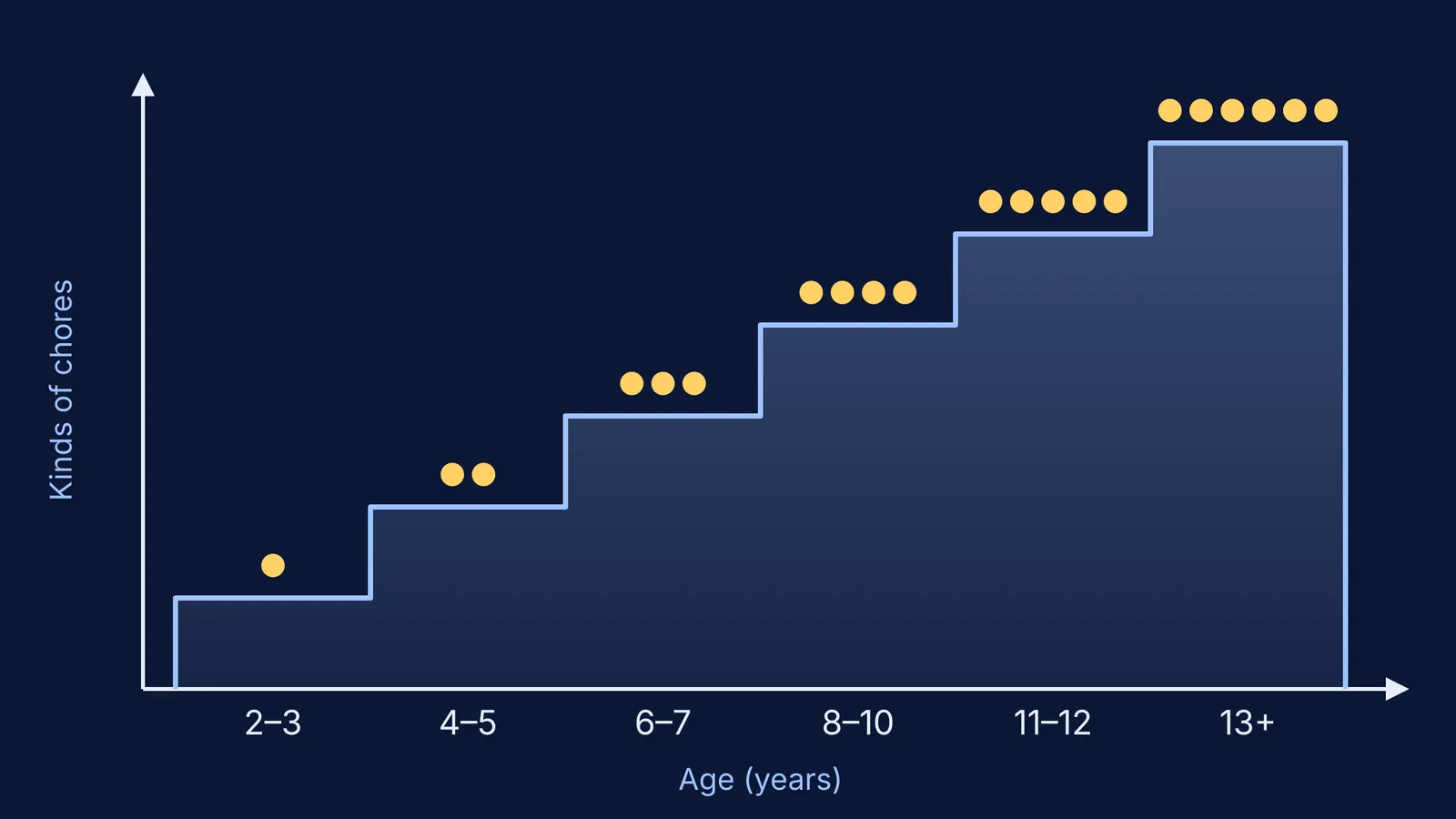
The American Academy of Child and Adolescent Psychiatry says research suggests there are benefits to chores "as early as age 3", and gives an age-by-age list in its Chores and Children guide. The American Academy of Pediatrics has a similar list for ages 5 to 12. We have adapted both to Indian homes. Each stage keeps the earlier jobs and adds one new kind of work.
Ages 2 to 3, tidying: put toys in a basket, chappals on the rack, and carry their own katori to the kitchen.
Ages 4 to 5, add self-care: fold handkerchiefs and small towels, put dirty clothes in the laundry bag, water the plants, set out steel glasses before meals.
Ages 6 to 7, add family-care: wipe the dining table, fill everyone's water bottles, fold the razai, sweep one room, pack the school bag the night before.
Ages 8 to 10, add food prep: shell peas, wash vegetables, put groceries away, separate wet and dry waste, make a sandwich or poha with an adult beside them.
Ages 11 to 12, add cleaning and laundry: change their own bedsheet, hang clothes to dry, wash their own tiffin and bottle, clean the bathroom basin, make chai with you watching.
Ages 13 and up, add money and errands: buy vegetables and check the change, cook dal-chawal in a pressure cooker once taught, pay a bill online with you, iron their own uniform, mind a younger sibling while an adult is at home.
Do household chores actually help children?
The evidence is encouraging but not proof. A US study of 9,971 children found that those who did chores with any frequency in kindergarten had better maths scores in third grade, while those who rarely did chores had higher odds of scoring in the bottom fifth for self-reported academic ability, friendships and life satisfaction (White, DeBoer and Scharf, 2019).
In an Australian study of 207 children aged 5 to 13, parents' reports showed that self-care and family-care chores predicted better working memory and inhibition, even after allowing for age, gender and disability (Tepper, Howell and Bennett, 2022). Pet-care chores showed no such link.
Both studies relied on parents to report chores and found associations, not cause and effect. Still, if you have domestic help, keep some self-care and family-care jobs for your child rather than handing them all to help.
Should boys and girls do the same chores?
Yes, and India's own numbers show why. In the government's Time Use Survey 2024, 81.5% of females aged 6 and above did unpaid domestic work for their household on a given day, against 27.1% of males. Women and girls who did this work spent 289 minutes a day on it; men and boys spent 88 minutes. Give your son and daughter the same ladder, the same rota and the same praise.
How do you make chores stick?
Use this plan for one new chore at a time:
Teach in four steps: you do it while they watch, you do it together, they do it while you watch, they do it alone.
Fix a time: the AAP suggests doing chores at the same time each day. Tie it to something that already happens, such as "bottles filled before dinner".
Praise the effort: the AAP advises praising effort, not the outcome. Do not refold the towel in front of them.
Make it visible: a chart on the fridge saves you from repeating yourself.
Keep money separate: our suggestion is no pay for everyday family jobs, but pay for extra ones. Our guide on teaching children the value of money by age has ideas.
Review weekly: swap jobs and move up a rung in a short family meeting with your teenagers.
For older teens, the ladder becomes a checklist of life skills to practise before moving to a hostel.
In board-exam years, shrink the list but keep one daily job; ten minutes of folding clothes is a break, not a distraction. If homework is what pushes chores out of the evening, Fermi's AI tutor can work out what your child already knows and build a plan for the session, so study time has a clear end.
Pick one rung from the ladder tonight, and teach it this week.