

On this page
When preparing a college education budget, families often focus almost entirely on tuition. Yet for students leaving home for undergraduate degrees, accommodation and daily food represent an equally critical expenditure. According to the National Statistical Office 75th round survey published by MoSPI, households supporting an erstwhile member studying away from home spend an average of ₹1,00,693 annually in urban areas, with accommodation and living costs comprising a major portion of non-tuition outlays. Whether navigating seat allocation through our JoSAA counselling guide for parents or planning for state universities, knowing what campus bills include prevents jarring financial surprises.
How much do government college hostels and messes cost?
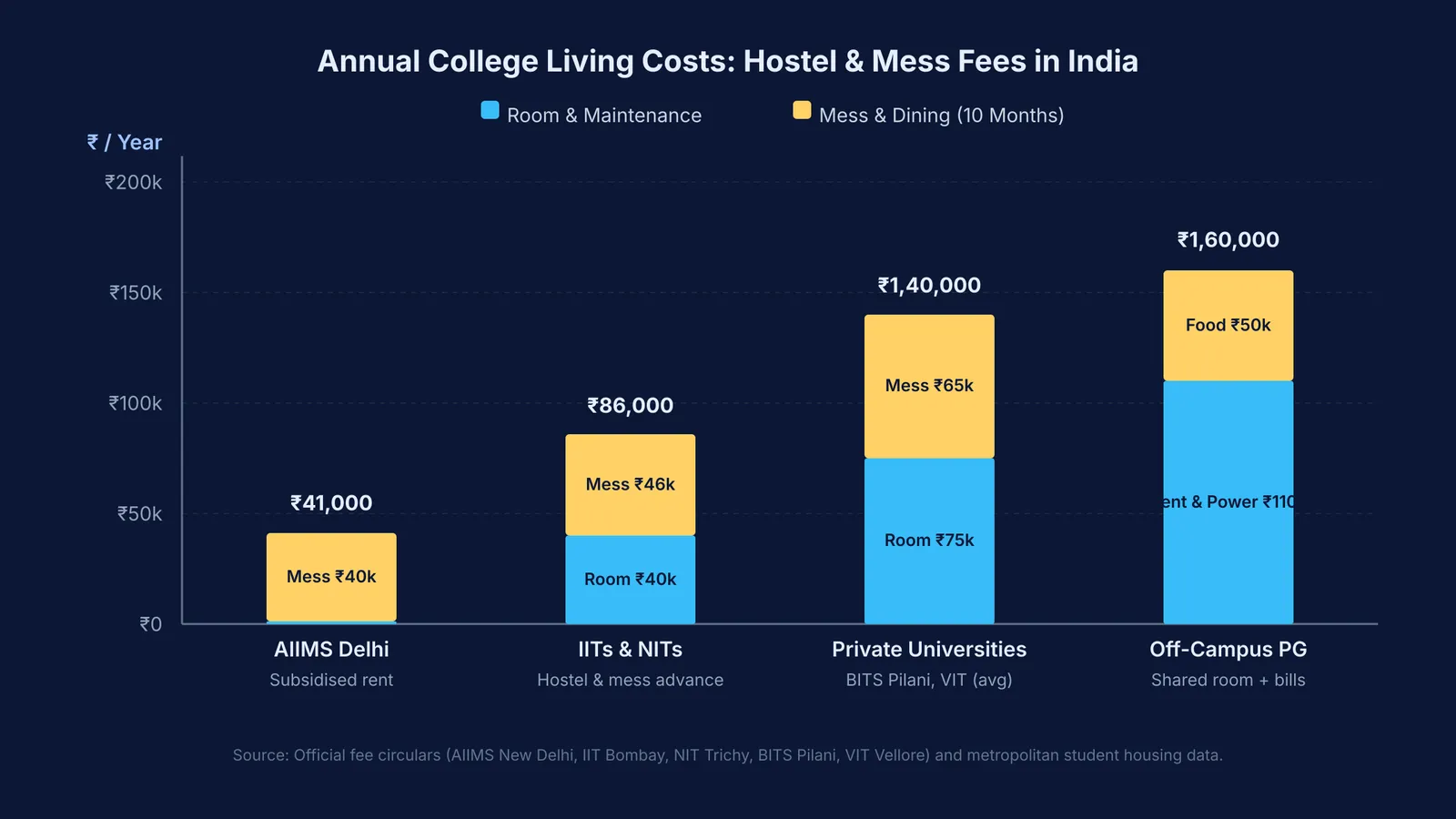
Government-funded institutions offer substantial subsidies on room rent, while messes operate on a self-financed basis. At central medical institutes like AIIMS New Delhi, undergraduate hostel rent and maintenance cost a nominal one-time fee of ₹3,728 for the entire five-and-a-half-year MBBS program. However, student-managed messes run at actual cost, requiring a separate monthly payment between ₹3,500 and ₹4,500, bringing annual dining costs to roughly ₹35,000 to ₹45,000.
Central engineering institutes charge moderate room maintenance alongside a mandatory mess advance. At IIT Bombay, undergraduate hostel rent and utilities total approximately ₹17,000 to ₹19,950 per semester, paired with a Semester Mess Advance of ₹22,500. Similarly, the NIT Trichy Hostel Administration charges newly admitted undergraduates ₹59,950 for their first semester, covering ₹17,700 in rent and utilities, ₹10,650 in establishment fees, a ₹24,000 mess advance, and ₹7,600 in deposits and admission fees. At Central Universities like Delhi University, annual hostel maintenance ranges from ₹40,000 to ₹70,000, with monthly dining adding ₹3,000 to ₹4,500.
What do private university hostels cost compared to PGs?
Private universities operate modern residential campuses, but their fees reflect unsubsidised infrastructure and air-conditioned options. At BITS Pilani, semester hostel fees range from ₹20,650 at Pilani to ₹27,750 at Goa and Hyderabad, alongside a ₹10,000 mess advance and ₹12,000 in institutional advances, totaling ₹85,000 to ₹1,05,000 annually. At VIT Vellore, room charges range from ₹52,300 yearly for a four-bed non-AC room to ₹1,29,800 for a single AC room, while annual mess plans cost ₹56,200 for vegetarian dining, ₹64,900 for non-vegetarian meals, and ₹75,700 for special catering. Including first-year deposits of ₹30,000, campus living at private universities typically totals ₹1,38,000 to ₹2,35,000 annually.
When campus rooms fill up, private paying guest (PG) accommodations and shared flats become the main alternative. In student hubs such as Delhi, Kota, and Bengaluru, shared PG rooms cost ₹8,000 to ₹15,000 monthly including meals, while single AC rooms reach ₹14,000 to ₹25,000. Off-campus living carries distinct extra expenses:
Electricity sub-meters billed at commercial rates of ₹8 to ₹12 per unit add ₹2,000 to ₹4,000 monthly during summer when running an air conditioner.
Landlords require one to two months of upfront security deposit, and brokers often charge up to a full month of rent as a finder fee.
Commuting to campus adds ₹1,500 to ₹3,500 in monthly local transit costs.
What hidden expenses do college fee circulars leave out?
Official college circulars outline institutional dues, but omit routine out-of-pocket costs that every residential student incurs. Families should budget for four overlooked items:
Initial room setup: Purchasing a mattress, bedding, buckets, table lamps, power strips, and storage bins costs ₹6,000 to ₹10,000 during the first week.
Laundry and water: Off-campus students and hostels without in-house facilities spend ₹800 to ₹1,500 monthly on laundry services or coin machines.
Holiday travel: Train and flight tickets between campus and home during festival breaks add ₹10,000 to ₹25,000 annually.
Academic and health supplies: Lab coats, printing, drafters, textbooks, and clinic visits average ₹5,000 to ₹10,000 per year.
How should families build a 4-year living expense budget?
A sound multi-year budget integrates accommodation fees, dining, and daily personal allowances into an all-inclusive yearly plan:
Account for annual fee escalation: Expect universities and catering providers to revise hostel and mess charges over successive sessions to match rising food and utility costs.
Ring-fence deposits: Keep one-time refundable caution deposits (typically ₹3,000 to ₹15,000) separate from monthly allowances so initial outlays do not strain living cash.
Seek maintenance grants: Look into merit-cum-means awards that offset residential bills, as detailed in our guide to scholarships for science students in India.
Build a disciplined room environment: Thriving away from home begins with an organized desk and study schedule, as outlined in our advice on studying in a hostel or PG room setup.
Campus life also brings demanding coursework where university problem sets require far more independent reasoning than school exams. Working through challenging coursework problems with Fermi's AI tutor can help bridge that gap, as it can work out what you already know and build a plan for the session so you sit down to a clear next step. For first-year science and engineering undergraduates revising calculus, mechanics, or thermodynamics before semester exams, the Fermi Problem Library provides worked problems with a step-by-step solver that explains the reasoning rather than printing an answer.
Discussing living budgets openly before admission ensures campus expenses remain predictable throughout your child's degree.


