On this page
Every Makar Sankranti and Uttarayan, kite string can cause deep cuts in birds and people. The culprit is manja, thread coated so it can slice a rival's line in a kite fight. The trick that wins fights is the physics that makes a knife sharp.
What is manja, and why does glass make it dangerous?
A study of vultures in Gujarat describes traditional manja as "abrasive strengthened threads made out of powdered glass, rice and glue paste with a color mix" (Roy and Shastri, Journal of Threatened Taxa, 2013). The same paper notes that nylon string imported from China has gained preference over traditional cotton thread.
A plain cotton thread is soft and round. Once glass grains are glued on, the surface is studded with hard, jagged edges. Doctors who reviewed manja injuries in Brazil put it plainly: "The use of glass and glue increases the potential cutting surface of the string, turning a simple game into a deadly activity" (Ventura, Hirano and Fraga, Clinics, 2011).
Why does a thin edge cut when a thick one does not?
Pressure is force divided by the area it acts on, P = F/A, measured in pascals, where 1 Pa is 1 newton per square metre (OpenStax College Physics, section 11.3). The same textbook points out that a force that barely bothers you from a fingertip can break the skin when it is applied over the tip of a needle.
Skin, feathers and thread give way when pressure passes a limit. Glass does not make the kite pull harder; it makes the contact area smaller, because mainly the sharp edges of the grains touch. Our post on why a sharp knife cuts better works through the same idea with everyday objects.
A worked example. These numbers are illustrative, not measured.
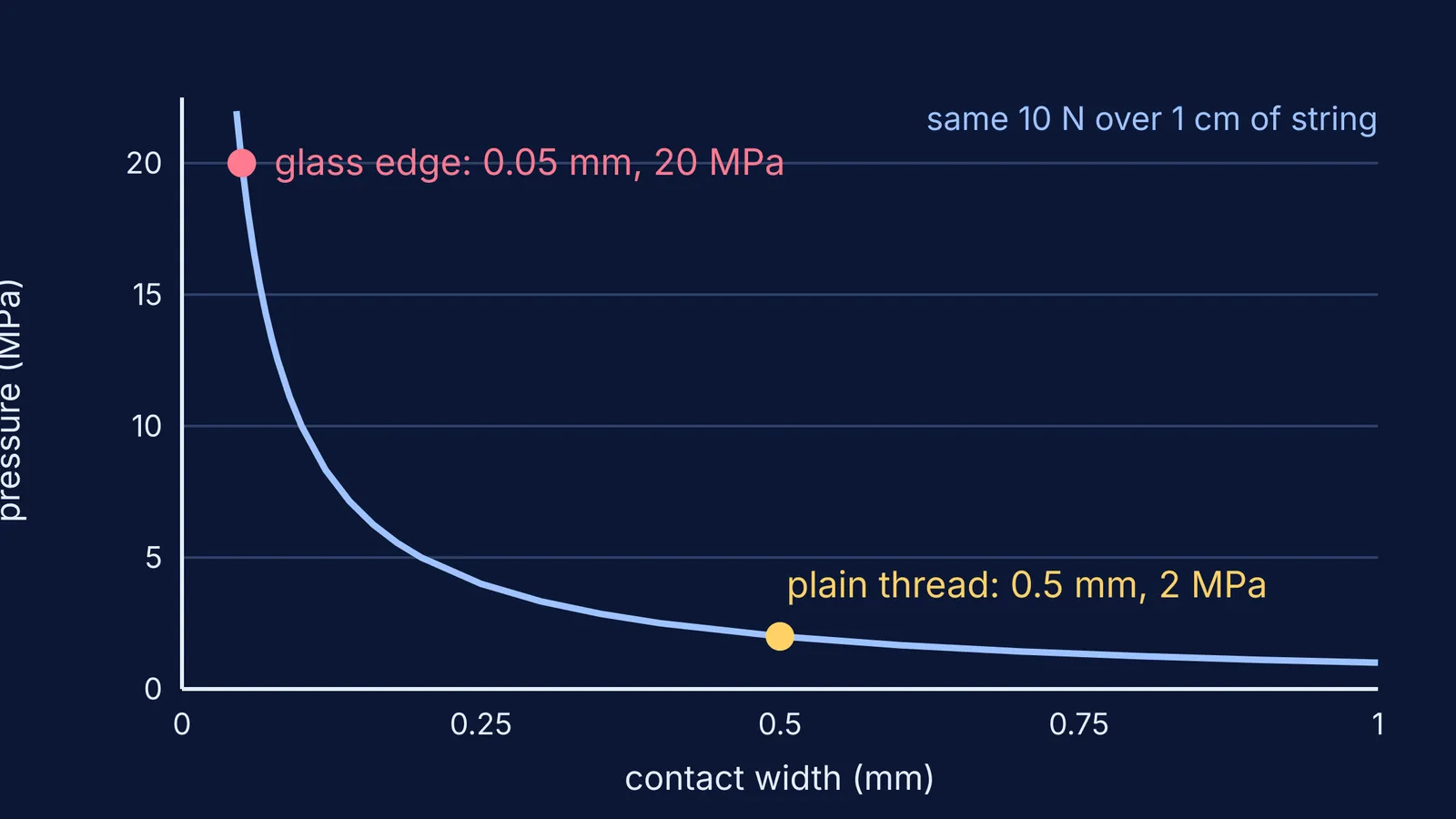
Suppose a taut kite line presses on a neck with a force of 10 N along 1 cm (0.01 m) of string.
Plain thread: say the contact strip is 0.5 mm wide. Area = 0.01 m x 0.0005 m = 5 x 10^-6 m^2. Pressure = 10 / (5 x 10^-6) = 2 x 10^6 Pa, or 2 MPa.
Glass-coated thread: only grain edges touch, say a strip 0.05 mm wide. Area = 5 x 10^-7 m^2. Pressure = 20 MPa.
Same force, one tenth the width, ten times the pressure.
Then add motion. A kite line is rarely still, and each glass grain dragged across skin acts like a tooth on a saw.
For the flight side, read how a kite flies and why a cut kite drifts down slowly. Ideas like pressure are easier to see than to read, which is what the Fermi Simulation Lab is for: interactive simulations for the ideas that are easier to see than to read.
What injuries does glass-coated manja cause?
The Brazilian case series reviewed 13 patients aged 7 to 50 with neck wounds from glass-coated kite string; 12 had injuries in the middle zone of the neck, and one patient died after the string cut the neck vessels and trachea (Clinics, 2011).
Birds fly into strings they cannot see. Among 108 White-rumped Vultures encountered, alive or dead, by rescuers in central Gujarat between 2009 and 2012, 43.9% of encounters were due to kite string injuries, and these occurred mainly in January, the month of the 14-15 January kite festival (Roy and Shastri, 2013).
Is glass-coated manja banned in India?
Yes, in large part. In December 2016 the National Green Tribunal issued an interim nationwide ban on glass powder-coated manja, nylon "Chinese manja" and thread coated with glass or other harmful compounds (The Tribune). Its final order in July 2017 imposed "a total ban" on kite thread "made of nylon or any synthetic material and/or is coated with synthetic substance and is non-biodegradable", covering manufacture, sale, storage, purchase and use (LiveLaw).
Enforcement is up to states and police. In August 2022 the Delhi High Court ordered the Delhi government to ensure strict compliance; action had been taken in 255 cases between January 2017 and July 2022 (LiveLaw). Rules vary by state and city, so check your local police or district notice before the season.
How can your family fly kites safely?
Buy plain cotton thread. If it feels gritty or looks shiny like plastic, skip it.
Never pull a line through bare fingers; wind it on a spool.
On a two-wheeler in kite season, ride slower and cover your neck with a scarf or high collar.
Cut loose string into short pieces and bin it, so birds do not get caught.
If you find a tangled bird, do not pull the string. Cover it with a cloth and call a local animal rescue or the forest department.
If someone is cut, call for emergency medical help at once.
This Sankranti, the safest kite is the one flown on plain thread.