

On this page
Every Makar Sankranti, somebody's patang gets cut. It doesn't drop like a stone. It sways and drifts over the rooftops. Gravity pulls on it like anything else; the difference is how hard the air pushes back.
Why does a cut kite drift down slowly instead of dropping?
In flight, a kite feels three forces: its weight, the tension in the line and the aerodynamic force from the wind, which splits into lift (perpendicular to the wind) and drag (along the wind), as NASA Glenn Research Center's page on the forces on a kite explains. Cut the string and the tension disappears. The kite starts to fall, and the air pushes back. NASA's drag equation gives the size of that push: D = Cd × ρ × V² × A / 2, where Cd is the drag coefficient (set by shape), ρ is air density, V is speed and A is the area facing the air.
Drag grows with the square of speed, so as the kite speeds up, drag climbs quickly until it equals the weight. According to NASA, when drag equals weight there is no net force, and the object falls at a constant speed called the terminal velocity.
What makes a kite's terminal velocity so low?
Rearrange "drag = weight" and you get NASA's terminal velocity formula: V = √(2W / (Cd × ρ × A)). The same NASA page puts it in words: an object with a large cross-sectional area or a high drag coefficient falls slower than one with a small area or low drag coefficient.
A kite scores on all three counts:
Small W: thin paper and two bamboo sticks weigh very little.
Large A: the sail is wide and flat.
High Cd: a flat plate has a drag coefficient of 1.28, the highest of the shapes on NASA's shape effects page, which notes that a flat plate gives the highest drag and a streamlined airfoil the lowest, by a factor of almost 30.
Worked example: a kite vs the same paper crumpled into a ball
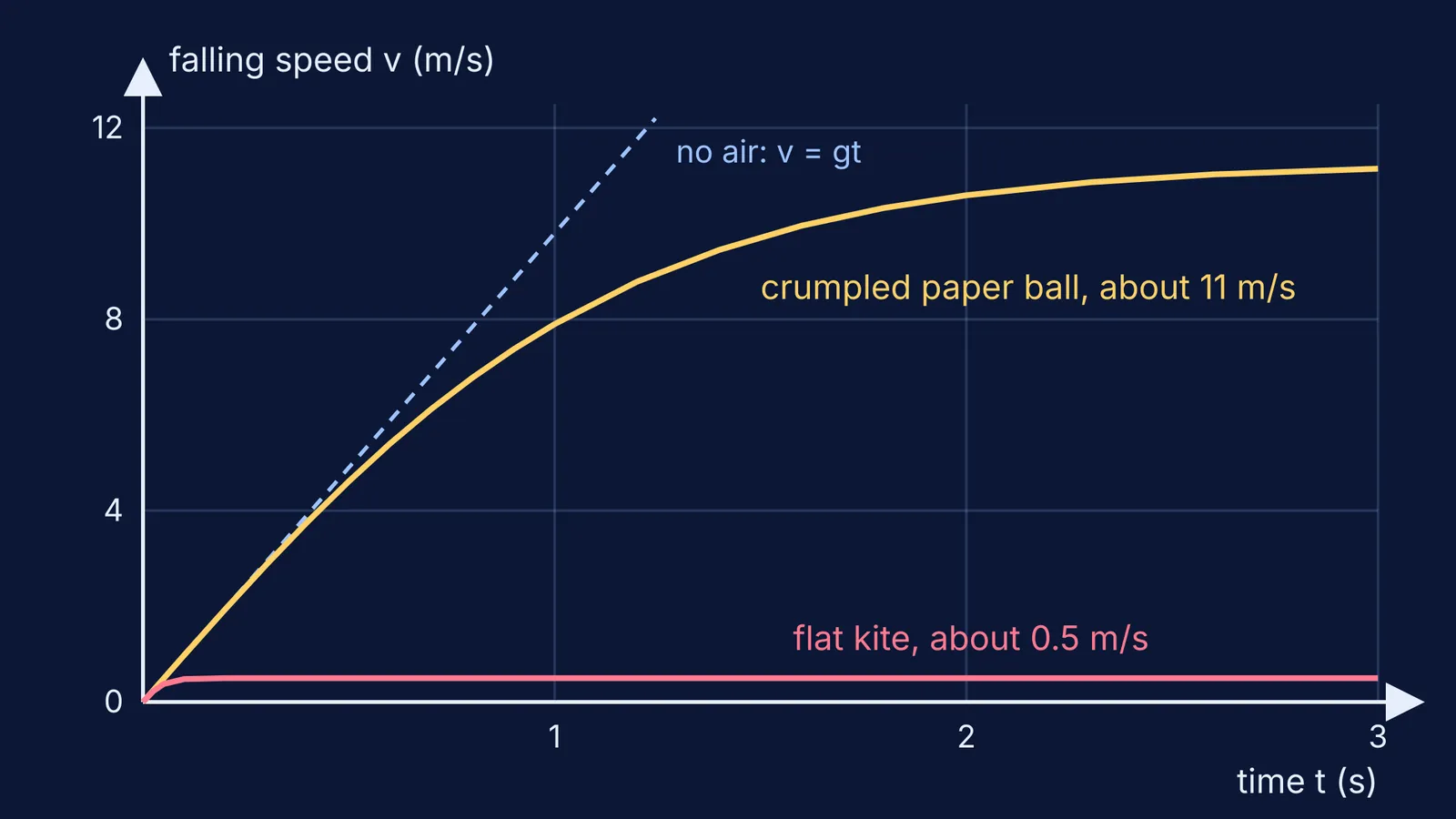
These numbers are assumptions for a light paper kite, not measurements: mass 5 g, a square sail 50 cm × 50 cm (A = 0.25 m²), falling flat. For air density we use 1.229 kg/m³, the typical value given on NASA's model rocket recovery page. For the ball, imagine scrunching the same kite paper into a 4 cm sphere and using Cd = 0.5, the top of the sphere range on NASA's shape effects page.
Weight: W = 0.005 kg × 9.8 m/s² = 0.049 N, so 2W = 0.098 N.
Kite: Cd × ρ × A = 1.28 × 1.229 × 0.25 ≈ 0.393. V = √(0.098 / 0.393) ≈ 0.5 m/s.
Ball: A = π × (0.02 m)² ≈ 0.00126 m². Cd × ρ × A = 0.5 × 1.229 × 0.00126 ≈ 0.00077. V = √(0.098 / 0.00077) ≈ 11 m/s.
Compare: same mass, same paper, but the flat kite falls about 22 times slower.
Time from 30 m up: the kite takes about 60 seconds. In a gentle 3 m/s breeze it is carried about 180 m sideways in that time, which is why it lands streets away. The ball, even with drag, is down in about 3.5 seconds.
Why does a cut kite swing and glide sideways?
A falling kite is rarely level. Once it tilts, the air meets the sail at an angle, so part of the air force acts sideways, like lift on a kite in flight, and the kite slides. Light, flat things such as paper and leaves often rock from side to side as they fall: that is the swaying you see. Add the wind pushing on the wide sail and you get a slow, wandering path. A safety note: let a cut kite land. Chasing one across a road or an unfenced terrace is far more dangerous than losing it.
How can you test this yourself in five minutes?
You need two sheets of A4 paper and a chair to stand beside.
Predict first: which lands first, and roughly how many times slower is the flat sheet?
Drop one flat sheet and one crumpled sheet together from the same height.
Fold the flat sheet into a small kite shape and repeat. Does it fall flat, or slide and swing?
Crumple the second sheet tighter each time. Smaller area should mean a faster fall. Does it?
To go further, our post on how parachute size changes falling speed turns this into a proper experiment. For the question of whether drag makes every falling object slower, read with air resistance, does a ball take longer to fall?
Some ideas are easier to see than to read: the Fermi Simulation Lab has interactive simulations for the ideas that are easier to see than to read.
Next Sankranti, when a kite gets cut, watch for the balance between weight and drag. To see what holds it up before the cut, read how a kite flies on Makar Sankranti.


