

On this page
In an ideal vacuum, vertical motion under gravity is symmetric: a ball launched upward at speed v₀ takes exactly t = v₀ / g to reach its peak, and the exact same time to fall back down. In the atmosphere, however, aerodynamic drag shatters this symmetry. Whether analyzing a tossed ball or solving mechanics problems for JEE physics, air resistance ensures that a projectile's descent always takes strictly longer than its climb.
Why does a ball take longer to fall back down?
The temporal asymmetry stems from how aerodynamic drag acts on the ball. Unlike gravity, which always pulls downward, drag opposes the instantaneous direction of motion.
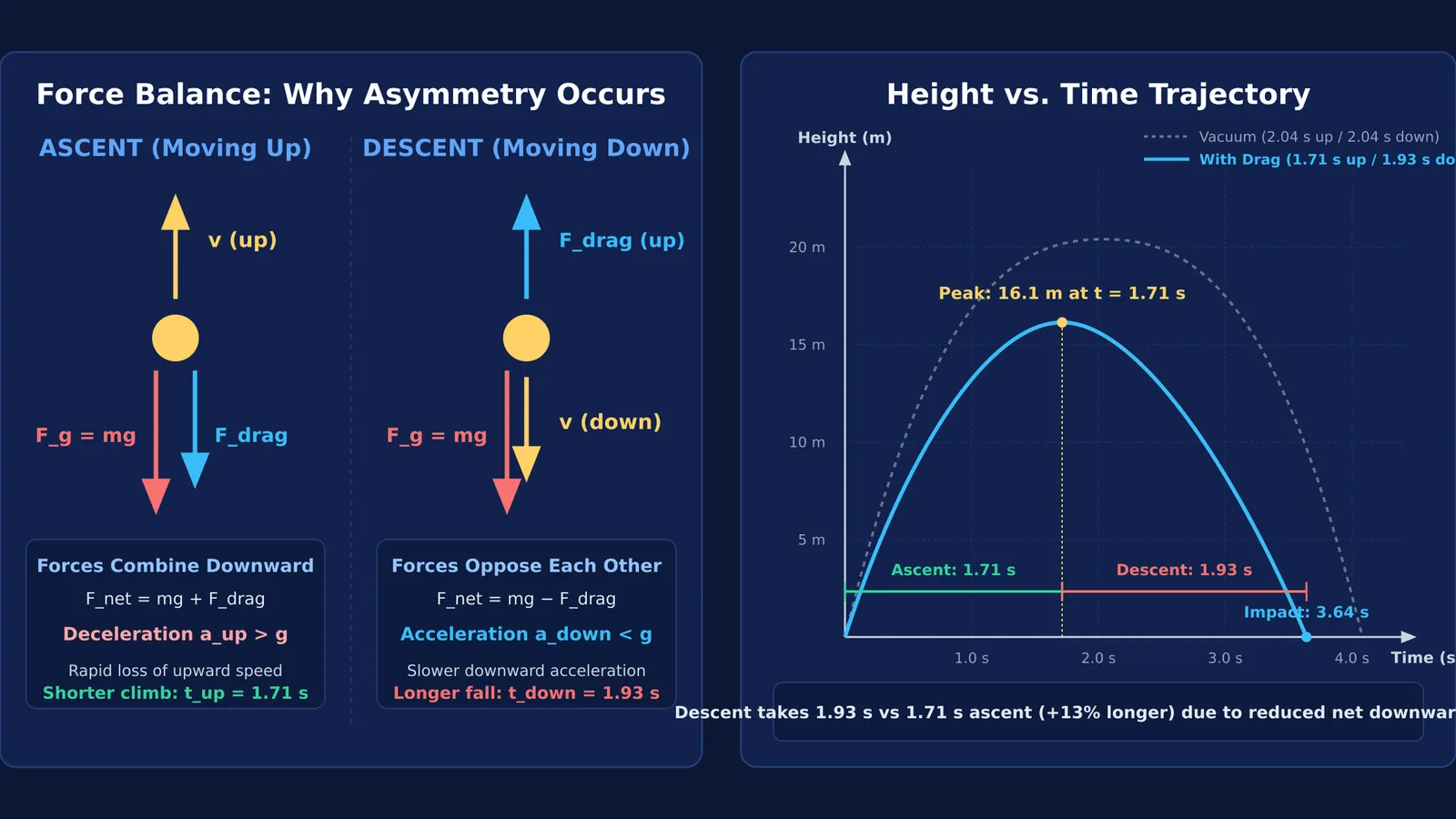
On ascent, the ball travels upward, so air drag pushes downward alongside gravity. Because both forces point downward, they combine into F_net,up = mg + F_drag. Deceleration is therefore strictly greater than gravity: a_up = g + (F_drag / m) > g, stopping the climb faster than in a vacuum.
On descent, the ball travels downward, so air drag pushes upward against gravity, yielding F_net,down = mg − F_drag. Downward acceleration is therefore strictly less than gravity: a_down = g − (F_drag / m) < g. Because a_up > g > a_down at every speed, average deceleration during ascent exceeds average acceleration during descent.
In 1634, French scientist Marin Mersenne noted in *Traité des mouvemens* that cannonballs fired vertically took longer to fall than to rise. In a 2014 study in *The American Mathematical Monthly*, C. W. Groetsch and S. A. Yost proved that for any continuous medium where resistive drag increases with speed, descent time t_down strictly exceeds ascent time t_up, and this time gap widens as launch speed increases. Compare this with textbook scenarios in vertical motion under gravity.
How does mechanical energy loss prove the delay?
A height-by-height energy argument provides a model-independent proof that holds for any resisting medium without relying on specific drag laws.
Consider an intermediate height y between the launch point and the apex H_max. Because air resistance is a non-conservative force, it dissipates mechanical energy throughout flight. By the work-energy theorem, kinetic energy at height y during descent equals kinetic energy on ascent minus round-trip work against drag: ½ m (v_down(y))² = ½ m (v_up(y))² − W_drag. Because drag constantly does negative work, W_drag > 0, ensuring v_down(y) < v_up(y) at every height below H_max.
The time to traverse a vertical interval dy is dt = dy / v. Because downward speed is smaller than upward speed at every height, the ball spends more time in each vertical slice while falling: dt_down = dy / v_down(y) > dy / v_up(y) = dt_up. Integrating from y = 0 to y = H_max gives t_up = ∫ dy / v_up and t_down = ∫ dy / v_down. Because 1 / v_down(y) > 1 / v_up(y) throughout flight, t_down > t_up holds universally.
In a 1982 paper in *Mathematics Magazine*, John Lekner proved that for standard drag laws proportional to vⁿ with n ≥ 1, total round-trip flight time in air remains strictly shorter than the vacuum duration 2v₀ / g, because the steep reduction in apex height offsets the slower descent.
How do you calculate ascent and descent times?
In the *American Journal of Physics*, Peter Timmerman and Jacobus P. van der Weele derived exact solutions for vertical trajectories under linear and quadratic drag.
For linear drag (F_drag = m k v), Newton's second law on ascent is dv/dt = −(g + kv). Integrating from initial speed v₀ to rest yields ascent time t_up = (1 / k) ln(1 + k v₀ / g) and peak height H_max = (v₀ − g t_up) / k. On descent, displacement follows y(t) = (g / k) t − (g / k²) (1 − e^(−kt)), where setting y(t_down) = H_max yields descent time.
Consider a ball launched at v₀ = 20 m/s with g = 9.8 m/s² and k = 0.20 s⁻¹:
In a vacuum, ascent time is v₀ / g = 2.04 seconds, reaching 20.41 metres.
With drag, ascent time drops to t_up = 1.71 seconds, reaching H_max = 16.14 metres.
Falling 16.14 metres back to the ground requires t_down = 1.93 seconds.
Descent lasts 1.93 seconds versus 1.71 seconds on ascent—about 13% longer—and the ball returns at 15.7 m/s instead of 20 m/s.
For high-speed projectiles where drag is quadratic (F_drag = m c v²), Timmerman and van der Weele showed ascent time is t_up = (1 / √(gc)) arctan(v₀ √(c / g)) and descent time is t_down = (1 / √(gc)) arcsinh(v₀ √(c / g)). Because arcsinh(z) > arctan(z) for all z > 0, descent is strictly longer under quadratic drag as well.
What are the most common exam traps in drag problems?
In competitive exams like JEE Advanced, questions on air resistance test whether students avoid standard kinematic traps:
Using constant-acceleration kinematic equations: Formulas like v = u + at assume uniform acceleration. Because air drag changes with velocity, you must treat the motion as variable acceleration as a function of velocity using integration.
Assuming return speed equals launch speed: Because drag does negative work throughout flight, mechanical energy is lost and impact speed is strictly less than launch speed.
Ignoring trajectory distortion in 2D: In two dimensions, drag shrinks horizontal range while delaying descent, breaking the parabolic symmetry seen in projectile motion on level ground.
When tackling multi-step mechanics problems that require differential equations, the Fermi Problem Library provides worked problems with a step-by-step solver that explains the reasoning rather than printing an answer. For concepts where force balances are clearer in motion, the Fermi Simulation Lab offers interactive simulations for the ideas that are easier to see than to read.


