

On this page
Every January, Makar Sankranti brings millions of kites to the sky, celebrating the festival with vibrant colors and friendly competitions. But how exactly does a simple paper diamond push back against gravity to reach such impressive heights? The secret is not just the wind blowing through the sky—it is the string firmly held in your hands.
What are the four forces on a kite?
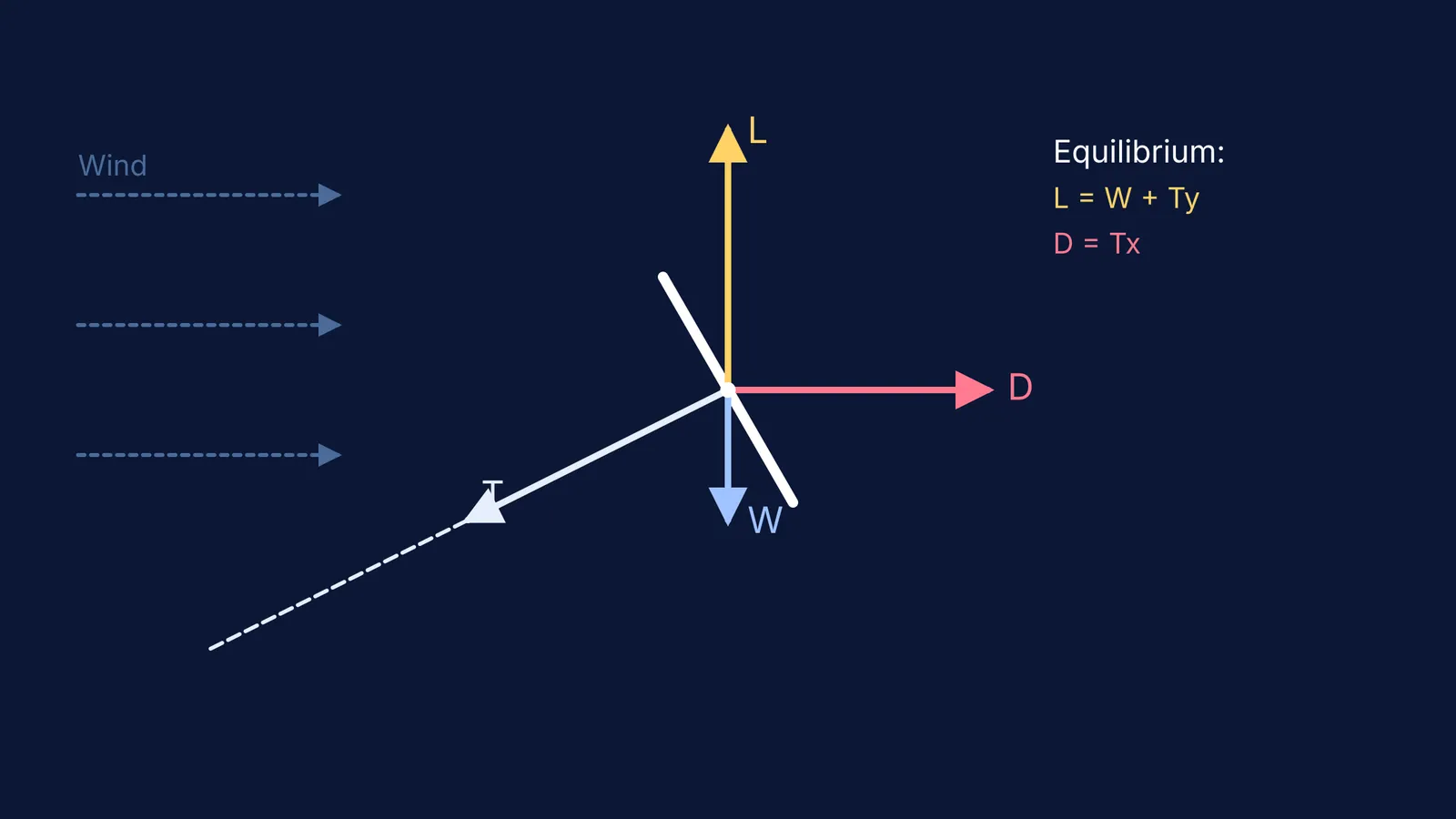
To keep a kite in the air, you are managing a delicate physical balance. According to the NASA Glenn Research Center, four primary forces act on a kite in flight: lift, drag, weight, and tension.
Weight: The force of gravity pulls the mass of the kite directly toward the center of the Earth. This weight depends on the materials used to build the kite, such as paper, plastic, and sticks. While the weight is distributed throughout the entire structure, for the sake of physics, we can imagine it acting through a single point known as the center of gravity.
Lift: An upward aerodynamic force generated by the air moving over the kite's surface. It acts perpendicular to the direction of the wind. Lift is created when the wind hits the angled surface of the kite and is deflected downward, which generates an opposite upward force to keep the kite aloft.
Drag: The wind's aerodynamic resistance against the kite. It acts in the same direction the air is moving, pushing the kite backward. Drag is generated by the friction of the air moving across the kite's surface and the pressure difference between the windward and leeward sides.
Tension: The force exerted by the kite string that holds the kite in place. This force is transmitted from your hands, along the string, and through the bridle point. Tension is the only force you can control directly, making it the most critical tool for a kite flyer.
How does a kite fly?
A kite flies steadily when the forces acting on it reach a state of equilibrium. When the wind's upward push (lift) perfectly balances the kite's downward weight and the downward component of the string's pull (vertical tension), the kite stops falling and stays in the air. Mathematically, this means the lift must equal the weight plus the vertical tension.
At the same time, the horizontal pull of the string (horizontal tension) must perfectly balance the drag pushing the kite backward. If you let go of the string, the tension drops to zero. Without tension, drag instantly overwhelms the balance, and the kite simply blows away instead of flying upward. By holding the kite in place, the string forces the air to flow rapidly over the kite's surface rather than simply carrying the kite along at the wind's exact speed.
If you are studying mechanics, imagining these invisible forces can be difficult. The Simulation Lab has interactive simulations for the ideas that are easier to see than to read, letting you adjust vectors for tension, lift, and drag to see when an object achieves equilibrium.
How do you fix a crashing kite?
The kite's bridle—the knot where the string attaches to the kite—sets the angle at which it meets the wind, known as the angle of attack. You can use basic physics to troubleshoot a kite that will not fly:
If the kite refuses to climb: The angle of attack may be too low. Adjust the bridle knot toward the tail to expose more surface area to the wind. This increases the angle and generates more lift.
If the kite spins rapidly or wobbles: The kite cannot find a balance point. According to NASA's stability guide, a kite must have a negative slope on its torque curve, creating a restoring torque. Check the symmetry of the frame and ensure the bridle is perfectly centered.
If the kite is unstable: Add a longer tail. The tail adds aerodynamic drag to the bottom of the kite, keeping the center of gravity stable and preventing the kite from flipping over.
When the wind changes, the equilibrium breaks. If the wind speed drops, lift decreases, and the kite begins to fall. You intuitively pull the string to temporarily increase tension and drag the kite rapidly through the air, artificially creating relative wind over its surface until it climbs back into a stronger breeze.
You can see similar principles of tension and equilibrium in other mechanics problems, such as finding the string tension in a simple pendulum or predicting which way a spool pulled by its string will roll. On Makar Sankranti, you are solving these vector equations instinctively with every tug of the string.


