On this page
Press a blunt knife into a tomato and the skin dents. Press a sharp one just as hard and it slices through. The force was the same both times; the area it was spread over was not.
What is pressure, and how does area change it?
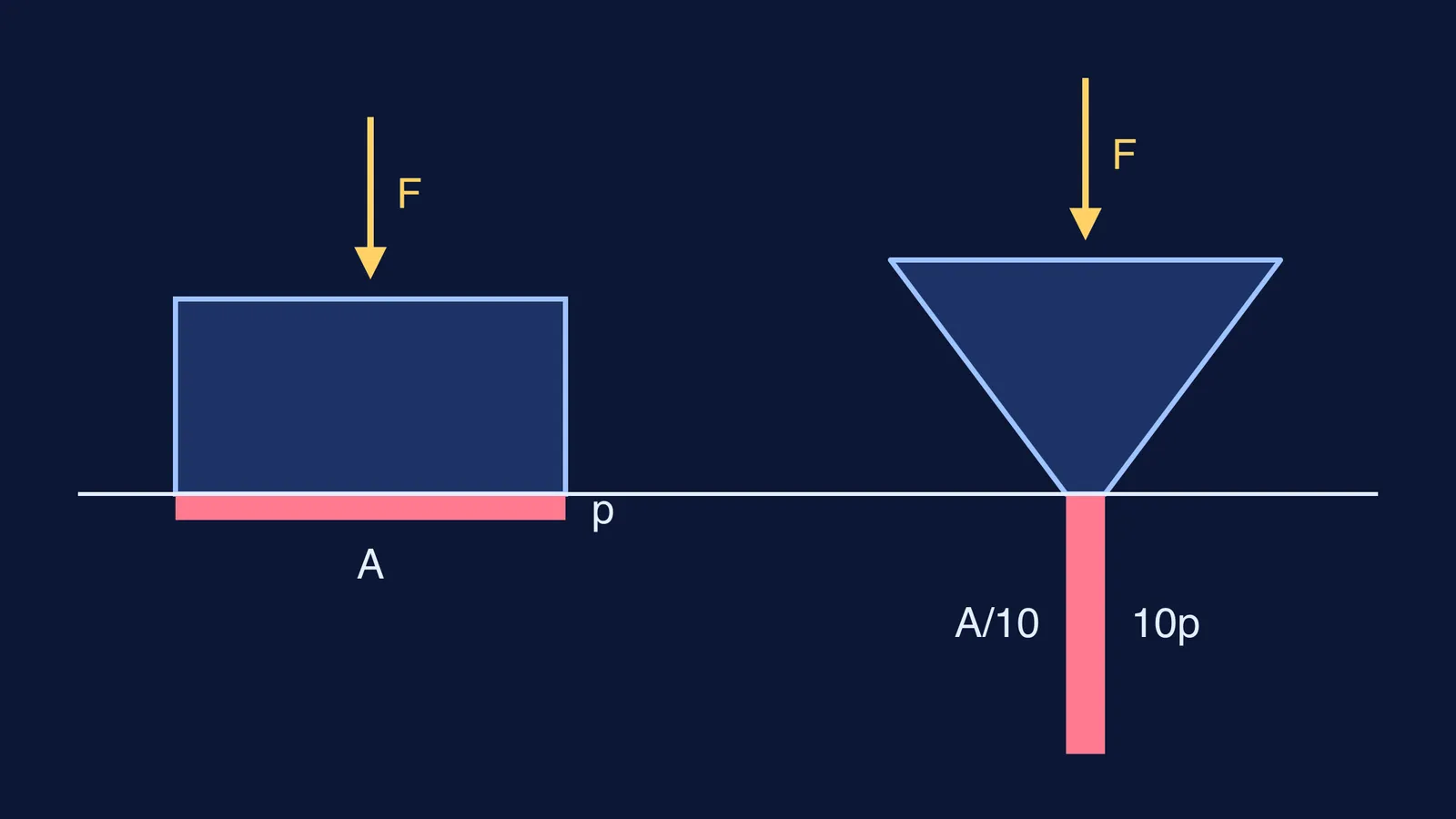
Pressure is the force acting at right angles to a surface divided by the area it acts on, p = F/A (OpenStax College Physics 2e). The SI unit of pressure is the pascal, and 1 Pa = 1 N/m² (BIPM SI Brochure, Table 4).
So with the force fixed, a smaller area means more pressure and a larger area means less. Every example below uses one of those two levers.
Why does a sharp knife cut better than a blunt one?
A knife cuts when the stress under its edge gets high enough to break the material apart. In a study of straight-edge blades cutting a soft, rubber-like material, McCarthy, Ní Annaidh and Gilchrist used lab tests and a computer model and found that a simple maximum-stress criterion predicted when cutting began. Sharpness was most sensitive to the blade's tip radius, and a larger tip radius or wedge angle made the blade less sharp (Engineering Fracture Mechanics, 2010).
Here is what that means in numbers. The edge widths are made up to keep the arithmetic clear.
You press down with 20 N along 10 cm (0.1 m) of edge.
A blunt edge touches along a strip 0.5 mm wide: A = 0.1 × 0.0005 = 5 × 10⁻⁵ m², so p = 20 ÷ (5 × 10⁻⁵) = 4 × 10⁵ Pa.
A sharp edge touches along a strip 0.05 mm wide: A = 5 × 10⁻⁶ m², so p = 4 × 10⁶ Pa.
Same push, ten times the pressure.
How do nails and camel feet use the same rule?
A nail uses both levers at once. Suppose you push one with 100 N, with a flat head of 1 cm² (10⁻⁴ m²) under your thumb and a point touching the wood over 0.5 mm² (5 × 10⁻⁷ m²). These sizes are made up too.
Pressure on your thumb: 100 ÷ 10⁻⁴ = 1 × 10⁶ Pa.
Pressure on the wood: 100 ÷ (5 × 10⁻⁷) = 2 × 10⁸ Pa.
The tip sees 200 times the pressure the head does. That is why the point goes into the wood and the head does not go into your thumb.
Camels pull the other lever. A 2020 study in Scientific Reports compared camels, which have large fat pads on their feet, with alpacas, whose pads are much smaller. The camels had larger foot contact areas that grew with speed, so their foot pressures were relatively lower (Clemente et al., Scientific Reports, 2020). The camels in the study weighed 584 to 685 kg, yet their foot pressure did not rise significantly with body mass (full text on PubMed Central). For the rest of the camel's toolkit, read how desert rats, snakes and camels survive heat and little water.
Why do school bags need wide, padded straps?
India's 2020 school bag policy from the Education Ministry recommends that a school bag weigh no more than about 10% of the student's body weight, with two padded, adjustable straps that fit squarely on both shoulders (The Tribune, reporting the Education Ministry's recommendations). Pressure explains the straps.
Take a 50 kg student carrying a 5 kg bag. Standard gravity is 9.80665 m/s² (NIST), so the bag weighs about 5 × 9.8 = 49 N.
One thin strap, 2 cm wide and touching 8 cm of shoulder: A = 16 cm² = 1.6 × 10⁻³ m², so p ≈ 31,000 Pa.
Two thin straps: 24.5 N on 16 cm² each, about 15,000 Pa per shoulder.
Two padded straps, 5 cm wide over 10 cm: A = 50 cm² = 5 × 10⁻³ m², about 4,900 Pa per shoulder.
This simple model ignores the load resting on the back. With two padded straps, each shoulder takes about one-sixth of the pressure that one thin strap puts on it.
How do you solve a pressure question without unit slips?
The formula is short; the area units are where it is easy to slip. Use this checklist on every question:
Find the force acting at right angles to the surface. For an object resting on a surface, it is the weight, mg.
Use the contact area, not the object's total surface area.
Convert to m² before dividing: 1 cm² = 10⁻⁴ m², not 10⁻² m², and 1 mm² = 10⁻⁶ m².
Divide, then sanity-check: did the smaller area give the bigger pressure? If not, look again.
The Fermi Problem Library has worked problems with a step-by-step solver that explains the reasoning rather than printing an answer, so you can see where a conversion went wrong. If pressure itself still feels shaky, the Fermi Concept Library gives every physics concept its own lesson and shows where it sits in the map.
Once force over area makes sense, move on to fluids with gauge pressure vs absolute pressure.