

On this page
Every desert animal runs a water budget. Water comes in through drinking, food and the body's own chemistry, and leaks out through urine, droppings, breath and skin. Each species balances that budget with three levers:
Behaviour: when and where it is active.
Excretion: how much water leaves with its waste.
Skin and breath: how much water evaporates from its body.
How does a kangaroo rat live without drinking?
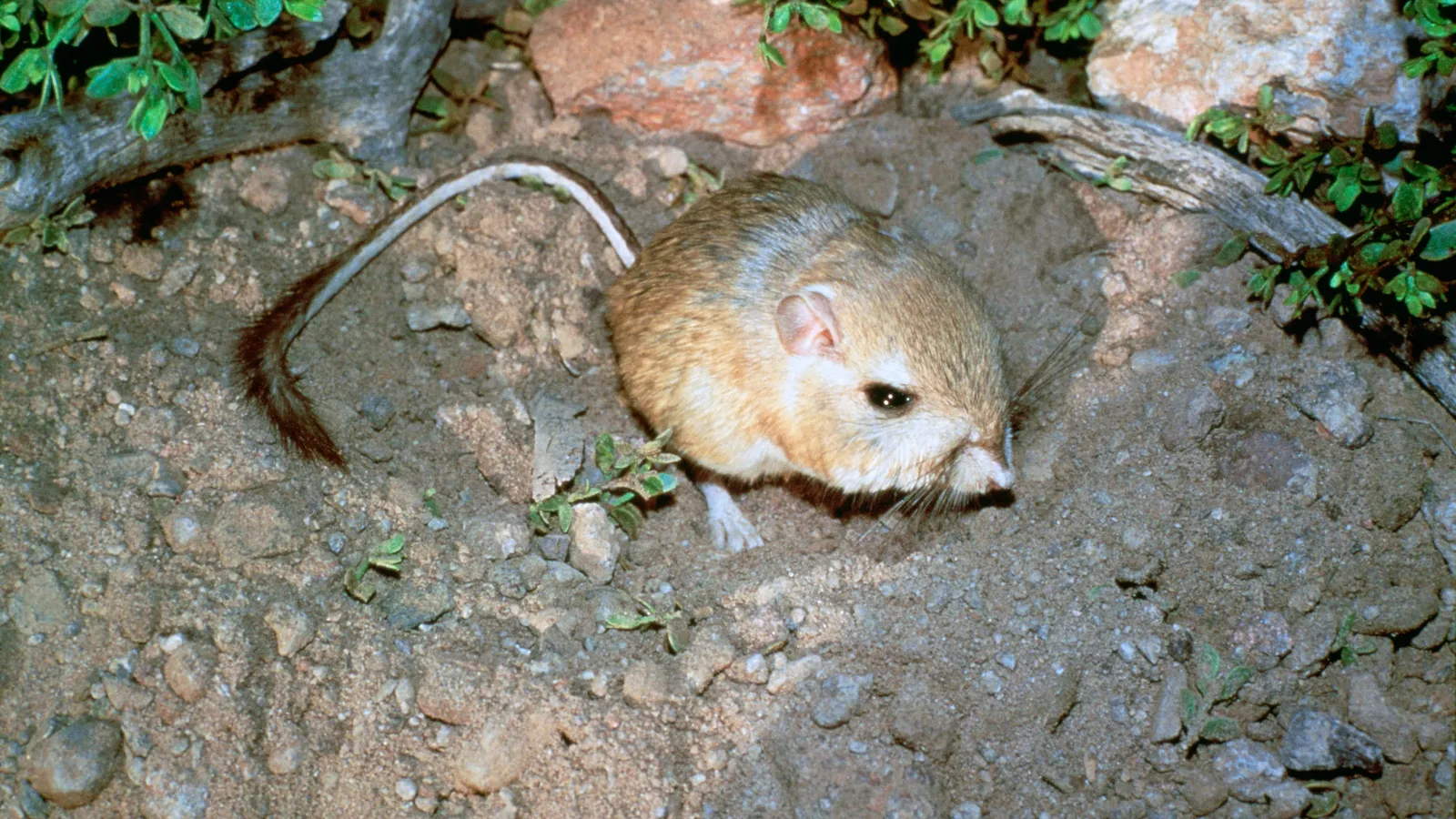
The North American kangaroo rat is the classic case. The US National Park Service at White Sands says kangaroo rats rarely, if ever, drink water. They get the water they need from the dry seeds they eat: breaking down nutrients from those seeds releases small amounts of water, called metabolic water, which together with the little water in the seeds is enough. The same page shows all three levers:
Behaviour: by day they shelter in burrows that stay cooler and more stable than the surface, packing the entrances shut with sand to keep them cool and humid. They forage at night.
Excretion: they produce highly concentrated urine and faeces.
Breath: specialised nasal passages cut the water lost when they breathe out.
Concentrated urine is the kidney's job. NCERT's chapter on excretory products and their elimination explains that mammals can produce concentrated urine thanks to Henle's loop and the vasa recta, and that in juxtamedullary nephrons the loop is very long and runs deep into the medulla. Our explainer on cortical vs juxtamedullary nephrons covers that difference.
How do desert snakes save water?
Take the sidewinder rattlesnake of the Mojave Desert. The National Park Service at Death Valley notes that it is most active at dawn and dusk, and at night in warmer periods. By day it hides in rodent burrows or lies buried in sand. Its sideways movement also keeps it cool, as no part of its body touches hot sand for long.
The same NCERT chapter states that reptiles, birds, land snails and insects excrete nitrogenous waste as uric acid in the form of a pellet or paste, with minimum loss of water; these animals are called uricotelic.
Then there is skin. A 2015 study of evaporative water loss in 120 lizard and snake species found that species from moister (mesic) habitats lose significantly more water by evaporation than species from arid habitats. A review of water relations of vertebrate skin explains that lipids are the main barrier to water loss through the skin of land vertebrates, and that in reptiles, birds and mammals they form a lipid-keratin complex in the outermost skin layer.
How does a camel cope with heat and thirst?
Camels are too big to hide underground, so they lean on physiology. In a study published in 1957, Knut and Bodil Schmidt-Nielsen and colleagues found that the body temperature of camels at rest could range from about 34°C to more than 40°C. The daily swing was usually about 2°C in winter but could exceed 6°C in summer in camels kept without water.
Why does that save water? Instead of sweating to hold a fixed temperature, the camel stores the day's heat in its body and gives it off in the cool night, so less water goes on evaporation. A 2014 study of camels in simulated desert conditions confirmed this strategy, called adaptive heterothermy.
Duke University's account of Schmidt-Nielsen's camel research describes how moisture in the camel's breath condenses in its folded nasal passages, so it largely avoids losing water by breathing. And when water arrives, a 2023 study in Frontiers in Veterinary Science notes that dehydrated camels can drink up to 110 litres within 10 minutes, while their red blood cells can swell to 240% of their starting volume without bursting.
To compare the camel with an Arctic specialist, read polar bear and camel adaptations. For animals that sit out a harsh season, see hibernation vs aestivation.
How do you write a desert adaptation answer in an exam?
Use the three levers as your plan: one line each for behaviour, excretion, and skin or breath, each ending with how it saves water.
Worked example. Question: explain how a kangaroo rat survives in a desert without drinking water (3 marks).
Water in: metabolic water, released when nutrients from the dry seeds it eats are broken down.
Water out through the kidneys: highly concentrated urine; name Henle's loop and the vasa recta.
Water out through evaporation: active at night, spends the day in a sealed, humid burrow, and its nasal passages reduce water lost in breath.
Before you move on, check:
Does each point say how water is saved, not just name the feature?
Have you used the exact term: metabolic water, uricotelic, heterothermy?
If a term like uricotelic or heterothermy is the gap, the Fermi Concept Library gives every concept in biology its own lesson and its place in the map. For practice, the Fermi Problem Library has worked problems with a step-by-step solver that explains the reasoning rather than printing an answer.
Next time a desert animal turns up in a question, start with its water budget and pull each lever in turn.


