

On this page
Extreme environments demand extreme engineering. When an animal lives in a climate that can freeze water or boil an egg, ordinary biology is not enough. Polar bears and camels survive because they have adapted their physics—specifically, how they manage heat, water, and surface area.
Understanding these adaptations is not just about memorising facts for biology exams. It shows how life solves complex problems using the fundamental laws of physics and chemistry.
How do polar bears stay warm in freezing water?
A polar bear's environment presents a dual challenge: biting wind on land and freezing water in the ocean. To survive, they use a two-layer insulation system and exploit geometric rules.
A polar bear's massive size is itself a thermal adaptation, illustrating Bergmann's rule. Larger animals have a lower surface-area-to-volume ratio, meaning they lose heat more slowly than smaller animals. Complementing this is Allen's rule, which explains why polar bears have relatively short legs and small ears compared to their temperate relatives: smaller extremities reduce the surface area exposed to the freezing air, further conserving core heat.
When swimming, their fur loses its insulating power, so they rely on a thick layer of subcutaneous fat called blubber. Because water conducts heat away from the body much faster than air, this blubber is essential for maintaining a stable core temperature in icy seas.
On land, their highly specialised fur takes over. A classic study found that polar bear winter fur has a thermal insulation value of roughly 0.8 m² °C W⁻¹ (Scholander et al., 1950). The individual hairs are hollow, trapping air and scattering infrared heat back toward the bear's black skin. Furthermore, their fur is coated in a sebum that lacks squalene, a compound common in other mammals; this distinct chemistry prevents ice from sticking to them when they climb out of the water (Sacchi et al., 2025).
Why do camels have humps and long legs?
The camel's adaptations to the hot desert are often misunderstood. The hump does not store water; it stores adipose tissue (fat). While the fat in the hump is primarily an energy store, its breakdown is chemically useful. When the camel metabolises this fat, oxygen combines with hydrogen to produce metabolic water. However, breathing in the necessary oxygen causes the camel to lose water vapour from its lungs. Therefore, the hump is not a net source of hydration, but rather an emergency fuel tank that helps the animal endure long treks across barren landscapes without starving.
The hump's real genius is thermal. By concentrating fat in one place rather than spreading it under the skin as an insulating layer, the camel leaves the rest of its body free to radiate heat. This is crucial when avoiding overheating.
Their long legs serve a similar thermal purpose. Desert sand can reach extreme temperatures during the day. Long legs elevate the camel's vital organs away from this scorching surface, placing them in a cooler microclimate and allowing breezes to carry heat away. They also increase the animal's surface-area-to-mass ratio, acting like radiators to cool the blood. (Compare this to the ammonotelic, ureotelic and uricotelic adaptations animals use to save water when excreting waste.)
How does adaptive heterothermy save water?
Most mammals fight to keep their internal temperature constant. Camels break this rule.
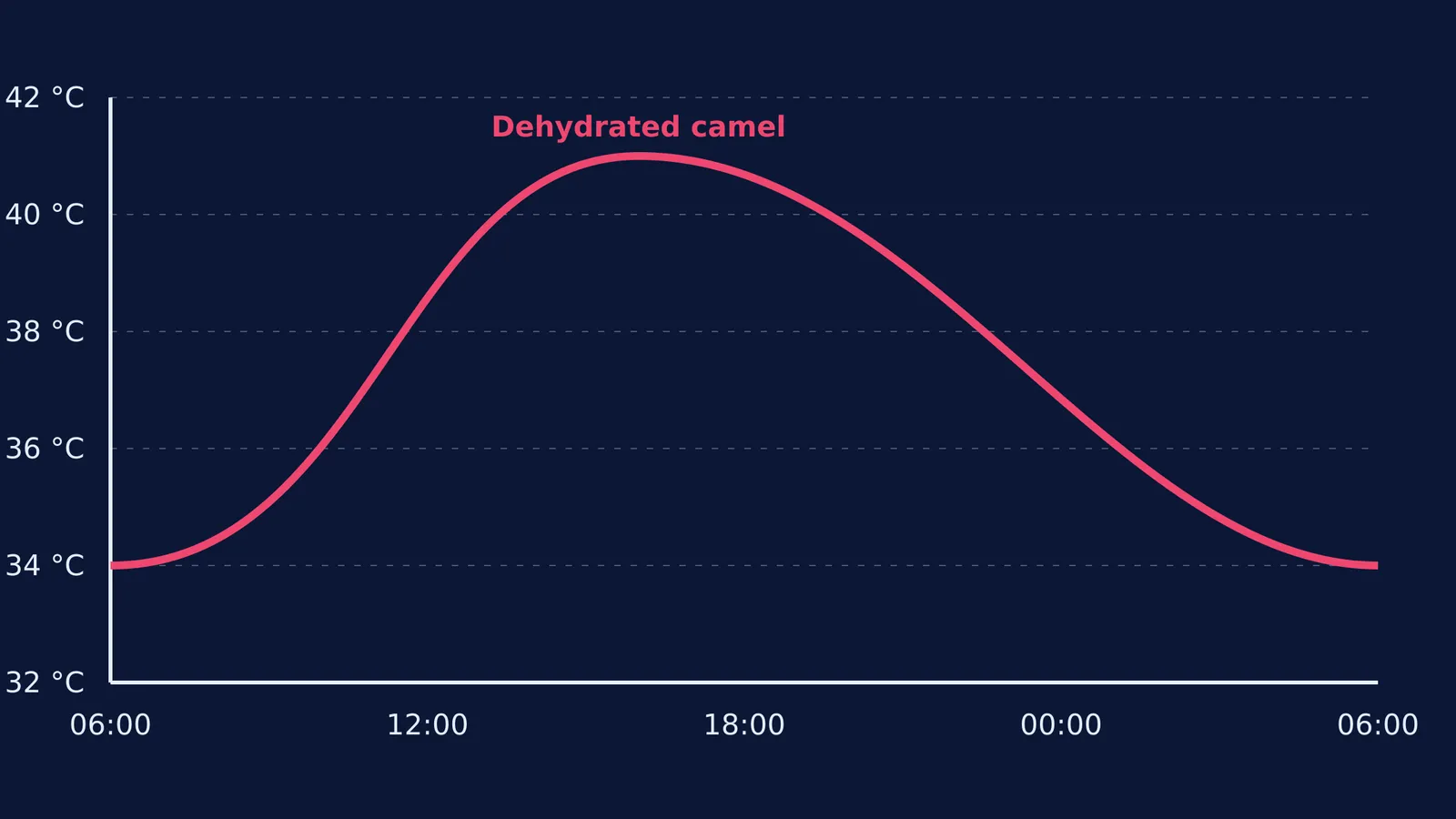
A landmark study showed that a dehydrated camel allows its core body temperature to fluctuate from 34 °C at dawn to 41 °C by late afternoon (Schmidt-Nielsen et al., 1957). By letting its body heat up during the day instead of sweating to stay cool, the camel stores the heat. At night, when the desert air cools, the camel dissipates this stored heat without losing a single drop of water. This mechanism, called adaptive heterothermy, saves significant amounts of water every day.
When you study these cross-disciplinary ideas, the Fermi Concept Library can help you build the connections. Fermi works out what you already know, builds a plan for the session, and teaches through it—so you can see how thermodynamics limits what an animal can do, and how evolution routes around those limits. Just as animals adapt to their specific challenges, you must adapt your study habits to the demands of what you are learning. For instance, understanding the respiratory quotient of fats versus carbohydrates helps explain why metabolising the hump's fat requires so much oxygen.


