

On this page
When environments become too harsh for survival, some animals simply hit pause. Instead of migrating or struggling to find non-existent food, they enter a state of deep dormancy. This strategy takes two main forms depending on the weather: hibernation in the winter, and aestivation (or estivation) in the summer.
While both states look like a long sleep, they are complex biological adaptations designed to solve different problems. Here is how they work.
What is the difference between hibernation and aestivation?
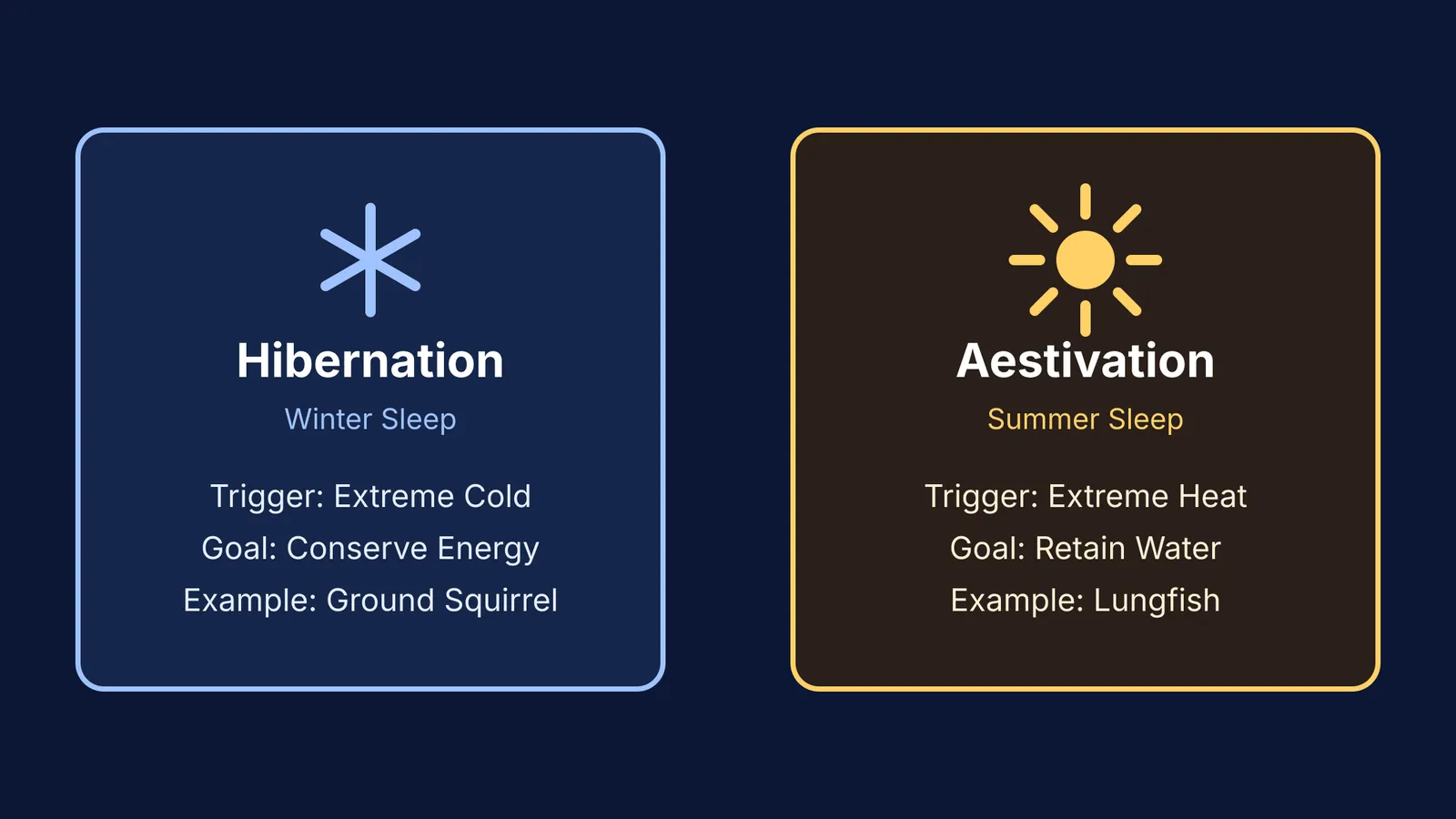
The primary difference lies in the environmental trigger. Hibernation is a response to extreme cold and winter food scarcity, whereas aestivation is a response to extreme heat and summer drought.
In both states, an animal's metabolic rate drops drastically, allowing it to survive on minimal resources. However, their survival goals differ. A hibernating animal's main objective is to conserve energy when there are no calories to be found. An aestivating animal's priority is to retain water and prevent fatal dehydration when lakes dry up and temperatures soar. Humans use water evaporation to cool off, which is why we sweat when we exercise, but small animals in a desert cannot afford to lose that moisture.
Where they sleep also differs. Hibernators seek out well-insulated spaces like deep dens or caves to stay warm. Aestivators look for cool, shaded, and moist environments, such as burying themselves deep in the mud.
Which animals go into hibernation vs aestivation?
The cold survivors
True hibernators are mostly small mammals, such as bats, hedgehogs, and rodents, because their high surface-area-to-volume ratio makes it too expensive to maintain a normal body temperature in freezing weather.
The Arctic ground squirrel (*Spermophilus parryii*) is an extreme example: it can lower its core body temperature to -2.9 °C without its blood freezing (Barnes, 1989). Meanwhile, the wood frog (*Rana sylvatica*) survives being frozen solid by rapidly converting stored glycogen into glucose, using the sugar as a natural antifreeze to protect its cells (Costanzo, Lee, and Lortz, 1993). (This survival mechanism is quite distinct from their warm-weather behaviours, such as why frogs croak so much in the rainy season to breed).
You might wonder about bears. While bears are famous for winter sleep, biologists often classify their state as a lighter "torpor" rather than true hibernation, because their body temperature only drops slightly and they can wake up relatively quickly.
The heat survivors
Aestivation is more common among cold-blooded animals (ectotherms) like reptiles, amphibians, snails, and certain fish, though some small mammals do it too.
The African lungfish (*Protopterus annectens*) is a master of aestivation. When its freshwater habitat dries up, the lungfish burrows into the mud and secretes a mucus cocoon that hardens around it. Inside this cocoon, it can aestivate for 3 to 5 years, dropping its metabolic rate until the rains return (Chng et al., 2015).
Land snails use a similar strategy on a smaller scale. To avoid drying out in the summer heat, they retreat into their shells and seal the opening with a thick, dried mucus plug called an epiphragm, trapping the moisture inside.
Why do animals hibernate or aestivate?
At the cellular level, these states are a matter of chemical economy. Maintaining a normal metabolism requires a constant intake of oxygen, water, and food to produce ATP (cellular energy).
When the environment cannot provide these, the animal suppresses its metabolic rate to a small fraction of normal. Heart rates plummet drastically, allowing the animal to stretch its stored fat or water reserves over months or even years. Without this mechanism, the animal would quickly starve in the snow or dry up in the sun, risking a population collapse—a fate shared by species that could not adapt to sudden environmental changes, much like why the dodo, quagga, thylacine and Steller's sea cow went extinct.
How to learn biological adaptations with Fermi
When studying ecology for exams, it is easy to mix up the triggers and examples for these survival strategies. The Fermi Concept Library breaks down these biological adaptations into clear, readable steps so you can build a strong foundation.
If you are not sure why a frog uses glucose instead of fat, or how a lungfish manages its nitrogen waste during its long sleep, Fermi's AI tutor can help. Instead of just giving you the answer, the tutor checks what you already know and builds a plan for the session, holding a line of reasoning until you see the biological connection yourself.
A checklist for comparing survival strategies
When comparing these two states for an exam or project, make sure you can list these five points:
The stressor: Is the animal escaping cold (hibernation) or heat (aestivation)?
The resource: Is it primarily trying to save energy (calories) or retain water?
The shelter: Does it need a warm, insulated den, or a cool, moist burrow?
The metabolic change: Both involve a massive drop in metabolic rate and heart rate.
The examples: Memorise one clear example for each, such as the Arctic ground squirrel for winter and the African lungfish for summer.
Understanding these extremes shows just how far life will go to wait out the hard times, rather than fighting a losing battle against the weather.


