

On this page
When you go for a run or play a strenuous sport, your muscles generate a massive amount of metabolic heat as a byproduct of producing energy, often through pathways like cellular respiration. In fact, during heavy physical activity, your body's heat production can exceed 1000 watts (Gleeson 1998). Since human cells function optimally only within a very narrow temperature range, if this heat stayed trapped inside your body without a way to escape, your core temperature would quickly rise to dangerous, potentially fatal levels.
Why do we sweat when we exercise?
To prevent overheating, the body relies on a biological process called homeostasis — the active regulation of a stable internal environment. For humans, this means keeping your core body temperature stable.
Your brain acts as the central command centre for this critical process. Specifically, a small region called the hypothalamus functions as a thermostat. It constantly monitors the temperature of the blood flowing through it, while also receiving signals from temperature receptors in your skin. When the hypothalamus detects a temperature spike, it initiates two main cooling responses. First, it causes vasodilation, widening the blood vessels near the surface of the skin to move hot blood away from your core. Second, it triggers the sweat glands scattered across your body to secrete a watery fluid onto your skin (Wikipedia).
How does evaporation keep us cool?
It is a common misconception that the sweat itself cools you down simply by being wet. In reality, sweating alone does not lower your temperature. The cooling effect only happens when the liquid sweat undergoes a phase change, turning into a gas and floating away into the air.
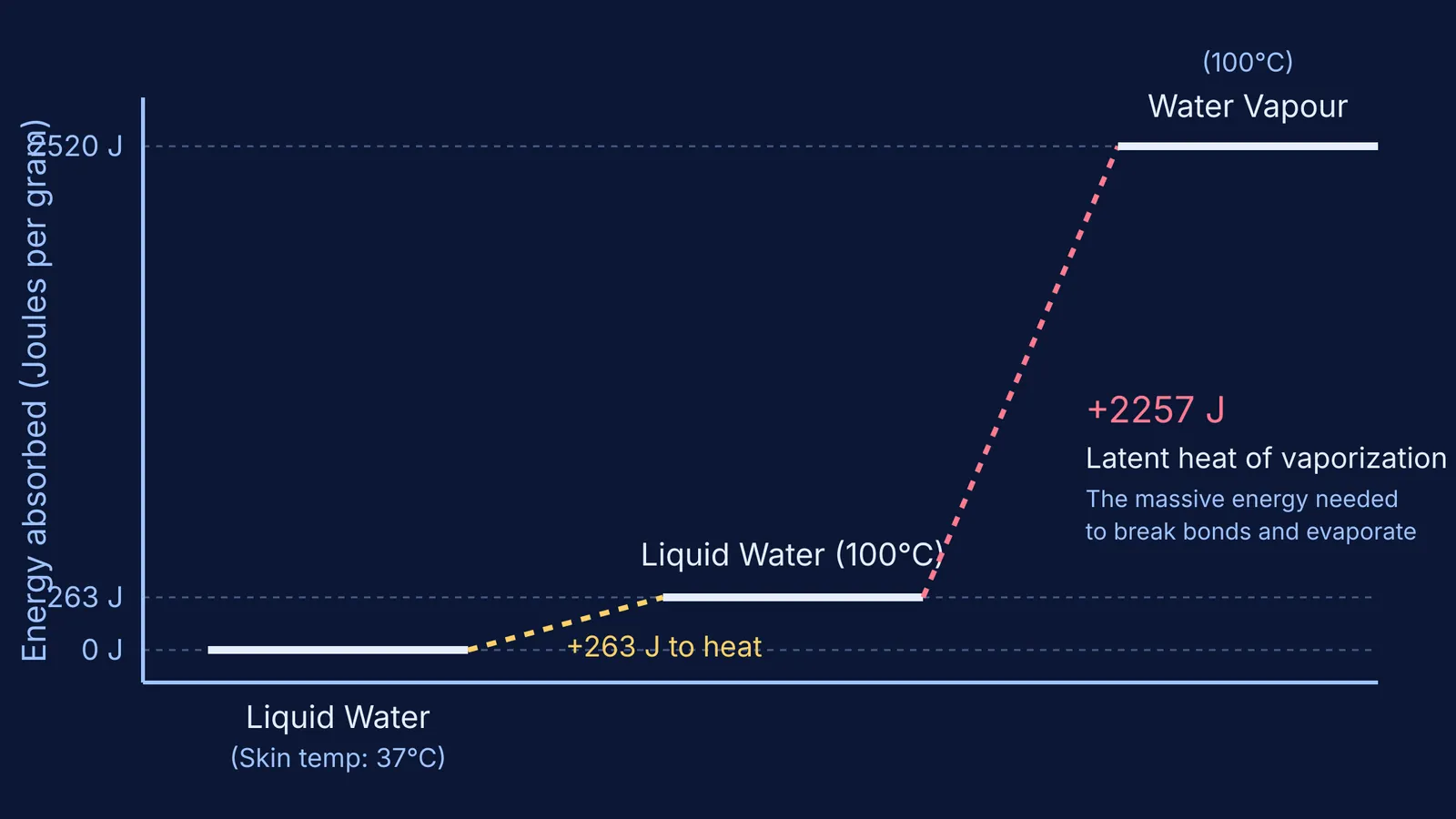
This phase change requires a significant amount of energy, which physicists refer to as the latent heat of vaporization. Water requires 2257 joules of energy to evaporate just one gram at its boiling point (Wikipedia), and even more at typical skin temperatures. Because water has such a high heat of vaporization compared to other liquids, even a small amount of evaporated sweat can dissipate a large amount of metabolic heat.
As the water molecules absorb this thermal energy directly from your skin to break their intermolecular bonds and escape into the air, the temperature of the remaining moisture and your skin drops. This is the exact same principle you study when comparing enthalpies of atomisation, sublimation and phase change.
Why does high humidity make us feel hotter?
Have you ever noticed that a hot day feels much more punishing when the air is sticky and humid than when it is dry? The efficiency of evaporative cooling depends entirely on a vapor pressure gradient between your skin and the surrounding air.
When the humidity is low, the dry air eagerly accepts more water vapour, allowing sweat to evaporate rapidly and cool you efficiently. However, when the air is already saturated with water vapour, there is nowhere for your sweat to go. Instead of evaporating, the liquid simply beads up and drips off your skin. Because the sweat never turns into a gas, it does not carry away that massive amount of latent heat. Your body keeps producing heat and pumping out sweat, but the primary cooling mechanism is blocked, leading to a rapid loss of water without any temperature relief.
How does this bridge biology and physics?
Thermodynamics and human physiology are deeply connected. Whether you are studying heat capacity in physics or the mechanisms of human physiology in biology, you have to understand how energy moves through a system. Evaporative cooling is just one example of how organisms rely on fundamental physics to survive in extreme conditions.
If you struggle to picture how environmental factors like humidity and wind slow down or speed up evaporation, the Fermi Simulation Lab lets you play with temperature and pressure interactively. If you hit a roadblock on a numerical problem involving heat in isobaric and isochoric processes, you can take it to Fermi's AI tutor. Instead of just handing you the final answer, the tutor works out what you already know and builds a plan for the session, teaching you the underlying principles step by step.


