

On this page
When the first heavy rains arrive, ponds and puddles fill up, and the noise begins. If you are studying for biology or physics exams, that croaking is more than just background noise—it is a live demonstration of reproductive strategy and acoustic resonance.
Why do frogs croak so much in the rainy season?
For most amphibians, rain is the ultimate cue that breeding conditions are right. Frogs need standing water to lay their eggs, ensuring their tadpoles have a safe, aquatic place to hatch and grow before they mature. The sudden abundance of water in the rainy season provides this exact environment. When you study Structural organisation in animals: tissues and the frog for NEET, you learn that frogs are amphibians heavily adapted to both land and water, and their reproductive cycles are tied to rainfall.
The loud croaking you hear is an advertisement call. Male frogs produce these sounds to attract females and to establish their territory against rival males. Furthermore, because frogs breathe partly through their skin, they must remain moist. The high humidity of a rainy night allows them to be highly active and vocal without the risk of drying out.
Calling is incredibly demanding work. A 1982 study on the Túngara frog (*Physalaemus pustulosus*) by researchers Theresa L. Bucher, Michael J. Ryan and George A. Bartholomew found that oxygen consumption during calling was over four times the frog's daytime resting rate. This massive energy cost means a loud, sustained call is an honest signal of a male's health and fitness to potential mates. Only the most robust males can afford to expend that much metabolic energy for hours on end.
How does a frog croak?
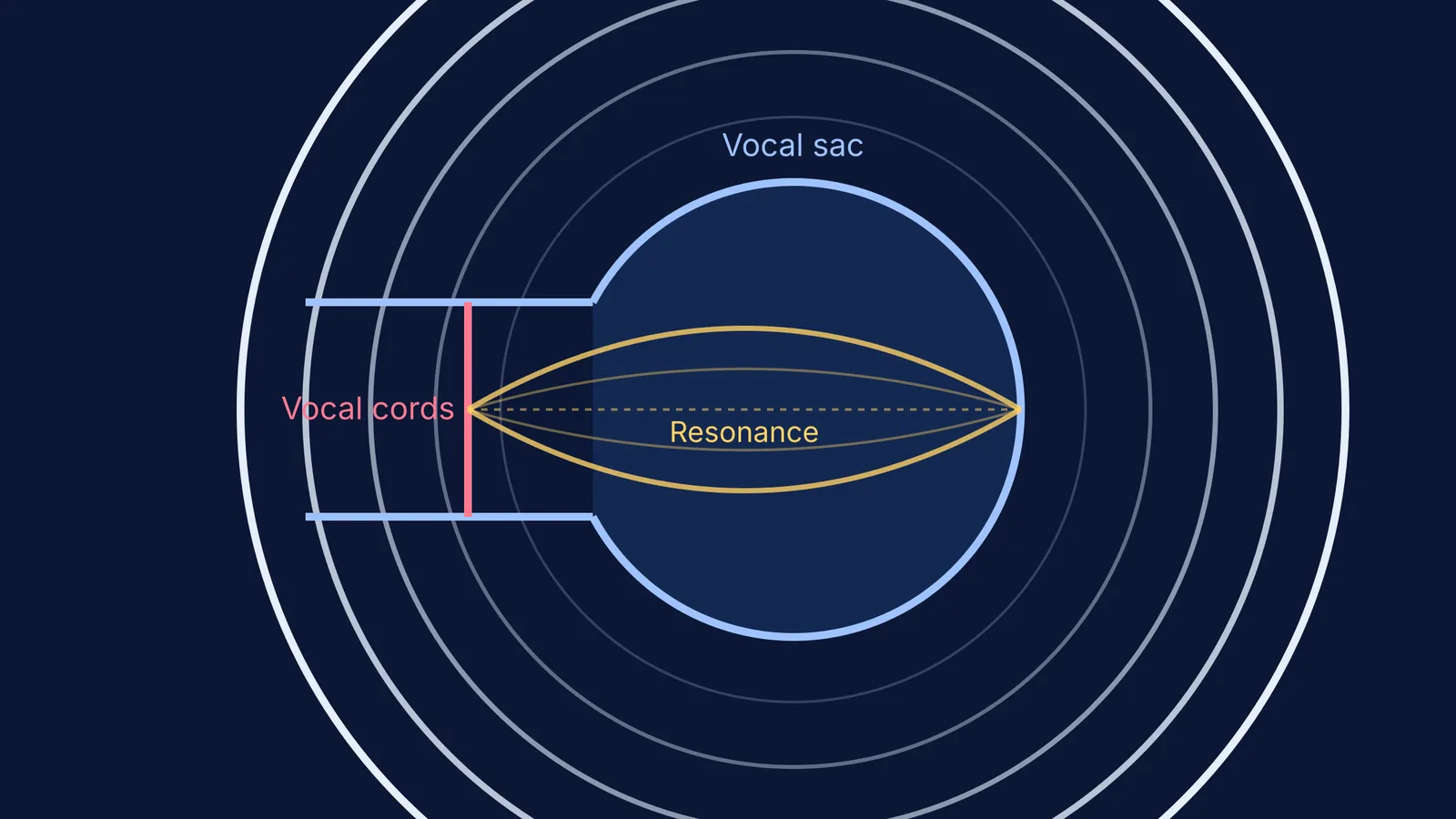
The process of making a sound begins in the larynx, or voice box. As a frog forcefully pushes air from its lungs, the air passes across the vocal cords, causing them to vibrate. Because most frogs call with their mouths and nostrils completely closed, they shuffle this air back and forth between their lungs and the vocal sac.
This internal air recycling is a highly efficient design. It means the frog can call repeatedly at a fast pace without having to stop, open its mouth, and take a fresh breath of air.
The physics of the vocal sac
The thin, elastic membrane that balloons out from a frog's throat is the vocal sac. It is important to note that the vocal sac does not produce the sound itself. Instead, it acts as a resonating chamber, much like the air column in a Resonance tube experiment: speed of sound and end correction.
When the frequency of the vibrating vocal cords matches the natural frequency of the air cavity inside the sac, resonance occurs. The air inside vibrates intensely, causing the elastic walls of the sac to vibrate in turn. The sac then acts as an acoustic radiator, coupling the vibrations to the outside air and drastically amplifying the sound. This acoustic matching is how a frog small enough to sit on your palm can produce a call that can be heard over huge distances. Understanding sound waves can be tricky, but for a detailed breakdown of how pressure changes in a wave, see our guide on Displacement and pressure waves in sound: the 90° phase shift.
Some frogs even use their environment to get louder. A 2014 study by W.-H. Tan and colleagues found that male Mientien tree frogs frequently call from inside concrete roadside drains. The drains act as miniature urban canyons, providing a reverberation chamber that enhances both the amplitude and duration of their calls.
If you struggle to picture how sound waves build up inside a closed chamber, the Fermi Simulation Lab has interactive simulations for the ideas that are easier to see than to read, letting you watch standing waves form and change as you adjust the frequency.
The source: What is creating the initial vibration? In frogs, it is the vocal cords; in humans, it is the same; in insects, it is often wings rubbing together.
The resonator: What enclosed volume is amplifying the sound? The vocal sac is a cavity resonator that builds up the sound waves to a high amplitude.
The radiator: How does the sound transfer to the air? For the frog, the expanding and contracting skin of the sac pushes against the surrounding air, acting as a highly efficient radiator surface.
The energy transfer: Sound is mechanical work. Remember that acoustic energy ultimately comes from metabolic energy, which is why calling takes such a toll on the animal's oxygen consumption.
Understanding the mechanics behind the noise makes it easier to see how biology and physics overlap in the natural world. The next time you hear a chorus of frogs, you are listening to thousands of tiny, highly tuned acoustic amplifiers at work.


