

On this page
You check the tyres at a petrol pump, one reads 0, and it is tempting to think that tyre is empty. It is not. It is full of air at the same pressure as the air around you. The gauge reads zero because it was designed to.
Which zero you measure from is the whole difference between gauge and absolute pressure, and the cause of a common mistake in gas-law numericals.
What is the difference between gauge pressure and absolute pressure?
Absolute pressure is measured from a perfect vacuum, where there is no gas at all. Gauge pressure is measured from the atmosphere around you.
The OpenStax College Physics textbook puts it in one line: "Gauge pressure is the pressure relative to atmospheric pressure" (OpenStax College Physics, section 11.6). The same section gives the link between the two:
P(absolute) = P(gauge) + P(atmosphere)
Gauge pressure is positive above atmospheric pressure and negative below it, the textbook explains. It adds that in most cases the absolute pressure in a fluid cannot be negative, so for a gas the lowest possible gauge pressure is minus one atmosphere: a perfect vacuum.
One standard atmosphere is defined as exactly 101 325 Pa (NIST CODATA value), or about 101 kPa. The real air pressure where you stand changes with weather and altitude, which is one reason everyday gauges measure from it rather than from vacuum.
Why does a tyre gauge read zero when the tyre is flat?
OpenStax says it directly: "Tire gauges are simply designed to read zero at atmospheric pressure and positive when pressure is greater than atmospheric" (OpenStax, section 11.6). With a gaping hole in the tyre, the same section adds, the gauge would read zero even though atmospheric pressure exists in the tyre.
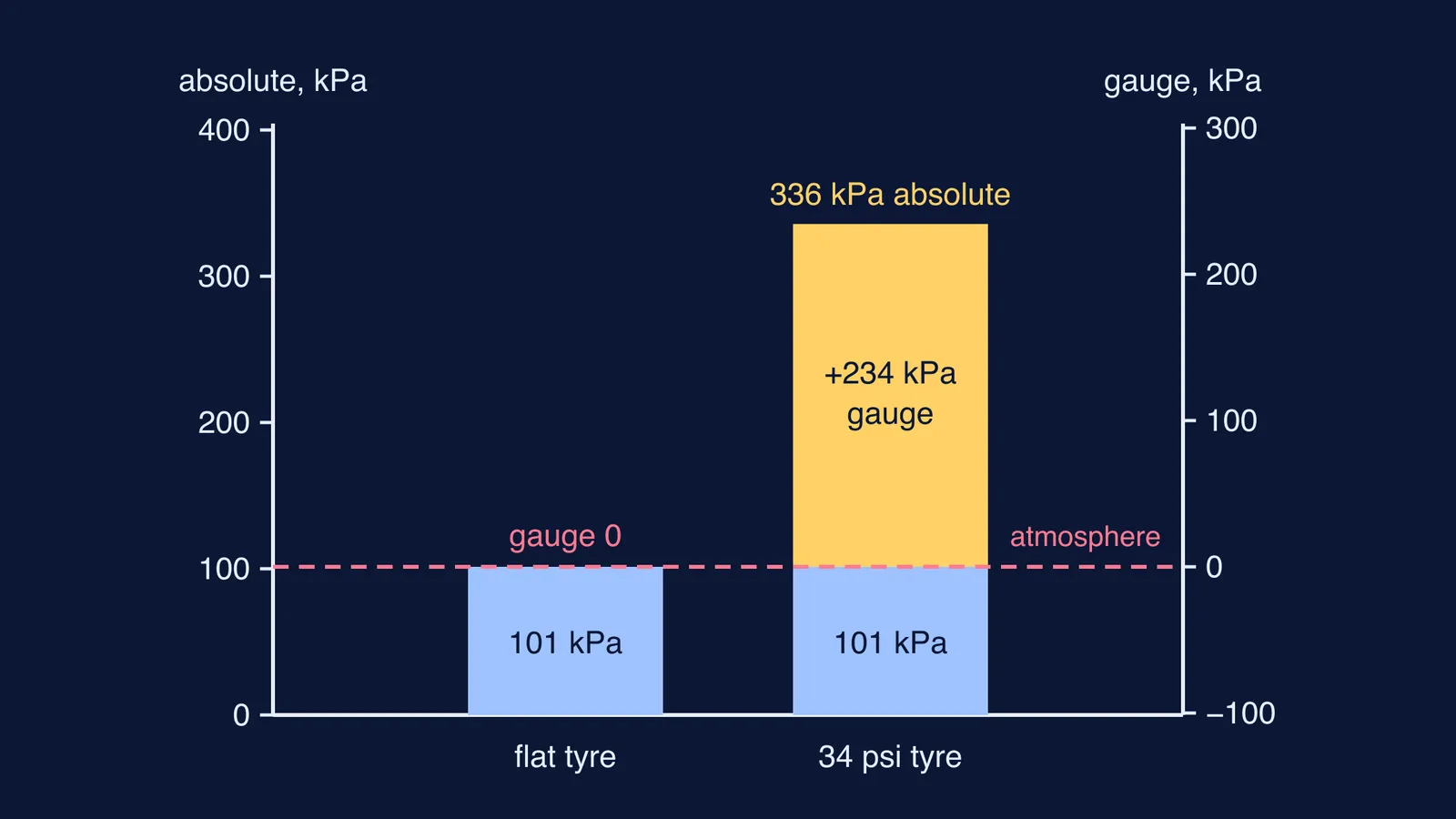
Picture what the gauge feels. Air from the tyre pushes on one side of its spring, and outside air pushes on the other. The gauge only reports the difference. In a flat tyre the two pushes are equal, so the needle sits at 0 while roughly 101 kPa of air pressure is still inside.
Blood pressure works the same way: the textbook notes that blood pressure readings, like tyre pressures, are made relative to atmospheric pressure. An open tube manometer does it too, because its open end is pushed on by the atmosphere.
Worked example: how much air is in a 34 psi tyre?
OpenStax uses a tyre gauge reading of 34 psi and adds 14.7 psi of atmosphere to get 48.7 psi absolute (OpenStax, section 11.6). Here is the same tyre in SI units, taken one step further.
Convert the reading. One psi is 6.894 757 kPa (NIST Guide to the SI, Appendix B), so 34 psi is 234.4 kPa gauge.
Add the atmosphere: 234.4 + 101.3 = 335.7 kPa absolute.
Compare with the flat tyre, which is at 0 kPa gauge, or 101.3 kPa absolute.
The ideal gas law, PV = NkT, needs absolute pressure (OpenStax College Physics, section 13.3). At the same volume and temperature, the number of molecules is proportional to absolute pressure, so the ratio is 335.7 / 101.3, about 3.3.
The pumped tyre holds about 3.3 times as many air molecules as the flat one, not "infinitely more" as 234 against 0 suggests. A real flat tyre squashes, so its volume is smaller, but the point stands: zero on the gauge does not mean zero air.
The same rule decides why tyre pressure rises on a long drive: the heating calculation only works in absolute pressure and kelvin.
When should you use gauge pressure and when absolute pressure?
Use this checklist before you plug in a number:
Gas laws (Boyle, Charles, PV = nRT, partial pressures): always absolute.
A pressure difference (the net force on a lid, window or tyre wall, the height difference in a manometer): gauge is fine, because the atmosphere acts on both sides and cancels.
Liquids open to the air: pressure at depth h is P(atmosphere) + ρgh absolute, and ρgh alone is the gauge pressure. Read which one the question asks for.
A negative value can only be gauge pressure. In a gas problem, a negative absolute pressure means you have made an error.
Wording: "gauge" or "above atmospheric" means gauge; "absolute" or "total" means absolute. If the question is silent and involves a gas law, assume absolute.
For more practice, try these hydrostatics problems on pressure at depth and gauge pressure, which ask for both.
If you keep losing marks on this step, the Fermi Problem Library has worked problems with a step-by-step solver that explains the reasoning rather than printing an answer, so you can follow each step instead of only checking the final number. If pressure itself still feels shaky, the Fermi Concept Library gives each physics concept its own lesson.
Next time a gauge reads 0, ask yourself: zero compared with what?


