

On this page
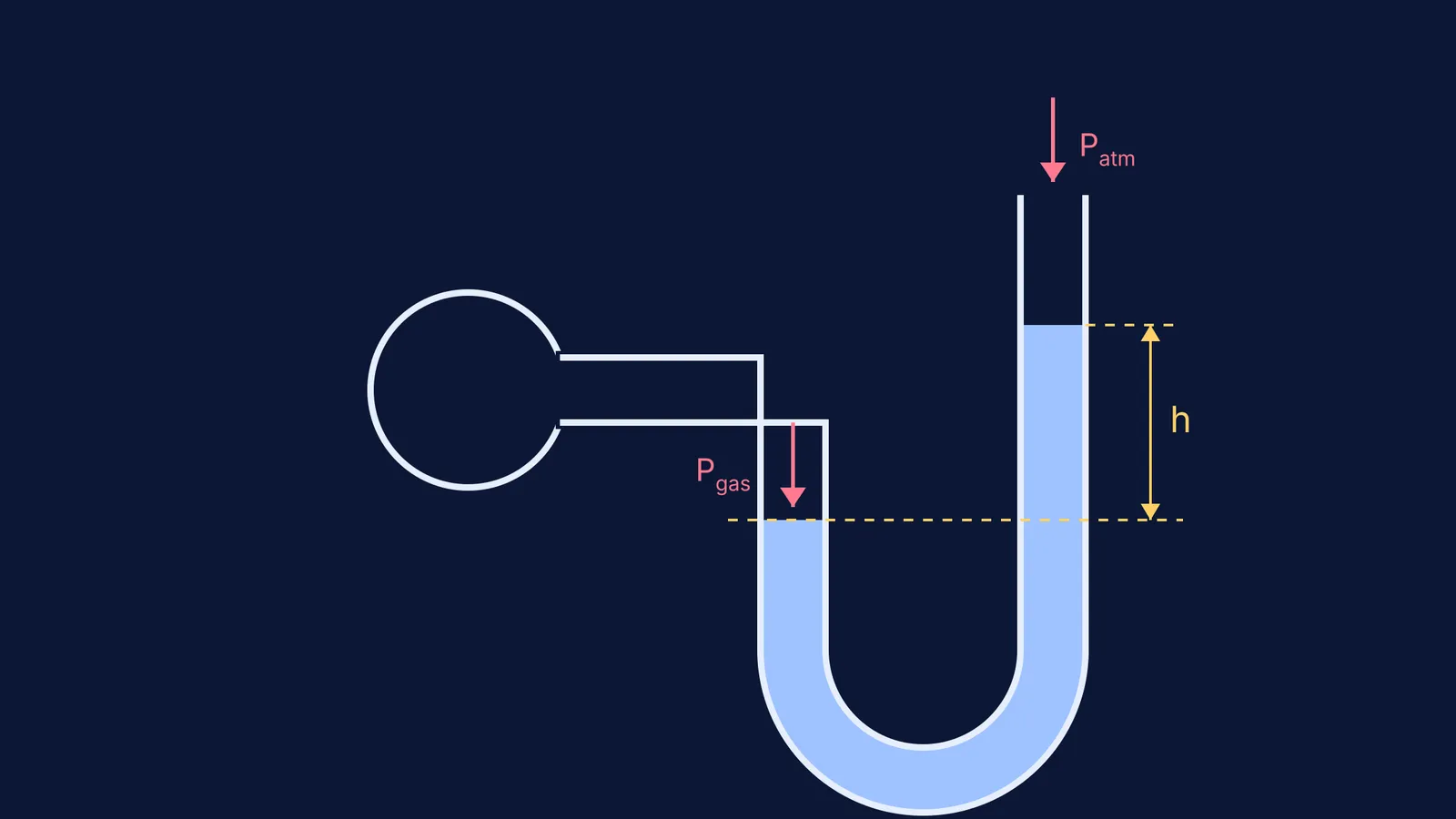
An open-tube manometer is a simple mechanical device used to measure the pressure of a confined gas. It consists of a U-shaped tube containing a liquid—typically mercury, water, or light oil—where one arm connects to the gas container and the other arm is open to the atmosphere.
The basic principle of a liquid-column manometer is that the difference in fluid height is proportional to the pressure difference between the two ends. It works like a tug-of-war: the gas pushes against the liquid from the sealed side, and the atmosphere pushes back from the open side. By measuring the difference in the liquid levels between the two arms, you can calculate the exact pressure of the gas.
How do you calculate pressure from a manometer?
When learning how to read open tube manometer pressure, you are comparing the pressure of the gas inside the container against the standard atmospheric pressure outside. The difference in fluid height (h) tells you exactly how much the pressures differ.
According to the hydrostatic pressure equation, the pressure exerted by a column of fluid is ρgh, where ρ is the density of the fluid and g is the acceleration due to gravity. To find the absolute gas pressure (P), you observe the fluid levels and apply one of three rules:
The open side stands higher. This means the gas is pushing harder than the atmosphere. You calculate the gas pressure by adding the pressure of the liquid column:
P = P_atm + ρgh
The closed side stands higher. In this case, the atmosphere is pushing harder than the gas, creating a partial vacuum. You subtract the liquid column's pressure from the atmospheric pressure:
P = P_atm - ρgh
The levels are equal. The gas pressure exactly equals the surrounding atmospheric pressure.
Mercury is highly preferred for these measurements because of its high density (13.534 g/cm³), which keeps the required tube length manageable. When using mercury, the height h is often read directly in millimetres of mercury (mm Hg), saving you from multiplying out the density and gravity.
What is the difference between gauge pressure and absolute pressure?
When solving manometer problems, students often confuse gauge pressure with absolute pressure.
Gauge pressure is simply the pressure relative to the atmosphere. In an open-tube manometer, the gauge pressure is the pressure exerted by the liquid column itself (ρgh). It can be positive or negative depending on which side is higher.
Absolute pressure is the total, true pressure of the gas. You find it by adding the atmospheric pressure to the gauge pressure.
If an exam question asks "what is the pressure of the gas?", it generally means the absolute pressure unless it explicitly specifies gauge pressure. Understanding the baseline atmospheric pressure is critical here; why atmospheric pressure decreases with height explains how your starting value for P_atm might change depending on where the experiment is done.
How do you solve a manometer example problem?
Imagine a manometer filled with mercury connected to a flask of gas. The mercury level in the open arm is 120 mm higher than in the arm connected to the gas. The atmospheric pressure in the room is 760 mm Hg. What is the absolute pressure of the gas?
Because the open side is higher, you know the gas pressure is greater than atmospheric pressure. You use the formula for addition: P = P_atm + h P = 760 + 120 = 880 mm Hg
If the fluid was water instead of mercury, you would need to account for water's much lower density. The liquid column would be much taller for the same pressure difference, which is why every 10 metres of water adds one atmosphere of pressure.
If you find yourself stuck deciding whether to add or subtract in these problems, the Fermi Concept Library maps out every physics idea. Fermi works out what you already know, builds a plan for the session, and teaches through it—drawing the figure and checking understanding as it goes, so you learn to write the balance equation yourself.


