

On this page
Have you ever swum to the bottom of a deep pool and felt your ears pop? That pressure you feel is the weight of the water above you. In physics, this is called hydrostatic pressure.
A standard rule of thumb for divers and scientists is that every 10 metres of water depth adds approximately one atmosphere of pressure. But where does this rule come from? The answer lies in the formula for fluid pressure: P = ρgh.
Why every 10 metres of water adds one atmosphere of pressure?
Hydrostatic pressure is the force per unit area exerted by a liquid on an object. It depends on three factors: the density of the liquid (ρ), the acceleration due to gravity (g), and the depth (h).
The formula is: Pressure = ρ × g × h
Let us plug in the standard numbers for fresh water on Earth:
The density of fresh water (ρ) is approximately 1000 kg/m³ (USGS).
Standard acceleration of gravity (g) is approximately 9.81 m/s² (the exact standard is 9.80665 m/s², NIST).
The depth (h) is 10 m.
Multiplying these together gives: 1000 × 9.81 × 10 = 98,100 pascals (Pa).
The standard atmosphere is defined as exactly 101,325 Pa (NIST). As you can see, 98,100 Pa is extremely close to 101,325 Pa. This is why every 10 metres of water adds one atmosphere of pressure.
If you are dealing with the ocean, the math is even closer. Because of dissolved salts, seawater is slightly denser than fresh water (USGS). This means you reach an extra 1 atm of pressure slightly sooner. In fact, to hit exactly 101,325 Pa in the ocean, you only need to descend 10.06 metres, or 33 feet (NOAA).
What does this mean for scuba divers?
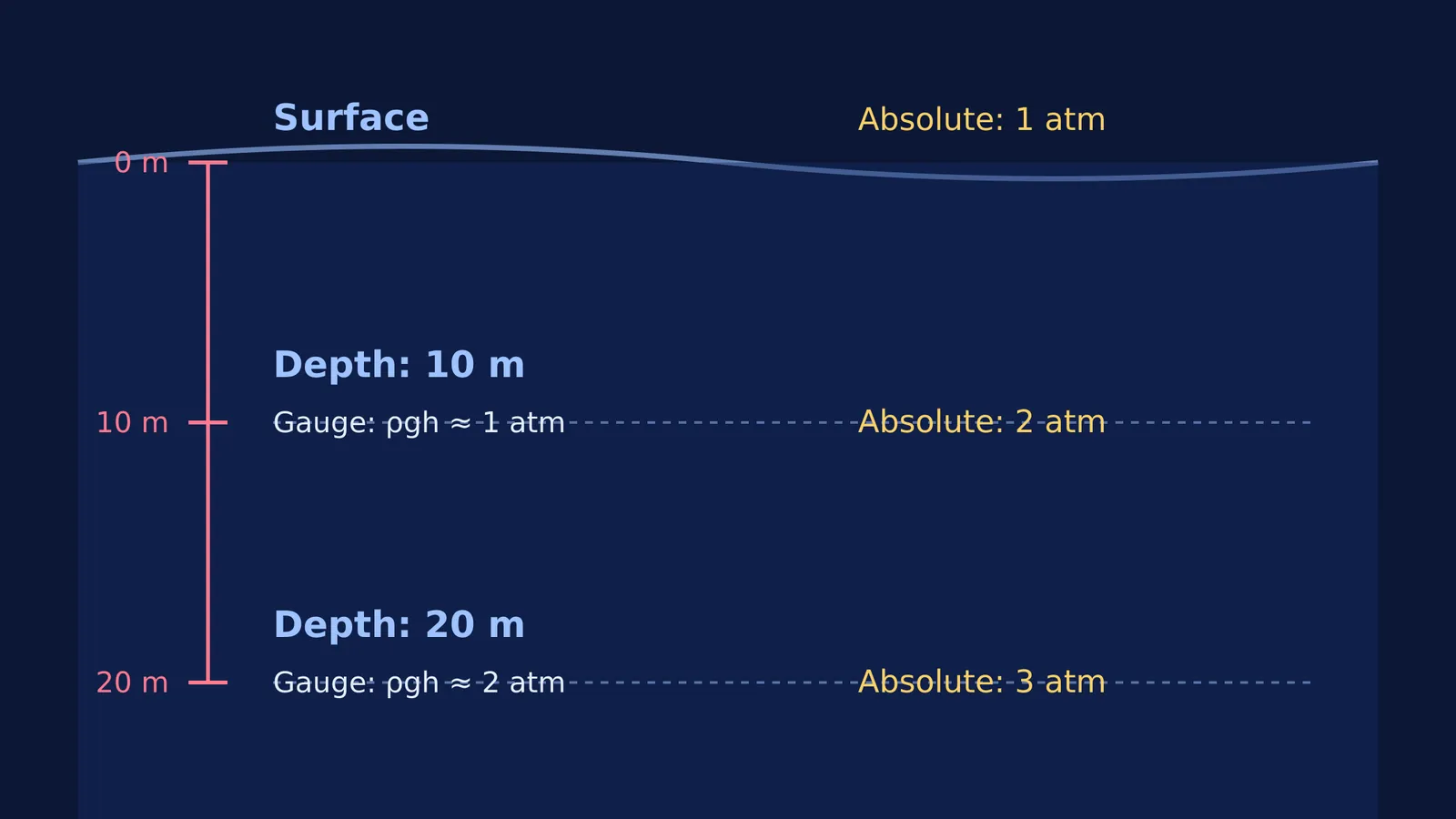
When you stand at sea level, the air above you presses down with one atmosphere (1 atm) of pressure. When a diver descends 10 metres into the ocean, the water adds another 1 atm of pressure.
This brings up a crucial distinction in physics problems: gauge pressure versus absolute pressure.
Gauge pressure is the pressure from the water alone. At 10 metres, the gauge pressure is 1 atm.
Absolute pressure is the total pressure, including the air above the water. At 10 metres, the absolute pressure is 2 atm (1 atm of air + 1 atm of water).
For every 10.06 metres you go down in the ocean, the absolute pressure increases by one atmosphere. At 20 metres, a diver experiences 3 atm of absolute pressure. At 30 metres, it is 4 atm.
This rapid increase in pressure is why a diver's lungs and the air spaces in their equipment compress as they go deeper. Marine mammals are built for this. Whales have loose, bendable cartilage that allows their rib cages and lungs to collapse safely under immense pressure, letting them hunt at extreme depths (NOAA).
How do you solve water pressure problems in exams?
If you are studying fluid mechanics for exams like JEE or NEET, questions often test your ability to distinguish between gauge and absolute pressure. A classic mistake is forgetting to add the surface air pressure when a question asks for the "total pressure" at the bottom of a lake.
Consider a common exam question: *What is the total pressure on a submarine window located 50 metres below the surface of a freshwater lake?*
First, calculate the gauge pressure contributed by the water: P_water = ρ × g × h P_water = 1000 × 9.81 × 50 P_water = 490,500 Pa
Convert this to atmospheres by dividing by 101,325 Pa, which gives roughly 4.84 atm. Next, remember that the lake surface is exposed to the atmosphere. The total absolute pressure is the water pressure plus the air pressure: P_total = P_water + P_air P_total = 4.84 atm + 1.00 atm = 5.84 atm.
If you are dealing with a U-tube or calculating fluid columns, you can read our guide on finding the unknown density of two immiscible liquids in a manometer. For another application of fluid pressure, see how Pascal's law in hydraulic machines lets you lift a car with a small push.
If you find yourself stuck on these distinctions, the Fermi Concept Library maps out hydrostatic pressure, gauge pressure and Pascal's law, each with its own lesson and its place in the map. If you prefer learning by doing, the Fermi Problem Library has worked problems with a step-by-step solver that explains the reasoning rather than printing an answer. It notices where a student is stuck—like forgetting to add the 1 atm of surface pressure—and decides whether to explain, ask, or show the next step.


