

On this page
Earth is wrapped in an atmosphere held bound by gravity. According to the NOAA National Weather Service Glossary, atmospheric pressure is the force exerted by the atmosphere at any given point, determined by multiplying gravitational acceleration by the mass of the vertical air column above a unit area.
At sea level, this downward pull produces a standard atmospheric pressure of 101,325 Pa (101.325 kPa or 1013.25 hPa), as documented in the NASA Technical Reports Server model of the U.S. Standard Atmosphere. Under baseline conditions, sea-level air density is approximately 1.225 kg/m³ at 15 °C (288.15 K). Every square metre of ground supports roughly 10,330 kg of air pressing down from above.
Why does atmospheric pressure decrease with height?
The main reason air pressure decreases with altitude is simple: as you ascend, less air remains above you. Because atmospheric pressure is the weight per unit area of the overlying air column, climbing higher leaves fewer gas molecules overhead to exert a downward gravitational force.
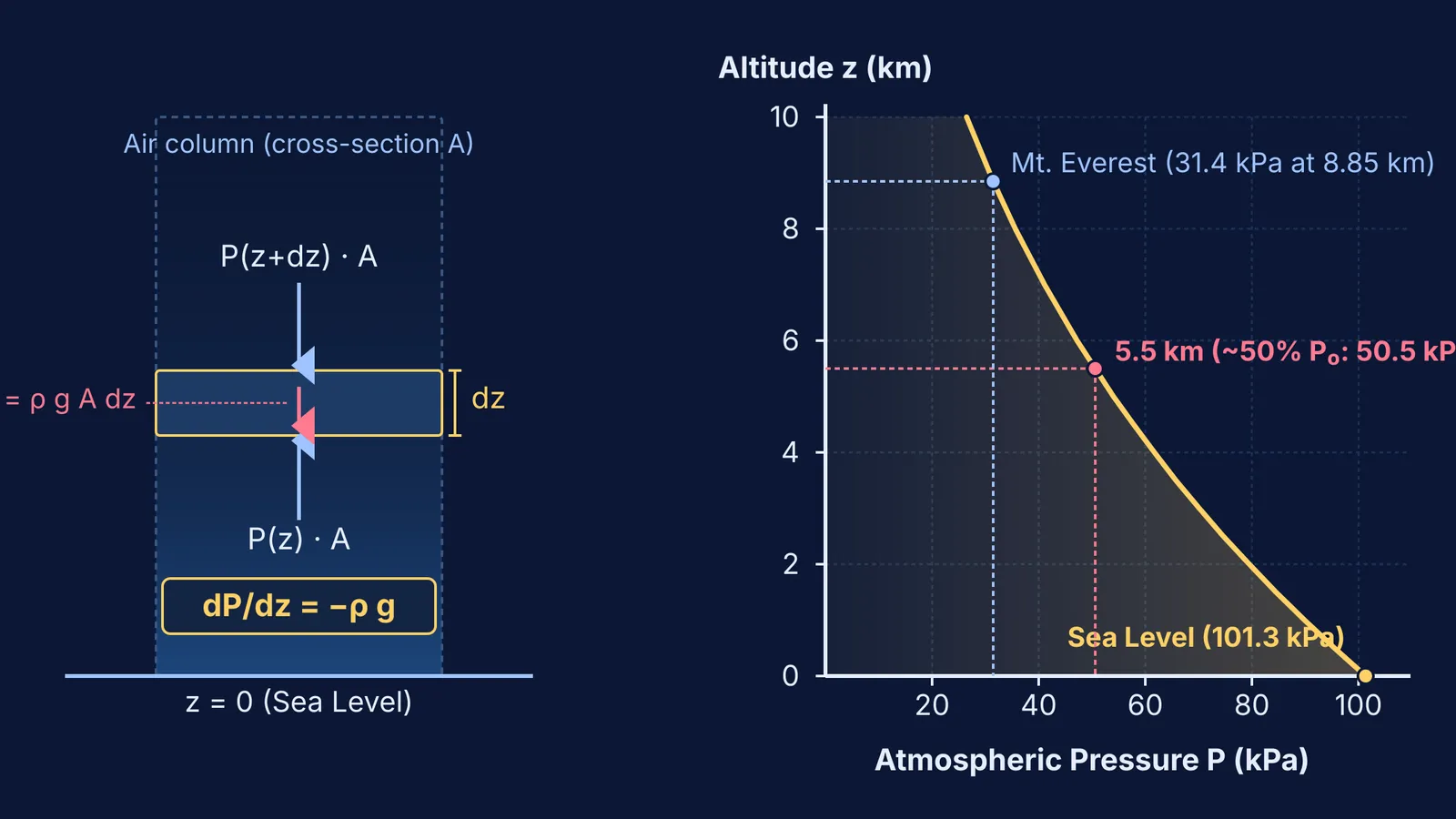
In fluid mechanics, this balance is described by the hydrostatic equation. For a static fluid parcel of cross-sectional area A and thickness dz, balancing forces yields dP/dz = −ρ g, where P is pressure, z is elevation, ρ is air density, and g is gravitational acceleration (~9.81 m/s²). As shown in OpenStax University Physics and the NCERT Class 11 Physics textbook, the negative sign indicates pressure drops as height increases.
Connecting free-body diagrams to differential equations is a regular hurdle in exam preparation. The Fermi Problem Library provides worked problems with a step-by-step solver that explains the reasoning rather than printing an answer.
Why does atmospheric pressure drop exponentially instead of linearly?
In liquids such as water, density remains nearly constant under pressure. In an incompressible fluid, pressure increases linearly with depth: ΔP = ρ g h. In contrast, air is a compressible gas whose density depends directly on its pressure.
From the ideal gas law, air density is ρ = P M / (R T), where M is the mean molar mass of air (approximately 0.02896 kg/mol), R is the universal gas constant (8.314 J/(mol·K)), and T is absolute temperature. Substituting this into the hydrostatic equation gives dP/dz = −(M g / (R T)) P. Integrating this differential equation produces the barometric formula, P(z) = P₀ exp(−z / H), where H = R T / (M g) is the atmospheric scale height (roughly 8.4 km in the lower troposphere), as analyzed in the American Journal of Physics.
According to the NASA Technical Reports Server atmospheric model, lower air layers bear the weight of everything above them, squeezing gas to maximum density near sea level. As you climb, density and pressure drop together, producing an exponential curve rather than a straight line.
The Fermi Simulation Lab offers interactive simulations for ideas that are easier to see than read, letting you observe how gas particle density compresses across a vertical gravitational field.
How quickly does air pressure drop over the first few kilometres?
Near Earth's surface, the atmosphere is at its densest, making the vertical pressure gradient steepest in the lowest few kilometres. According to data from the NASA Technical Reports Server documentation of the U.S. Standard Atmosphere, standard pressure values drop predictably with altitude:
Sea level (0 m): 101.3 kPa (100% of baseline pressure)
1,000 m (1.0 km): 89.9 kPa (an 11.3% drop from sea level)
2,000 m (2.0 km): 79.5 kPa (a 21.5% drop from sea level)
3,000 m (3.0 km): 70.1 kPa (a 30.8% drop from sea level)
5,500 m (5.5 km): 50.5 kPa (roughly 50.1% of sea-level pressure)
8,848 m (Mount Everest summit): 31.4 kPa (roughly 31.0% of sea-level pressure)
Over the first 1,000 metres, pressure drops by approximately 1.2 kPa per 100 metres (about 12 hPa per 100 m, or 1 hPa per 8.3 m of ascent). At higher elevations, air thins, so the rate of pressure drop gradually flattens.
How can you estimate atmospheric pressure at high altitude?
You can estimate local atmospheric pressure across different elevation ranges using baseline values from the NASA Technical Reports Server Standard Atmosphere:
Low elevations (0 to 2,000 m): Subtract 1.2 kPa per 100 metres of ascent from 101.3 kPa.
Moderate elevations (2,000 to 6,000 m): Apply the half-pressure rule, halving pressure roughly every 5.5 kilometres.
High elevations (above 6,000 m): Use the exponential formula P(z) = P₀ exp(−z / 8.4 km).
Here is how this framework works in practice:
Bengaluru, India (~920 m elevation): The linear gradient gives ΔP = (1.2 kPa / 100 m) × 920 m = 11.0 kPa. Subtracting from 101.3 kPa yields 90.3 kPa. The NASA Technical Reports Server standard atmosphere table lists 90.8 kPa at 920 m, confirming accuracy within 1%.
Leh, Ladakh (~3,500 m elevation): The linear rule overstates the loss. Using scale height H = 8.4 km gives P = 101.3 × exp(−3.5 / 8.4) ≈ 66.8 kPa, matching recorded values near 65.8 kPa.
At 66 kPa, water boils at roughly 88 °C rather than 100 °C, explaining why cooking takes longer in the mountains and why human travellers need acclimatization.
For students reviewing fluid statics and thermodynamics, the Fermi Concept Library provides every concept in physics, chemistry, biology, mathematics and computing, each with its own lesson and its place in the map.


