On this page
GDP is the number behind headlines like "India's economy grew 7.8%". This guide explains it in plain words using the figures India's statistics ministry published in 2026, with two calculations you can do yourself and a checklist for any GDP headline.
What is GDP in simple words?
Gross domestic product (GDP) measures the money value of final goods and services produced in a country in a given period, such as a quarter or a year, according to the International Monetary Fund's explainer on GDP.
"Final" is the important word. Think of a roti. A farmer sells wheat to a mill, the mill sells flour to a dhaba, and the dhaba sells you a roti. Add up all three sales and you count the wheat three times. So statisticians count only what the final buyer pays, which equals the value added at every step. The same IMF explainer defines value added as total sales less the value of intermediate inputs.
A worked example with made-up prices: the farmer sells wheat for ₹4, the mill sells the flour for ₹7, and the dhaba sells the roti for ₹10. Value added: farmer ₹4, mill ₹3 (₹7 minus ₹4), dhaba ₹3 (₹10 minus ₹7). Total: ₹10, exactly the price of the final roti.
What does GDP count, and what does it leave out?
GDP can also be measured by adding up spending: what households buy, what the government spends, what businesses invest in buildings and machines, plus exports minus imports. In India, households' spending is the biggest part. In the Ministry of Statistics and Programme Implementation (MoSPI) provisional estimates of June 2026, private final consumption expenditure was 56.7% of GDP at current prices in 2025-26.
GDP also leaves things out. The IMF explainer lists unpaid work, such as household work or volunteer services, and black-market activity as exclusions. Dinner cooked at home adds nothing to GDP; the same meal bought from a restaurant does. The IMF also says GDP is not a measure of overall standard of living or well-being: it does not reveal environmental damage, changes in leisure time or how income is shared among residents.
What is the difference between nominal and real GDP?
Nominal GDP is measured at current prices, while real GDP adjusts for inflation by valuing output at constant prices, as the IMF explainer puts it. Nominal GDP can rise just because prices rose; real GDP asks whether the country produced more.
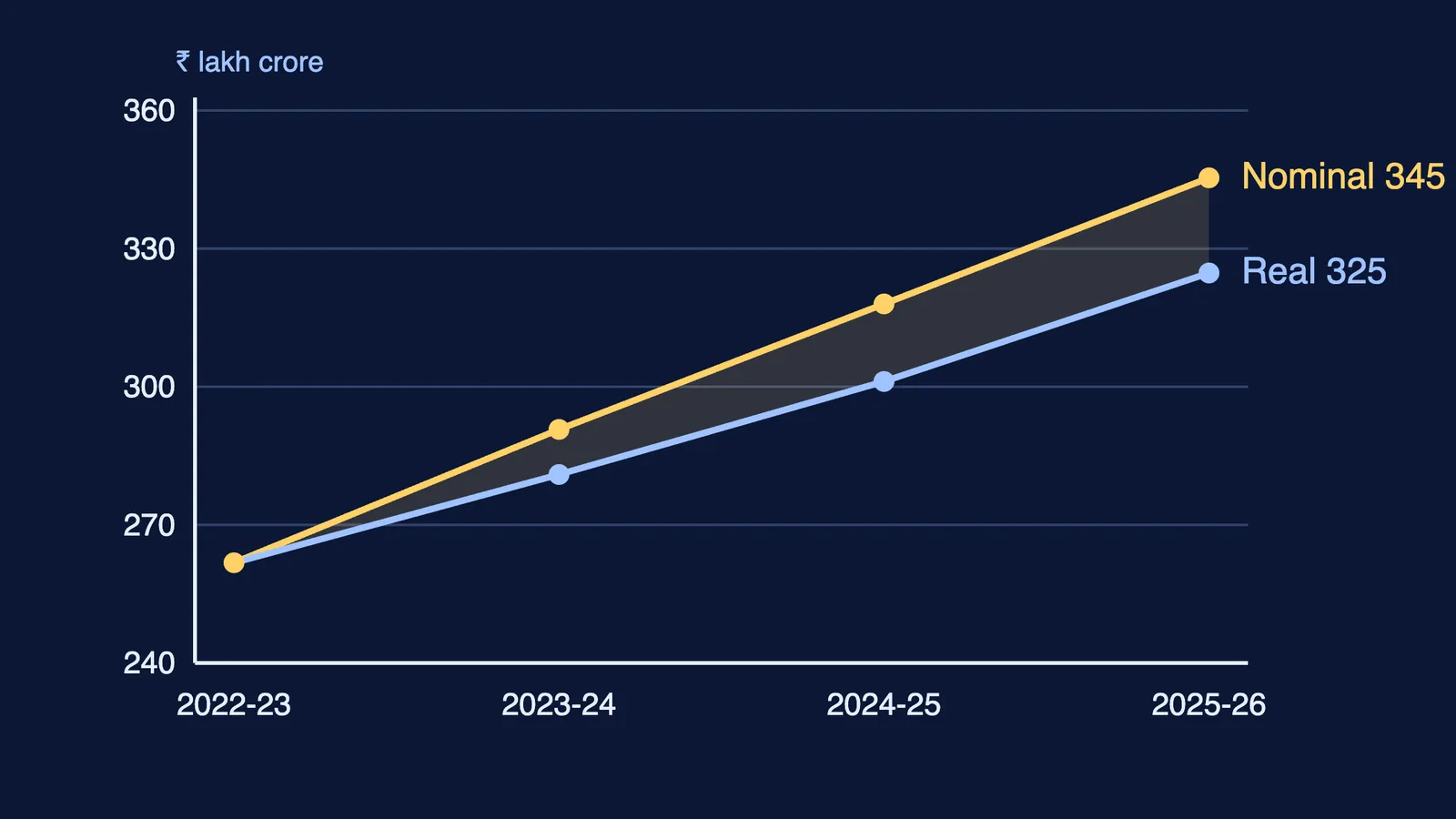
India's real GDP is valued at 2022-23 prices. MoSPI's National Accounts Statistics 2026 release of 31 August 2026 put GDP for 2025-26 at ₹345.37 lakh crore in nominal terms, up 8.6%, and ₹324.70 lakh crore in real terms, up 7.8%. In the chart at the top, the two lines start together in the 2022-23 base year; the shaded gap is price rise.
You can measure that gap yourself: 345.37 ÷ 324.70 ≈ 1.064. Prices across the economy were, on average, about 6% higher in 2025-26 than in 2022-23.
If percentage change still feels slippery, our guide to finding what percent one number is of another walks through the same arithmetic.
What is GDP per person, and how do you work it out?
GDP per person, also called per capita GDP, is GDP divided by the population. MoSPI's June 2026 press note, which came before the August update, used a population of 1,421 million for 2025-26 and gave per capita GDP of ₹2,43,803 at current prices and ₹2,27,447 at 2022-23 prices.
Check it yourself with that note's nominal GDP of ₹346.36 lakh crore:
One lakh crore is 10¹² rupees, so GDP is 346.36 × 10¹² rupees.
1,421 million people is 1,421 × 10⁶ people.
Divide: (346.36 × 10¹²) ÷ (1,421 × 10⁶) ≈ ₹2,43,700 per person.
That is within about ₹100 of MoSPI's figure; the gap comes from rounding the population. Spread over 12 months, ₹2,43,803 is about ₹20,300 a month.
Per person GDP is an average, not anyone's income. A few very high earners pull an average up, which is why the IMF lists distribution among the things GDP does not reveal. To read MoSPI's charts with care, see our post on reading line graphs for trends.
A five-question checklist for any GDP headline
Nominal or real? Look for "current prices" (nominal) or "constant prices" (real).
Which estimate? India's figures are revised as data arrives: MoSPI put nominal growth for 2025-26 at 8.9% in its June 2026 press note and 8.6% in its August 2026 update.
Total or per person? A large country can have a large GDP and a modest figure per person.
Level or growth? "₹345 lakh crore" is a level; "7.8%" is growth.
What is missing? Unpaid work at home and well-being are not in the number.
If large-number arithmetic or percentage change trips you up, the Fermi Problem Library has a step-by-step solver that explains the reasoning rather than printing an answer.
If numbers like these interest you as a career, see our comparison of BSc statistics and BSc maths.