

On this page
You see “What percent of 80 is 12?” in a quiz, and the answer is 15%. That takes ten seconds. The harder version turns up in exam word problems, where nobody tells you which number is the whole. This guide gives you the rule, five worked examples and a short check to run before you commit to an answer.
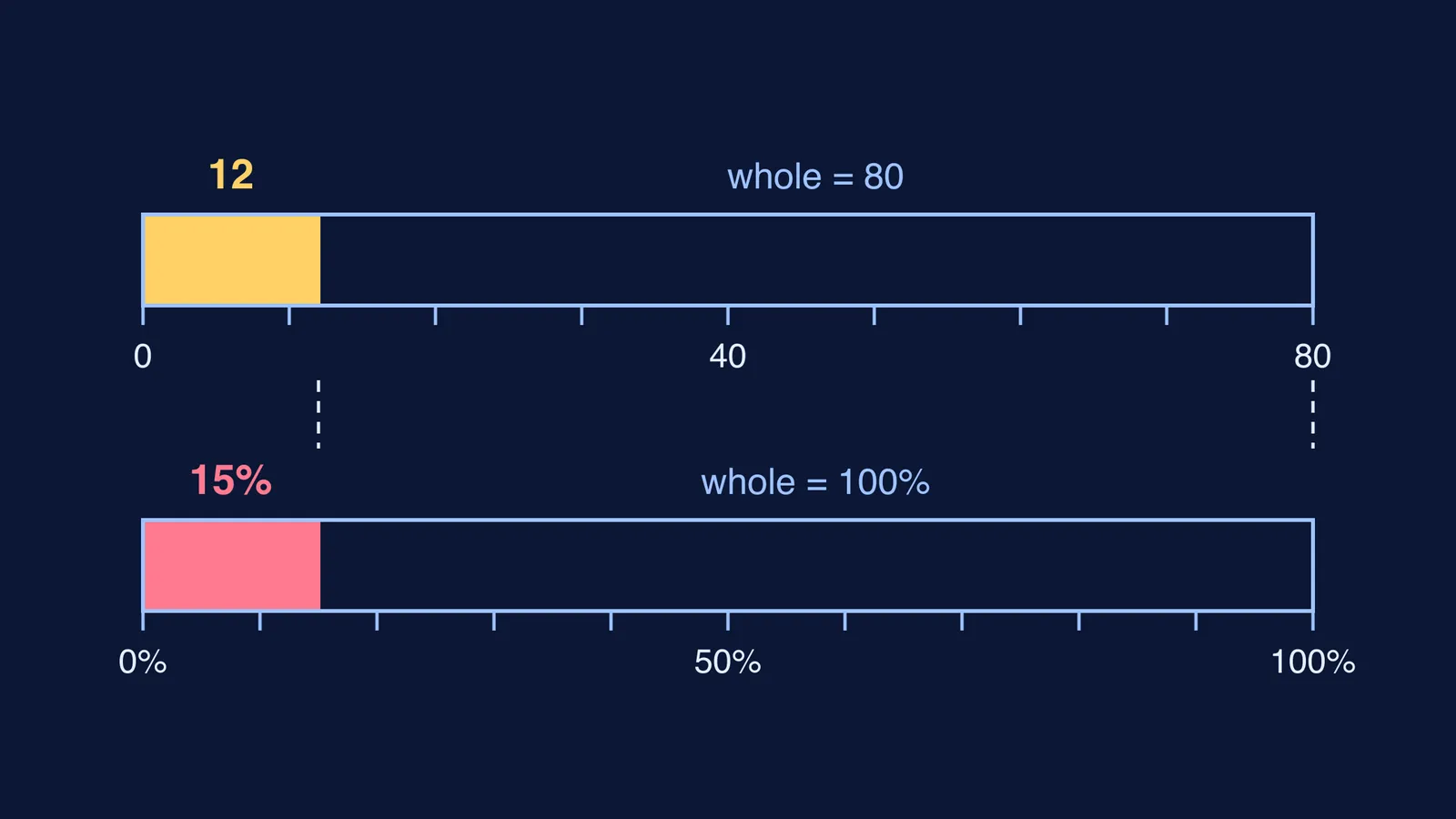
What percent of 80 is 12?
Divide the part by the whole, then multiply by 100: 12 ÷ 80 = 0.15, and 0.15 × 100 = 15. So 12 is 15% of 80.
You can also see it without a calculator. 12/80 simplifies to 3/20, and multiplying top and bottom by 5 gives 15/100, which is 15 per hundred.
What is the formula for what percent one number is of another?
A percentage is a number or ratio expressed as a fraction of 100, and the word comes from the Latin per centum, “by a hundred” (Wikipedia: Percentage). That gives the rule.
The same article works an example of 50 apples out of 1,250: 50 ÷ 1,250 = 0.04, which is 4%. The arithmetic never changes. Only the choice of the whole does.
How do you find the whole when the question hides it?
This is where many mistakes happen. Word problems give you two numbers, and often neither one is the whole. Use these clues:
“of” usually points to the whole: “what percent of 80”.
“than” in a comparison points to the whole: “more than Riya's score” makes Riya's score the base.
“original”, “cost price”, “marked price” and “before” point to the whole in profit, loss and discount questions.
In a mixture or a class, the whole is the total, which you may have to add up yourself.
Here are five worked examples.
Absent students. 12 students are absent and 68 are present. What percent are absent? The whole is the class, 12 + 68 = 80, not 68. Answer: 12 ÷ 80 × 100 = 15%.
A discount. A school bag's price drops from ₹800 to ₹680. What percent is the discount? The part is the drop, ₹120. The whole is the original price, ₹800. Answer: 120 ÷ 800 × 100 = 15%.
Salt solution. 12 g of salt is dissolved in 68 g of water. What is the mass percent of salt? The whole is the solution, 12 + 68 = 80 g, not the water. Answer: 15%. This is the classic trap in chemistry concentration questions.
More than. Riya scores 60 and Arjun scores 75. By what percent is Arjun's score more than Riya's? The difference is 15, and “than Riya's” makes 60 the whole. Answer: 15 ÷ 60 × 100 = 25%.
Less than. Same scores: by what percent is Riya's score less than Arjun's? Now the whole is 75. Answer: 15 ÷ 75 × 100 = 20%.
Examples 4 and 5 use the same two numbers and give different answers. That is not a trick. The whole changed.
Why is percent so easy to get wrong?
Melanie Parker and Gaea Leinhardt open the abstract of their 1995 review in the Review of Educational Research with this exact question: “Why is percent, a ubiquitous mathematical concept, so hard to learn?” (Parker and Leinhardt, 1995). Part of their answer is language. They describe percent as “an extremely concise language that has lost its explicit referents, has misleading additive terminology for multiplicative meanings, and has multiple uses for the preposition of.”
In plain terms, “25% more” sounds like adding, but it means multiplying by 1.25. And “15% of” assumes you know what the “of” refers to. When the sentence drops that referent, you have to put it back yourself. That is why it helps to name the whole before you calculate.
How do you check a percentage answer?
Run this 30-second check before you write the final answer:
Name the whole and the reason, such as “original price” or “total solution”.
Name the part. Is it a piece of the whole, or a change in it?
Divide the part by the whole and multiply by 100.
Sense check: a piece of a whole cannot be more than 100%. If “percent absent” comes out above 100, you have the numbers the wrong way round.
Reverse it: 15% of 80 should give back 12.
If you keep picking the wrong base in profit-and-loss or concentration questions, work a few in the Fermi Problem Library. Its step-by-step solver explains the reasoning rather than printing an answer, so you can see the step where the whole was chosen. For the idea underneath, ratio and proportion, the Fermi Concept Library gives each concept in mathematics its own lesson.
Next time you meet a percentage question, write down the whole first. The division is the easy part.


