On this page
Suppose the samosa at your school canteen cost ₹15 last year and ₹18 this year. When that kind of rise happens across almost everything a family buys, it is called inflation. Here is what it means, how to measure it with five items, and what 6 percent a year does in ten years.
What is inflation in simple words?
Inflation is the rise in the general level of prices over time, which means each rupee buys a little less than it did before. One item getting dearer, say onions after a bad harvest, is a price change. Inflation is when the whole basket of things households buy costs more.
India's official measure is the Consumer Price Index (CPI). In February 2026 the National Statistics Office under the Ministry of Statistics and Programme Implementation released a new CPI series with 2024 as its base year, covering 358 items, with prices collected from 1,465 rural markets, 1,395 urban markets and 12 online marketplaces, as PTI reported on the launch. In that basket, food and beverages carry a weight of 36.75 percent, down from 45.86 percent in the old 2012 series, according to the same report. Weight is the share of household spending, so heavy items move the index more.
The Reserve Bank of India's job is to keep CPI inflation near a target set by the central government. The target is 4 percent with a tolerance band of 2 percent either side, renewed by a government notification in March 2026 for five years through March 2031, as RBI Deputy Governor Poonam Gupta set out in a May 2026 speech.
How is a price index calculated?
The official CPI works on the same idea as the small version below, only with 358 items instead of five. Fix a basket for one month, price it in a base year, then price the exact same basket a year later. The prices here are made up for the example; swap in your own.
Base year (index = 100), a student's monthly basket:
20 samosas at ₹15 = ₹300
One monthly bus pass at ₹500 = ₹500
4 notebooks at ₹50 = ₹200
One mobile data recharge at ₹300 = ₹300
10 litres of milk at ₹50 = ₹500
Total: ₹1,800.
One year later the samosa costs ₹18 (₹360), the bus pass is unchanged (₹500), notebooks cost ₹55 (₹220), the recharge costs ₹318 and milk costs ₹51 (₹510). Total: ₹1,908.
Index = (new cost ÷ base cost) × 100 = (1,908 ÷ 1,800) × 100 = 106. Inflation for the year is 6 percent.
The samosa jumped 20 percent, yet the basket rose only 6 percent: samosas are a sixth of the spending and the bus pass did not move. That is why your favourite item's price is not the inflation rate.
What does 6 percent inflation do in ten years?
Six percent is the upper end of the RBI's tolerance band, so it makes a useful upper case. Inflation compounds: each year's rise sits on top of last year's higher price, not the original one. It is the same arithmetic as interest on savings, which we work through in compound interest for two and a half years, step by step.
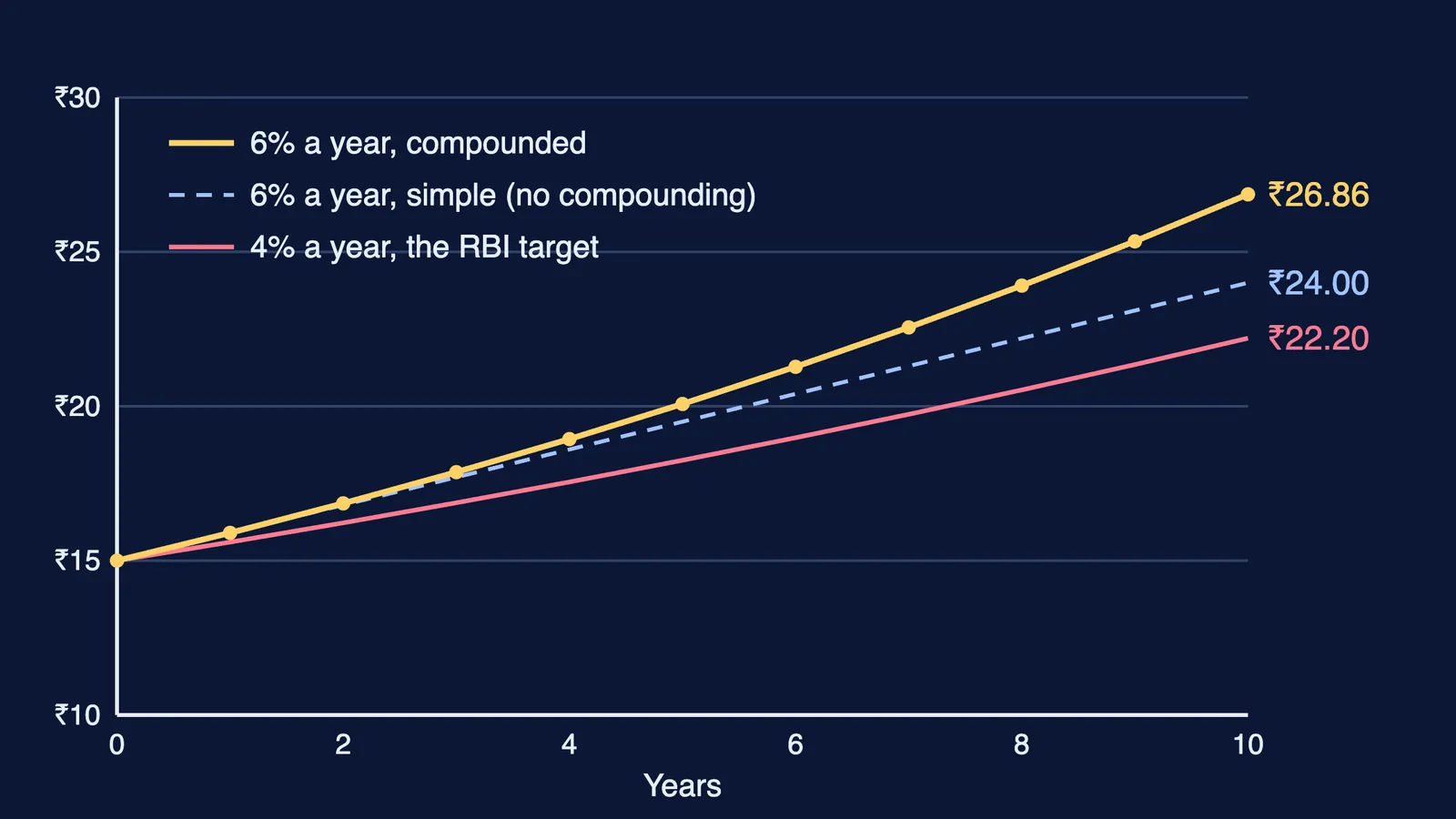
Multiply the ₹15 samosa by 1.06 each year:
Year 0: ₹15.00
Year 1: ₹15.90
Year 2: ₹16.85
Year 5: ₹20.07
Year 10: ₹26.86
After ten years, prices are 1.06 to the power 10, about 1.79 times what they were: a 79 percent rise, not the 60 percent you get by adding 6 ten times. Your ₹1,800 basket would cost about ₹3,224.
At the 4 percent target, the same samosa reaches about ₹22.20, since 1.04 to the power 10 is about 1.48. Two percentage points a year sounds small; over a decade it is a ₹4.66 gap on a single samosa.
For a mental check, use the rule of 72: 72 ÷ rate ≈ years for prices to double. At 6 percent that is 12 years, and 1.06 to the power 12 is about 2.01. For the straight-line version, see in how many years money doubles at simple interest.
Why should a school student care about inflation?
Pocket money: if your allowance stays the same for three years while prices rise 6 percent a year, the top of the RBI's band, it buys about 16 percent less. That is a fair point to bring, with your working, to a family talk about how much pocket money a teenager should get.
Savings: money earning less than inflation loses buying power.
School maths: percentage change, compounding and index numbers all show up in exams.
If percentages or compounding feel shaky, the Fermi Concept Library has a lesson for each concept in mathematics. To check your working on a problem, the Fermi Problem Library has a step-by-step solver that explains the reasoning rather than printing an answer.
Your next step: price your five-item basket this weekend, save the list, and run it again next year.