On this page
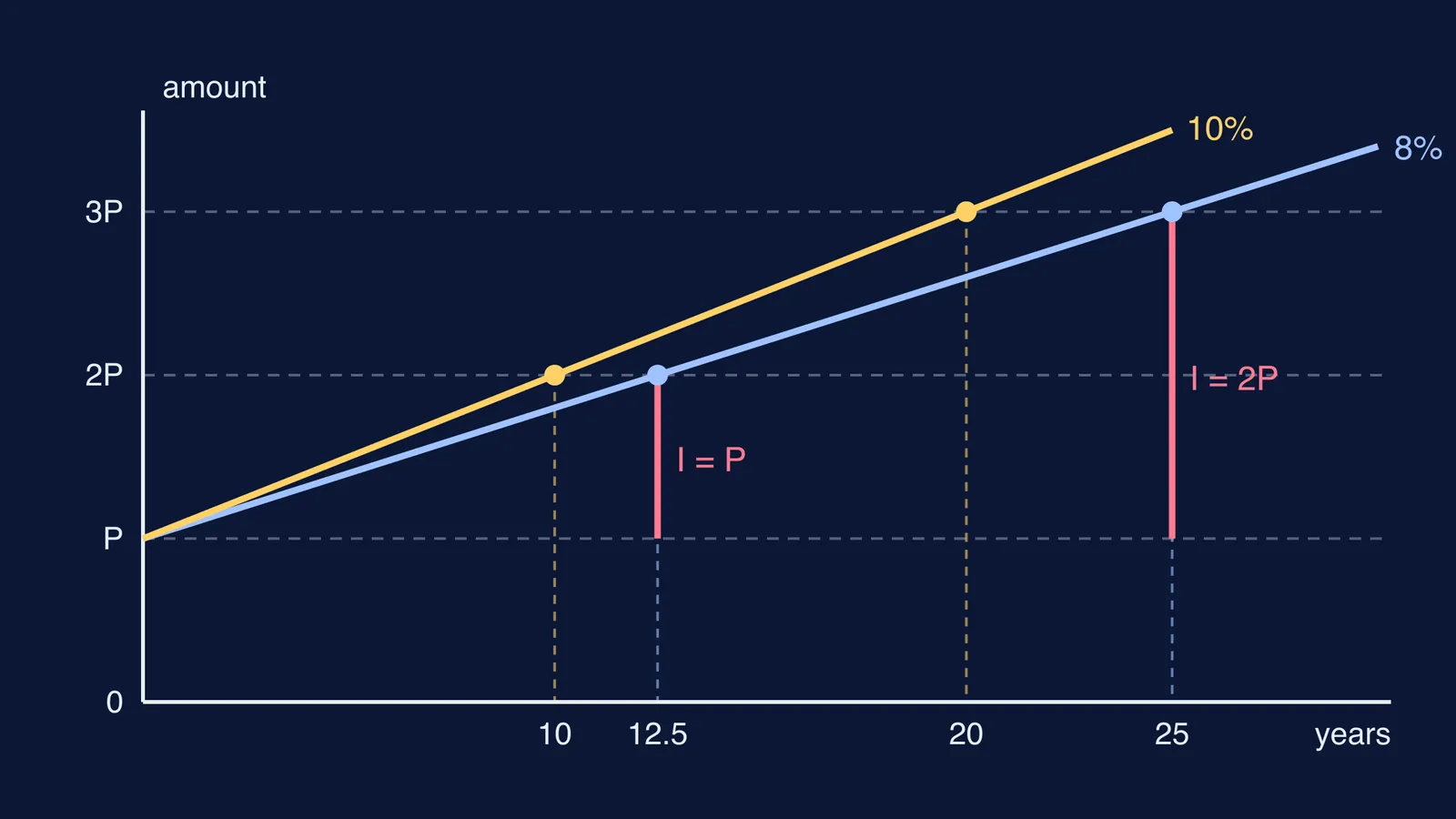
Money at simple interest doubles in 100 ÷ R years, where R is the yearly rate in percent. It follows from the simple interest formula I = Prt in OpenStax Prealgebra: at 8% a year that is 12.5 years; at 10% it is 10 years. Once you see the one line of algebra, you can do tripling and "four times" questions in your head.
What is the simple interest formula?
Simple interest is interest paid only on the original principal, never on interest already earned. OpenStax Prealgebra states it as I = Prt: if a principal P is invested for t years at an annual rate r, the interest earned is I = Prt. School textbooks often write the same thing with the rate as a percentage: SI = P × R × T / 100.
The amount at the end is principal plus interest. The OpenStax-based Contemporary Mathematics text writes the future value as FV = P + I = P + P × r × t.
In how many years does money double at simple interest?
"Doubles" means the amount A becomes 2P. Since A = P + SI, the interest must have grown to equal the principal: SI = P. If the two words blur for you, see the difference between amount and interest.
Put that into the OpenStax formula I = Prt, with the rate as R%:
P × R × T / 100 = P
Divide both sides by P: R × T / 100 = 1
So T = 100 / R
Notice that P cancels. Whether you lend ₹500 or ₹5 lakh, the doubling time depends only on the rate.
A few values to sanity-check your answers:
4% a year: 25 years
5% a year: 20 years
8% a year: 12.5 years (12 years 6 months)
10% a year: 10 years
12.5% a year: 8 years
20% a year: 5 years
It runs backwards too: R = 100 / T. If a sum doubles in 8 years, the rate is 12.5% a year.
How long does it take money to triple at simple interest?
Tripling means A = 3P, so the interest must be 2P. The same steps with I = Prt give T = 200 / R. At 10% a year, money triples in 20 years.
The general rule: if a sum becomes n times itself, the interest is (n − 1)P, so T = 100(n − 1) / R.
Because simple interest grows in a straight line, every extra P takes the same time. If money doubles in 10 years, it triples in 20, not 15 or 30. On a graph of amount against time, each line climbs by one P in equal steps of time.
In how many years will a sum become four times itself?
This is the classic exam version, and it rests on the same I = Prt straight line. "A sum doubles in 6 years at simple interest. In how many years will it become four times itself?"
Doubling in 6 years means the interest adds one P every 6 years.
Four times means the interest must be 3P.
So the time is 3 × 6 = 18 years.
Check with the rate: R = 100 / 6 = 16⅔% a year, and T = 300 ÷ 16⅔ = 18 years.
The trap is writing 4 × 6 = 24. That counts the principal as if it were interest. Always subtract 1 first.
If this n versus n − 1 step keeps catching you, try a few more in the Fermi Problem Library, where a step-by-step solver explains the reasoning rather than printing an answer.
Why does compound interest double money faster?
Under compound interest, interest also earns interest, so the curve bends upward instead of running straight. With yearly compounding the amount is A = P(1 + r)^t, the n = 1 case of the compound interest formula from OpenStax Precalculus. At 8% compounded yearly, 1.08 multiplied by itself 9 times is about 1.999, so money roughly doubles in 9 years instead of 12.5.
The tripling shortcut also changes. With compounding, tripling takes about 1.58 times as long as doubling (log 3 ÷ log 2), not twice as long. For more on this side, see how to derive the compound interest formula from year-by-year steps.
A 30-second check before you mark your answer
Did you use (n − 1)P as the interest, not nP?
Does rate × doubling time come to 100? If not, recheck.
Is the rate per year? If it is per half-year or per month, convert first.
Is the answer in years, and have you turned decimals into months where asked (12.5 years is 12 years 6 months)?
Does the question say simple interest, not compound?
If the idea of percentages and interest itself feels shaky, the Fermi Concept Library has a lesson for each concept in mathematics, so you can rebuild from the start before returning to exam questions.