

On this page
Most compound interest questions give whole years. Then one says 2½ years, or 2 years 4 months, and the formula A = P(1 + R/100)^n suddenly needs an n that is not a whole number. NCERT-based school maths in India expects one method, and it takes two lines once you see why it works.
How do you calculate compound interest for 2 and a half years?
NCERT's Class 8 chapter Comparing Quantities defines compound interest as interest calculated on the previous year's amount, and builds the formula A = P(1 + R/100)^n one year at a time (NCERT Class 8 Mathematics, Comparing Quantities). That formula counts whole compounding periods. For the leftover part of a year, the interest has not yet been added to the principal, so it is simple interest on the amount reached at the end of the last full year.
An exercise from earlier editions of the same NCERT chapter makes the rule explicit: Kamala borrows ₹26,400 at 15% p.a. compounded yearly for 2 years and 4 months, and the hint says to find A for 2 years, then find simple interest on that amount for 4/12 years (the question, hint and solution on Careers360). The answer works out to ₹36,659.70.
So, for n whole years plus a fraction f of a year:
Compound for the whole years: amount after n years = P(1 + R/100)^n.
Find simple interest on that amount for the fraction: SI = amount × R × f / 100.
Add them to get the final amount. Compound interest = final amount − P.
In one line: A = P(1 + R/100)^n × (1 + fR/100). For half a year, f = ½.
If you want the reasoning behind the formula itself, our post on deriving the compound interest formula from year-by-year steps builds it from scratch.
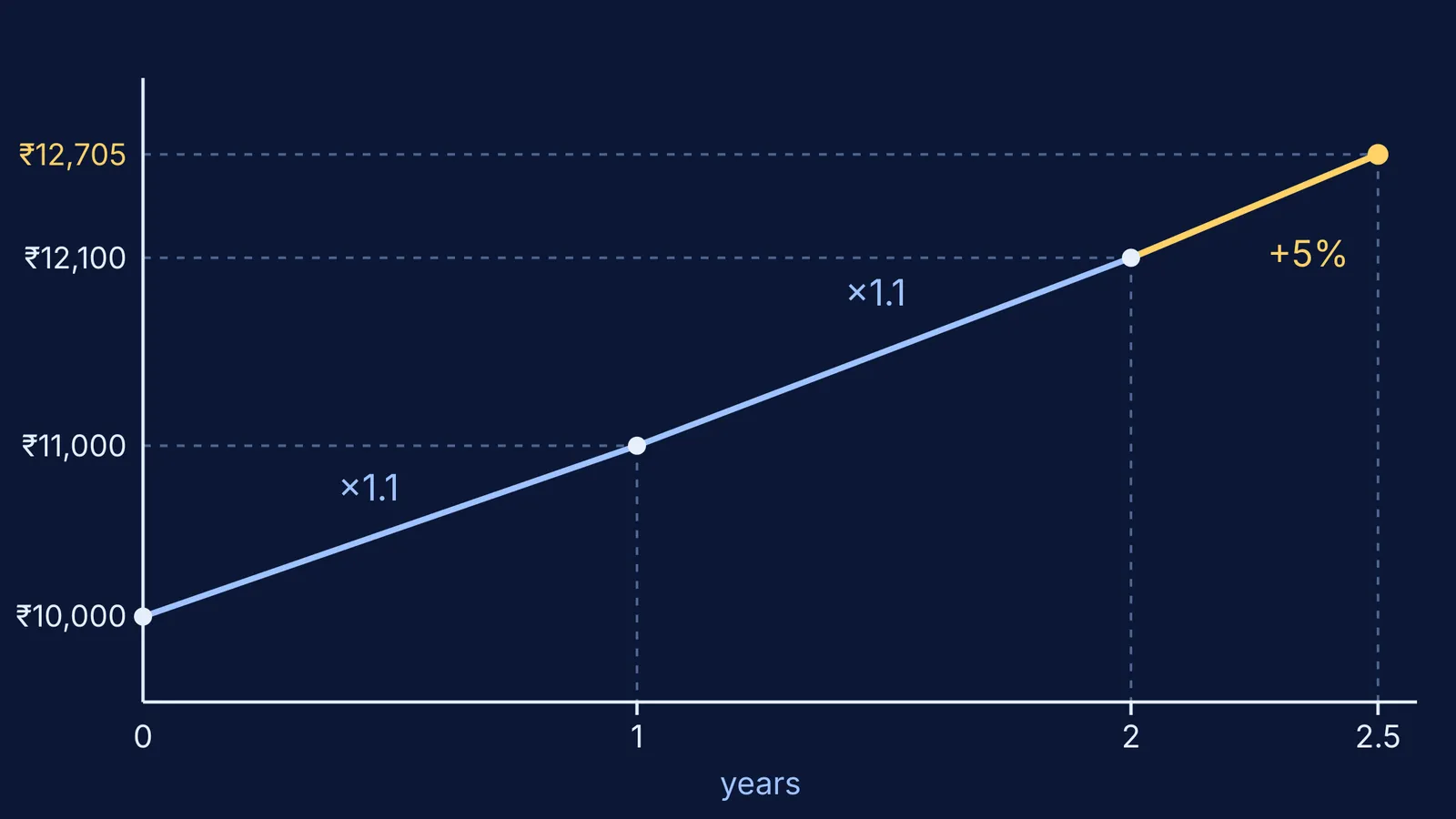
Worked example: ₹10,000 at 10% for 2½ years
Say you invest ₹10,000 at 10% per annum, compounded annually, for 2½ years.
After year 1: 10,000 × 1.1 = ₹11,000.
After year 2: 11,000 × 1.1 = ₹12,100.
Last half-year, simple interest on ₹12,100: 12,100 × 10 × ½ / 100 = ₹605.
Amount = 12,100 + 605 = ₹12,705.
Compound interest = 12,705 − 10,000 = ₹2,705.
Check with the one-line form: 10,000 × 1.21 × 1.05 = 12,705. Same answer.
Read whether the question asks for the amount or the interest. Writing ₹12,705 when the question wanted ₹2,705 is an easy way to lose a mark; our explainer on the difference between amount and interest covers it.
Why not just put 2.5 in the power?
You can work out 10,000 × 1.1^2.5, and you get about ₹12,690.59. That treats the growth as smooth through the final half-year at the same yearly factor. It is not what the textbook method asks for, so it will not match an answer key built on that method.
The difference is small but real. A lesson on fractional periods from All-in-One Homeschool notes that some financial institutions use simple interest for the fractional period, and that for a partial period simple interest is slightly higher than compound interest. Our example shows it: ₹12,705 against ₹12,690.59, a gap of about ₹14.
What are the common mistakes?
Simple interest on the original principal: 10,000 × 10 × ½ / 100 = ₹500, giving ₹12,600. Wrong base.
Rounding 2½ up to 3 years: 10,000 × 1.1³ = ₹13,310. That charges for half a year that has not passed.
Confusing this with half-yearly compounding. If the question says "compounded half-yearly", the rate per period is 5% and there are 5 periods: 10,000 × 1.05^5 ≈ ₹12,762.82. Read the compounding frequency before you start.
Getting the fraction wrong for months: 4 months is 4/12 = ⅓ year, 9 months is 9/12 = ¾. Write the fraction down before multiplying.
How should you set it out in an exam?
First underline the compounding frequency, the number of whole periods and the leftover fraction. Then:
Write P(1 + R/100)^n for the whole periods.
Multiply by (1 + fR/100) for the leftover.
Subtract P only if the question asks for the interest.
If you keep reaching a different answer and cannot see where it slips, the Fermi Problem Library has worked problems with a step-by-step solver that explains the reasoning rather than printing an answer, so you can find the step that went off. For the idea underneath, the Fermi Concept Library gives each concept in mathematics its own lesson.
Parents: if your child keeps losing marks on steps like this, our guide to responding to silly mistakes in maths exams is a calmer place to start than more drills.


