On this page
You ask a chatbot which Article covers the right to education. It says Article 45, a Fundamental Right. That is two mistakes in one line: Article 45 is a Directive Principle, and the Fundamental Right is Article 21A. Here is how to check any Article an AI gives you, using two free sources: the official text and your NCERT book.
Why does AI get Article numbers wrong?
A chatbot writes the most likely-sounding text; it doesn't look up the Constitution unless it is connected to a source and uses it. Close numbers (21 and 21A) and topics found in both Parts (education, work) are easy to swap.
Researchers have measured this kind of error in law. In a 2024 study in the Journal of Legal Analysis, Matthew Dahl, Varun Magesh, Mirac Suzgun and Daniel E. Ho found that public chatbots, including ChatGPT 4, hallucinated at least 58% of the time on questions about US federal court cases (Dahl et al., 2024). The models also often went along with a user's incorrect legal assumption, so a question that already contains the mistake ("Which Fundamental Right is Article 45?") may get a confident wrong answer. The study tested US law, not the Indian Constitution, and models have changed since, but the lesson holds: a confident legal answer is not a checked one.
Which Articles are Fundamental Rights and which are Directive Principles?
The Legislative Department of the Ministry of Law and Justice publishes the official text (The Constitution of India, 2024 edition). Its contents pages give the ranges:
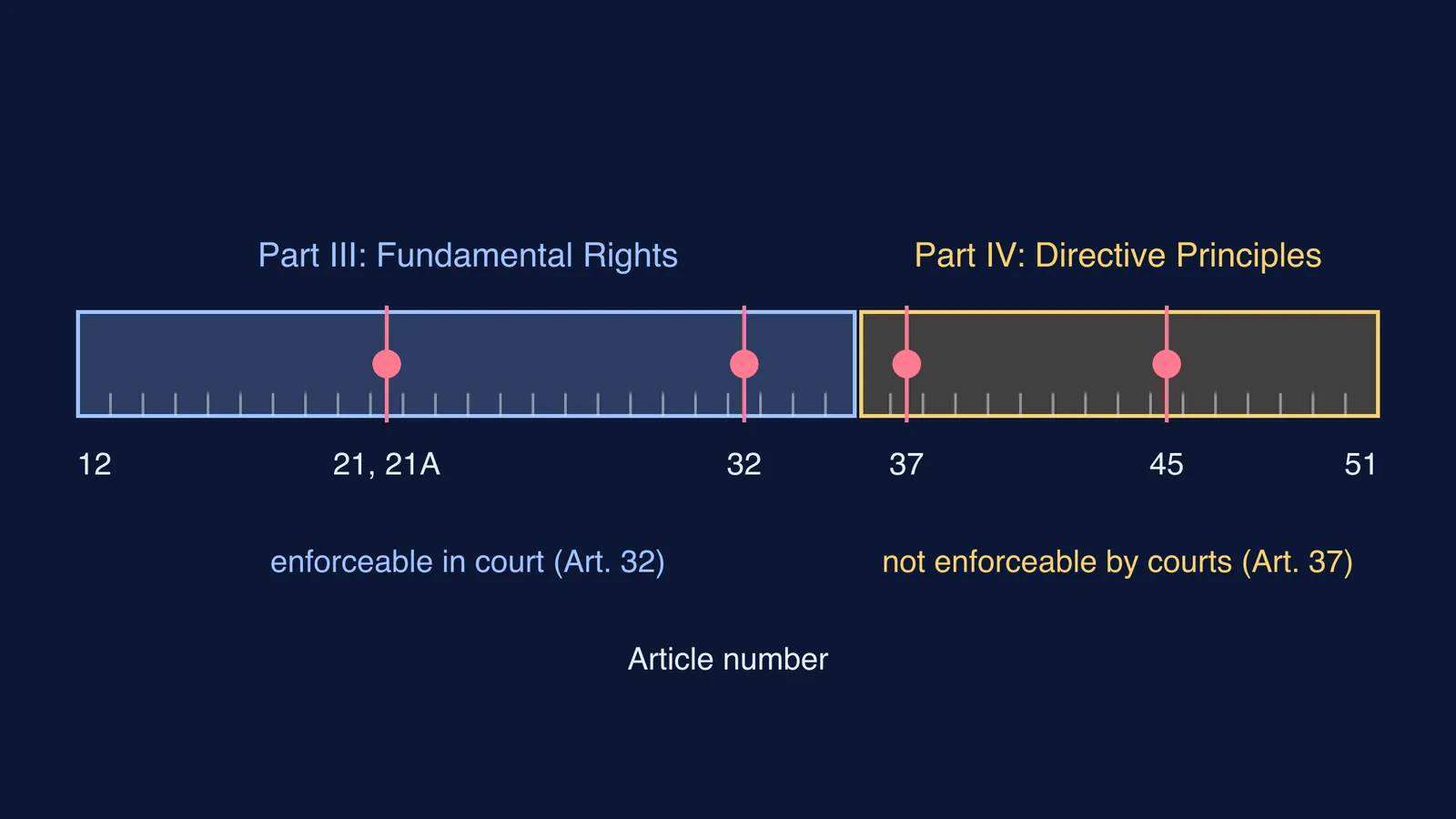
Part III, Fundamental Rights: Articles 12 to 35.
Part IV, Directive Principles of State Policy: Articles 36 to 51.
Part IVA, Fundamental Duties: Article 51A.
Article 37 draws the line between them. It says the Directive Principles "shall not be enforceable by any court", yet they are "fundamental in the governance of the country". Article 32, in Part III, guarantees the right to go to the Supreme Court to enforce Fundamental Rights.
NCERT's Class 11 book Indian Constitution at Work calls the Directive Principles "non-justiciable": you can't ask a court to make a government follow one (NCERT, Chapter 2: Rights in the Indian Constitution).
How do you check an AI's Article number?
Run these five checks in order:
Range test: is the number in 12 to 35 or 36 to 51, and does that match what the AI called it?
Heading test: search the official PDF for the number with a full stop ("45.") and read its bold heading.
Footnote test: lettered Articles such as 21A, 39A and 51A were added by amendments; the footnote names which one.
Book test: find the same right in the NCERT chapter's charts. Part III lists the right to education under Right to Freedom; the Directive Principles chart lists equal pay for equal work and a uniform civil code.
Quote test: ask the AI to quote the Article word for word and name its Part. If the quote doesn't match the PDF, throw the answer out.
A worked example: the right to education
Say an AI writes: "Right to education is a Directive Principle under Article 45, so it cannot be enforced." Here is what the official text shows:
Range test: 45 is in Part IV, so the label fits. But is it the right to education for school-age children?
Heading test: Article 45 is "Provision for early childhood care and education to children below the age of six years".
Article 21A, in Part III, says: "The State shall provide free and compulsory education to all children of the age of six to fourteen years".
Footnote test: the footnotes say Article 21A and the current Article 45 both come from the Constitution (Eighty-sixth Amendment) Act, 2002, in force from 1 April 2010.
Corrected: free and compulsory education for ages 6 to 14 is a Fundamental Right (Article 21A); early childhood care and education below six is a Directive Principle (Article 45).
Two more traps. Equal pay for equal work is Article 39(d), in Part IV, not a Fundamental Right. And NCERT's chapter notes that the 44th Amendment in 1978 removed the right to property from the Fundamental Rights and made it a legal right under Article 300A.
What should you type when you catch the mistake?
Try: "You said Article 45 is a Fundamental Right. The official text puts Article 45 in Part IV. Quote Articles 21A and 45 word for word and tell me which Part each is in." Then check the new quotes against the PDF too; a corrected answer is still unchecked. For why a sure tone tells you little, read what an AI's confidence statement really means. Parents can find a calm script in what to tell your child when an AI tutor is wrong.
For STEM subjects, Fermi's AI tutor teaches rather than just answering: it holds a line of reasoning across a session and checks understanding as it goes.
Tonight, open the official PDF beside your NCERT chapter and check the next three Articles an AI gives you.