On this page
You asked a chatbot about the Harappan civilisation and got a neat paragraph full of years and names. One of those years may be wrong, and nothing in the tone will tell you which one. Here is why it happens and how to check each fact against your NCERT textbook.
Why does AI get history dates wrong?
A chatbot often does not look dates up in a book. It writes the most likely-sounding text. In the paper Why Language Models Hallucinate, Adam Tauman Kalai and colleagues argue that models guess because training and evaluation reward guessing over admitting uncertainty.
The same paper explains which facts suffer most. Models seldom err on facts that are mentioned again and again, such as Einstein's birthday. Facts that appear only once in the training data are another matter: the authors write that "if 20% of birthday facts appear exactly once in the pretraining data, then one expects base models to hallucinate on at least 20% of birthday facts" (Kalai et al.).
Many history details are rarely repeated. A NeurIPS 2024 benchmark called HiST-LLM, built from the Seshat Global History Databank, tested seven models on four-choice history questions. Their balanced accuracy ranged from 33.6% to 46%, against 25% for random guessing.
What kinds of history errors does AI make?
Look for five patterns:
Near-miss dates. Two real years from the same story get swapped, such as the year someone took office and the year they published.
Swapped names. Credit for one person's work goes to a better-known colleague.
Broken sequence. Every event is real, but "later" or "after" puts them in the wrong order.
Off-textbook facts. The claim comes from another book or an older account and differs from your current NCERT edition.
Invented precision. An exact year, figure or quote appears where your textbook gives only a decade, or nothing at all.
How do you check an AI history answer against NCERT?
Split the answer into single claims, one date, name or event per line.
Open the chapter from NCERT's textbook site and search the PDF for each name.
Mark each line: matches, differs (write NCERT's version and the page), or not in NCERT.
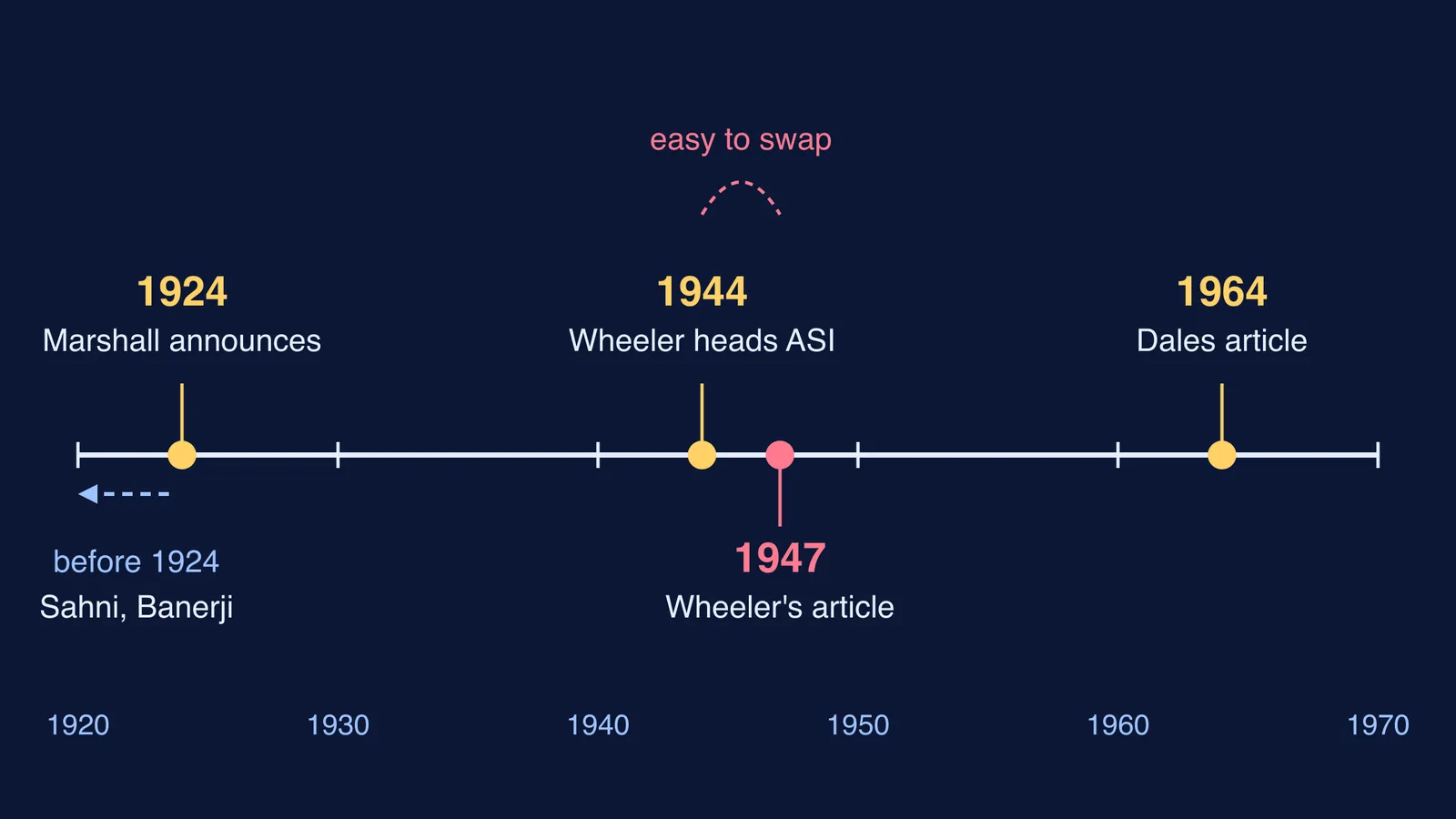
Put the dated events on a short timeline in textbook order, then read the AI's "before" and "after" against it.
Rewrite the answer in your own words using only the matched and corrected lines.
A worked example: who discovered the Harappan civilisation?
Here is a sample answer we wrote to show the error types: "John Marshall discovered Harappa in 1924. Later, Rakhal Das Banerji excavated Mohenjodaro, the largest Harappan city. Mortimer Wheeler became head of the ASI in 1947."
Now check it against Theme One, Bricks, Beads and Bones, in Class 12 Themes in Indian History Part I (reprint 2026-27):
"Marshall discovered Harappa" is a swapped name. Page 20 says seals were discovered at Harappa by archaeologists such as Daya Ram Sahni; Marshall, as Director-General of the ASI, announced the discovery of a new civilisation in 1924.
"Later, Banerji" is a broken sequence. Page 20 says Marshall's 1924 announcement was based on these finds, including Banerji's seals from Mohenjodaro, so they came first.
"The largest Harappan city" is off-textbook. Page 18 calls Rakhigarhi, in Hisar district of Haryana, the biggest Harappan city, spread over 550 hectares.
"Wheeler in 1947" is a near-miss date. Page 21 says he took over as Director-General in 1944; 1947 is the year of his article "Harappa 1946" in Ancient India, quoted on page 18.
Watch for invented precision. If the AI adds an exact year for Sahni's finds, note that this chapter says only "the early decades of the twentieth century".
The corrected version: Daya Ram Sahni found seals at Harappa and Rakhal Das Banerji found similar ones at Mohenjodaro. Based on these finds, John Marshall announced a new civilisation in 1924. R.E.M. Wheeler took over the ASI in 1944.
What should you write when NCERT and the AI disagree?
For a school exam set from NCERT, write the NCERT version. If the AI gives a detail the chapter does not mention, leave it out or ask your teacher where it comes from. Do not treat "Are you sure?" as a check: whether the chatbot keeps or changes its answer does not tell you which version is right; we explain why in what an AI's confidence actually tells you.
Our guide on helping your child learn history dates without rote memory shows how to hang dates on a story, and the same NCERT pages feed straight into answering source-based questions in history exams.
Fermi is a STEM learning platform, so history is not its subject, but the habit carries over to your science subjects. In physics, chemistry, biology and maths, Fermi's AI tutor is built to teach rather than only answer: it works through problems alongside you and checks understanding as it goes.
Next time an AI gives you a date, split it out, find the page, and keep only what the textbook confirms.