

On this page
History is often taught as a sequence of isolated dates, leaving children to rely heavily on rote memorisation. However, memorising a list of numbers does not build a lasting understanding of cause and effect. If your child struggles to remember when the French Revolution began or when India gained independence, the problem is rarely a poor memory. It is how the information is framed.
Why can't my child remember history dates?
Young children do not experience time in the same way adults do. A 2018 study by Tillman and colleagues, published in *Developmental Science*, found that the "mental timeline"—the ability to map temporal events onto a spatial line—is gradually constructed during childhood.
The researchers discovered that while preschoolers understand basic sequences like "before" and "after," their spontaneous use of a left-to-right timeline only becomes automatic and conventional during the early school years.
Because this spatial understanding takes time to mature, handing a younger child a printed list of dates and expecting them to memorise it often leads to frustration. Without a spatial or narrative structure to anchor the numbers, the dates remain abstract and are easily forgotten.
How to help a child learn history dates?
To move away from rote memory, you need to give the dates a physical and emotional context. You can do this by bringing the timeline out of their head and onto the wall, and by wrapping the facts in a story.
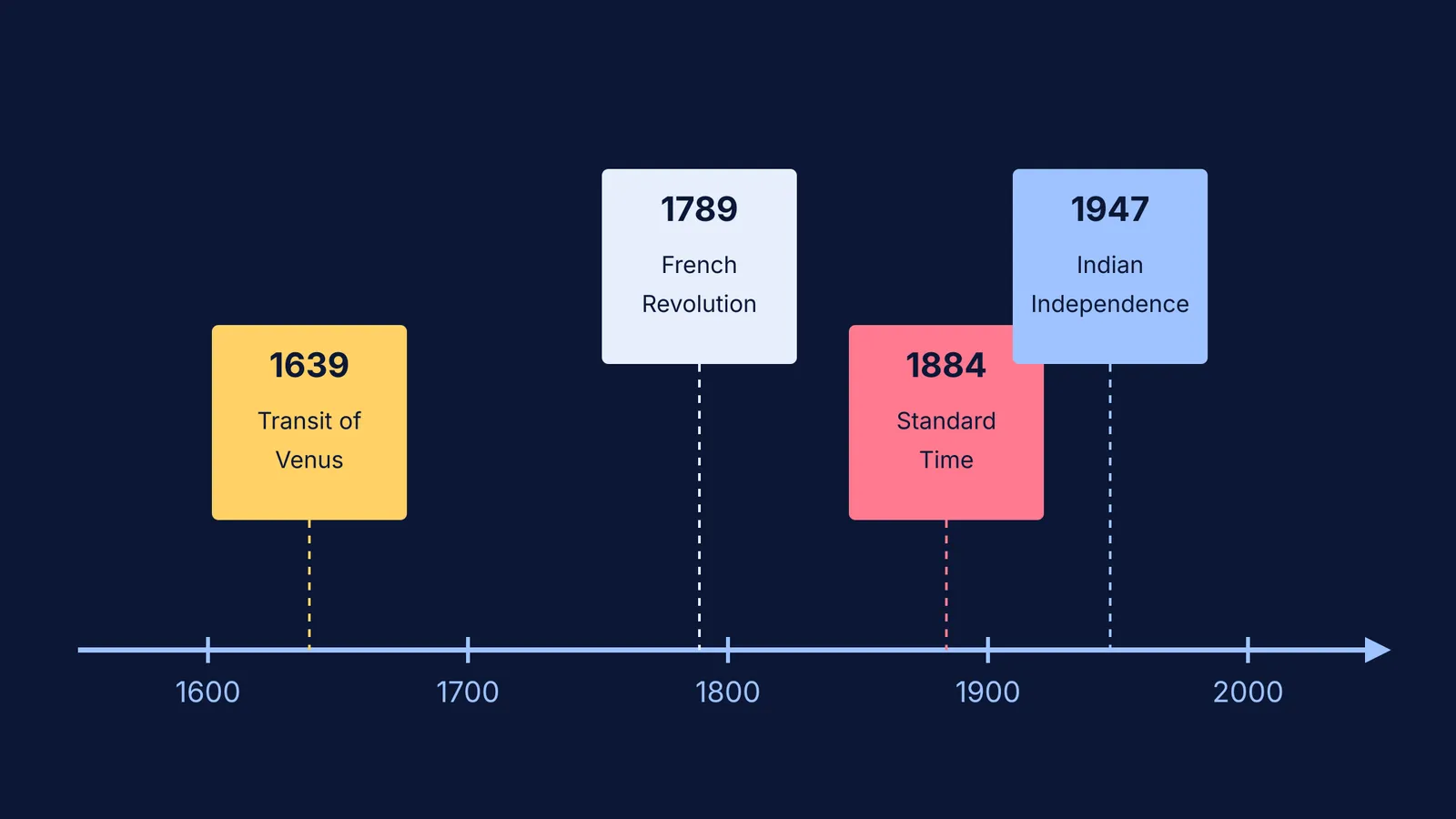
Build a physical timeline: Hang a long strip of paper on a bedroom or study wall. When your child learns a new historical event, have them write the date on a sticky note and place it on the line. This turns abstract time into physical distance. They can visually see that the gap between the building of the pyramids and the Roman Empire is much larger than the gap between the two World Wars.
As they add more sticky notes over the school year, the timeline becomes a visual map of their learning. Encourage them to draw small icons or symbols next to the dates—a tiny telescope or a steam train. This uses dual coding, combining a visual cue with the verbal information, which gives the brain two different ways to retrieve the memory later during an exam.
Tell the story first: Dates stick better when they are attached to a narrative. Rather than starting with the year, start with the people and the conflict. If they are learning about the history of astronomy, read them the story of Jeremiah Horrocks and the first transit of Venus ever observed. Once they understand why Horrocks was rushing to his telescope before the sun set, the year 1639 becomes a meaningful part of the plot rather than just an isolated number.
How do you link new dates to known events?
A date is easiest to remember when it connects to something the child already knows. If your child has a solid grasp of when the telephone was invented, use that as an anchor point for other industrial changes.
When introducing a new event, ask: "Did this happen before or after the railways were built?" This forces them to actively retrieve and compare information, which strengthens the memory trace far more than simply rereading a textbook.
How often should they review the timeline?
Even with a strong narrative, a child's memory of a date will fade if it is never revisited. In the 1880s, the psychologist Hermann Ebbinghaus described the forgetting curve, noting that humans lose roughly half of newly learned knowledge within a matter of days if they make no attempt to retain it.
To flatten this curve, use spaced repetition. Have your child review their physical wall timeline one day after adding a new date, then three days later, and then a week later. Instead of asking them to recite the dates, ask them to explain the sequence of events. For example, "Why did the invention of the steam engine have to happen before standard time zones were introduced?" This active recall strengthens the connections between the events and ensures they are remembering the history, not just the numbers.
How does active learning apply to every subject?
The principle of linking new facts to existing knowledge applies far beyond history. When a child learns actively, they build a map of understanding rather than a fragile list of facts.
When your child sits down to study, they shouldn't face a blank page or a daunting list of dates. For science subjects, Fermi's AI tutor works out what a student already knows, builds a plan for the session, and teaches through it, checking understanding as it goes. Whether they are balancing a chemical equation or mapping out a historical timeline, students learn best when they can connect the next step to the ground they already stand on.


