

On this page
In the Central Board of Secondary Education (CBSE) Class 12 history exam, source-based questions make up 12 marks of the 80-mark theory paper. Examiners provide three text extracts from the shaded boxes in your NCERT textbook. Students often treat these passages like a standard reading comprehension test, copying sentences directly into the answer sheet.
But historical texts are not just containers of facts. They are arguments made by people with specific motives in a specific time and place. To score full marks, especially on the analytical sub-questions, you must read the text the way a historian does.
What is the CBSE Class 12 history marking scheme?
Every 4-mark source question in the CBSE marking scheme follows a strict pattern. The first two sub-questions, worth 1 mark each, are usually direct. You earn the mark by finding a specific fact or identifying a person mentioned in the text. The marking scheme awards full credit for a single correct point or a concise sentence.
The final sub-question carries 2 marks and is where students drop points. It requires you to step outside the text. You have to use your own knowledge of the chapter to explain the significance of the source. For example, if the extract is from a colonial official's diary, you might need to explain how it reflects the British justification for rule. You earn the 2 marks by providing two distinct points or one well-developed explanation.
Why is reading top-to-bottom a mistake?
Most students read a historical document the same way they read a textbook: starting at the first word and reading straight through. A landmark 1991 study by researcher Sam Wineburg at the University of Washington revealed that professional historians do the exact opposite.
Wineburg gave primary sources about the American Revolution to high school students and to working historians. He found that students read the text to find the "right answer," accepting the narrative at face value. In contrast, historians immediately looked for the document's attribution. They checked who wrote it, when it was written, and why, before they even read the first sentence.
This habit is called the "sourcing heuristic." By knowing the author's background, historians can spot bias and understand what the text is actually trying to achieve. When you sit down to read a science textbook actively or a history text, checking the source first stops you from falling for an illusion of fluency where the text makes sense but you miss the hidden agenda.
How should you structure your 4-mark answer?
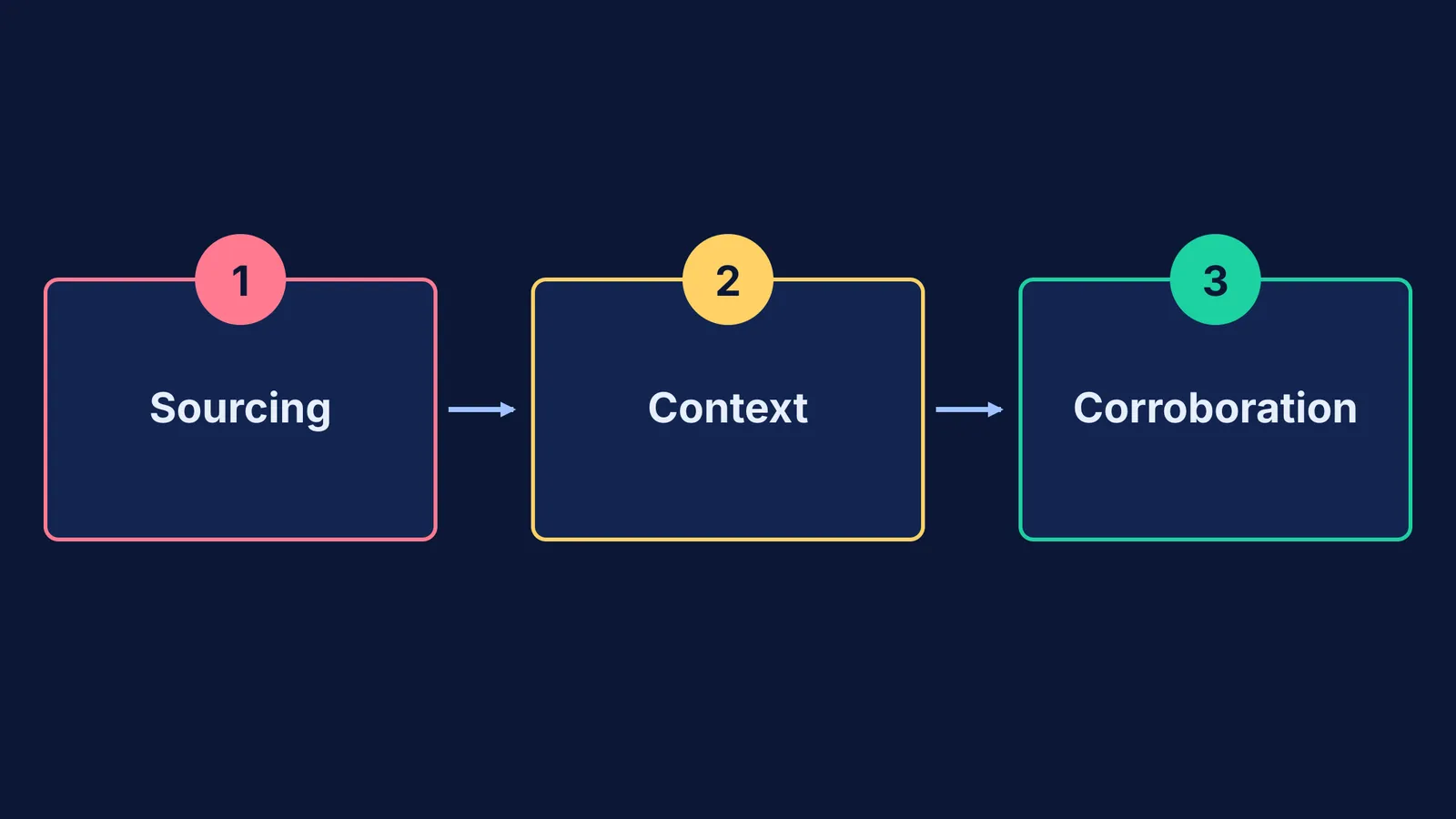
You can use Wineburg's heuristics to structure your 2-mark answers in the CBSE exam. When you read the source, run it through these three checks:
Sourcing: Look at the author and date. What was their job, religion, or political stance? If the text is by a court historian, they were likely paid to flatter the king.
Contextualisation: What major events were happening when this was written? How does this extract fit into the broader chapter?
Corroboration: Does this match what the rest of your textbook says? If it disagrees, explain why the author might have a different view.
What does a full-mark answer look like?
Imagine an extract from François Bernier's *Travels in the Mogul Empire*, detailing his claim that there was no private property in land under Mughal rule.
A surface-level student reading the text might write: "Bernier states that the king owned all the land and distributed it among his nobles, which led to the ruin of agriculture." This merely repeats the source.
A student using the sourcing heuristic writes: "Bernier was a French traveller comparing Mughal India to Europe. His claim that the king owned all land was an exaggeration meant to warn European kings against absolute power, rather than a completely accurate description of Mughal property laws." This answer uses the text as evidence of the author's bias, exactly what the 2-mark question in the CBSE exam demands.
Learning to read like a historian takes practice. When you do not know where to start in STEM subjects, Fermi's AI tutor works out what you already know and builds a plan for the session. In history exams, you have to build that plan yourself by linking the primary source to the chapter's broader themes. By looking at the origin first and bringing in your own context, you can turn a simple reading exercise into an analytical answer that secures full marks.


