

On this page
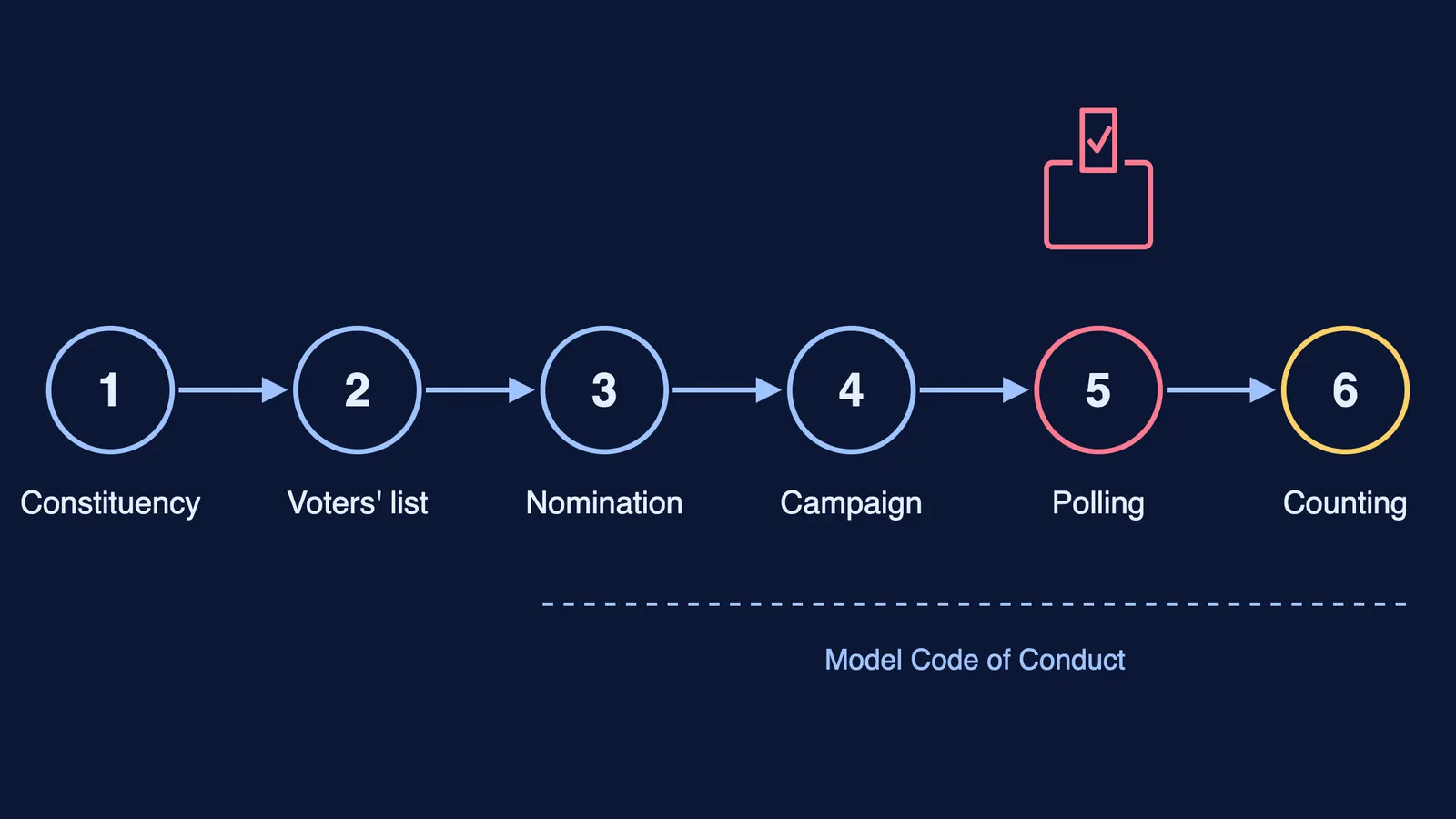
India has the largest electorate in the world, with 96.88 crore people registered to vote for the 2024 general election, according to the Press Information Bureau. Your Class 9 chapter on electoral politics asks two things about it: how an election actually runs, and how you can tell whether it was fair. Both get easier once you see the election as one sequence of six stages: constituency, voters' list, nomination, campaign, polling and counting. Below we walk through each stage with facts you can quote, then give you a fairness test you can use in any long answer.
What is a constituency, and why are some seats reserved?
A constituency is an area whose voters elect one representative. The 2024 general election was held for 543 Lok Sabha seats in seven phases, with voting from 19 April and results on 4 June, as WION reported from the Election Commission's announcement.
Some constituencies are reserved. Article 330 of the Constitution reserves Lok Sabha seats for Scheduled Castes and Scheduled Tribes, and the number reserved in each state is, as nearly as possible, in proportion to their share of that state's population. The aim is that these communities are represented in Parliament by design rather than left to chance.
Who can vote, and what is the voters' list?
Every citizen aged 18 or over can vote unless disqualified by law, a rule set by Article 326 of the Constitution and called universal adult franchise. The original 1950 text of Article 326 set the age at twenty-one; it now says eighteen.
The voters' list, officially the electoral roll, is the record of everyone allowed to vote in a constituency. Article 324 places the preparation of electoral rolls and the conduct of elections under the Election Commission. The list is revised regularly: the final roll for 2024, as on 8 February 2024, held 96,88,21,926 electors, up from 95,73,52,077 in the draft, according to the PIB flipbook's roll data.
If someone in your family has just turned 18, our guide on how to register a first-time voter in India walks through the steps.
How do nominations and campaigns work?
Anyone who wants to stand for election files a nomination. To contest a Lok Sabha seat you must be at least 25 years old, under Article 84 of the Constitution.
Campaigns have rules too. The Model Code of Conduct comes into force as soon as the Election Commission announces the poll schedule, and although the code is not itself a statute, several of its provisions are backed by laws such as the Representation of the People Act, 1951, as Onmanorama's explainer on the Model Code sets out.
What happens on polling day and counting day?
On polling day, voters cast their votes at polling stations. Reaching them has become easier over time: the number of polling stations grew from 1,96,084 in 1951-52 to 10,37,848 in 2019, more than five times as many, according to the PIB flipbook's history of elections.
Since 2013, voters who reject every candidate can press None of the Above (NOTA). In a judgment on 27 September 2013 in PUCL v Union of India, the Supreme Court directed the Election Commission to introduce the NOTA option, as recorded in the PIB flipbook's NOTA page and the Oxford Human Rights Hub's case note. Votes are then counted on a fixed day and the results declared; in 2024 that day was 4 June, as WION reported.
How can you tell whether an election was fair?
Use these five tests, in this order:
Could every adult citizen vote? Look for people wrongly left off the voters' list.
Was there a real choice? Could opposition parties and candidates stand and campaign freely?
Was the referee independent? Did a body like the Election Commission run the election, or the ruling party?
Were the campaign rules equal? Did the government follow the same code as everyone else?
Was the count honest, and did the winner take office?
Here is a worked example. Suppose a question describes a country where the ruling party appoints the officials who count votes, and the main opposition leader is arrested two weeks before polling. Test 2 fails, because voters lose a real choice. Test 3 fails, because the ruling party controls the count. Your verdict: the election is not free and fair, even if most people voted.
If you revise with an AI chatbot, check any Article number it gives you; our guide on checking an AI-quoted Article against the Constitution shows how. To see how elected representatives connect to services you use every day, read who runs a government school, from panchayat to Parliament.
If the rest of term revision feels shapeless, Fermi's AI tutor works out what you already know and builds a plan for the session, so you sit down to a clear next step.
Next step: take one election in the news this year and run it through the five tests in writing.


