

On this page
Federalism is Chapter 2 of *Democratic Politics II* in the CBSE Class 10 Social Science syllabus for 2026-27, where the five political science chapters together carry 20 marks. The facts below come from NCERT's Federalism chapter, so you can check each one against your own book.
What is federalism?
NCERT defines federalism as a system of government in which power is divided between a central authority and various constituent units of the country.
In a unitary system the centre can pass orders to provincial or local governments. In a federation it cannot, and each level answers to the people separately.
What are the key features of federalism?
NCERT lists seven features; learn them as a numbered set.
Two or more levels (tiers) of government.
Each tier governs the same citizens but has its own jurisdiction in legislation, taxation and administration.
These jurisdictions are written into the constitution, so each tier's authority is guaranteed.
Fundamental provisions cannot be changed by one level alone.
Courts interpret the constitution and act as umpire in disputes between levels.
Each level's sources of revenue are clearly specified, for financial autonomy.
Dual objectives: safeguard national unity and accommodate regional diversity.
In coming together federations (USA, Switzerland, Australia), independent states pool sovereignty. In holding together federations (India, Spain, Belgium), a large country divides its power; the centre tends to be stronger and units can have unequal powers.
What are the Union, State and Concurrent lists?
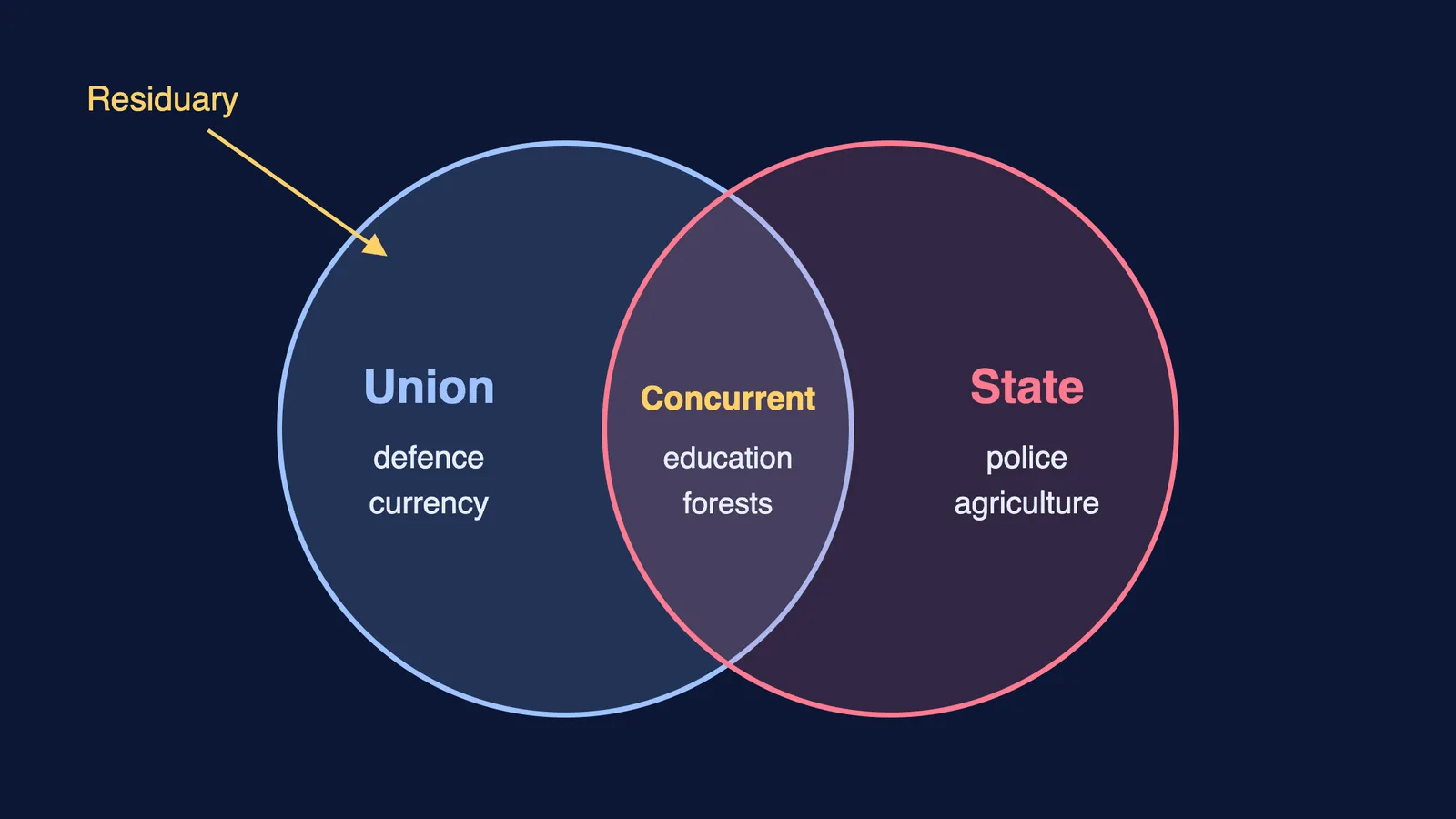
The Constitution makes a three-fold distribution of legislative powers, set out in NCERT's chapter:
Union List: national subjects such as defence, foreign affairs, banking, communications and currency. Only the Union makes laws on them.
State List: police, trade, commerce, agriculture and irrigation. Only States make laws on them.
Concurrent List: education, forest, trade unions, marriage, adoption and succession. Both can legislate; in a conflict, the Union law prevails.
Residuary subjects: anything outside the lists, such as computer software, goes to the Union.
Changing this arrangement needs at least a two-thirds majority in both Houses of Parliament plus ratification by the legislatures of at least half the States. If a chatbot hands you an Article number, check it against the Constitution before you learn it.
Worked example: NCERT asks whether Rajasthan could stop nuclear tests at Pokharan. Defence is on the Union List, so no. It asks whether the Prime Minister can order the Chief Ministers of three States to follow one policy on how their police respond to naxalites. Police is on the State List, and the centre cannot order a state government, so no. Try the third yourself: Sikkim wants new textbooks, and education is on the Concurrent List. Write two lines on who can legislate and what happens in a conflict.
How is federalism practised in India?
NCERT says constitutional provisions are necessary but not sufficient, and names three tests:
Linguistic States. Boundaries were redrawn so speakers of one language lived in one State; Nagaland, Uttarakhand and Jharkhand were formed on culture, ethnicity or geography. Leaders feared break-up; instead, the chapter says, the country became more united.
Language policy. India has no national language. Hindi is the official language, yet it was the mother tongue of about 44 per cent of Indians in the 2011 Census, and 22 languages are in the Eighth Schedule. English continued alongside Hindi after protests in non-Hindi States.
Centre-State relations. After 1990, regional parties and coalition governments brought more respect for State autonomy, and a Supreme Court judgement made arbitrary dismissal of State governments difficult.
What changed with decentralisation in 1992?
NCERT defines decentralisation as taking power from Central and State governments and giving it to local government. The 1992 amendment made this third tier more powerful and effective:
regular local elections became constitutionally mandatory;
seats are reserved for Scheduled Castes, Scheduled Tribes and Other Backward Classes;
at least one-third of all positions are reserved for women;
a State Election Commission in each State runs these elections;
States must share some powers and revenue with local bodies.
In villages the gram panchayat, headed by a sarpanch, works under the gram sabha of all the village's voters; gram panchayats group into a panchayat samiti, and all the samitis in a district form the zilla parishad. Towns have municipalities and big cities have municipal corporations, where the political head is the mayor. To see these tiers at work, read who runs a government school, from panchayat to Parliament.
How do you write a 5-mark answer on federalism?
The CBSE question paper design for 2026-27 has four 5-mark long-answer questions. For one on federalism:
Open with NCERT's one-line definition.
Give three points, each with a named example (Pokharan, police, education).
Close with one line on unity with diversity.
For passage-based questions, see our guide to answering case-based questions in CBSE boards. If your board plan also has maths and science gaps, Fermi's AI tutor can work out what you already know and build a plan for the session.


