On this page
Federalism is Chapter 7 of NCERT's Class 11 textbook *Indian Constitution at Work*, and the CBSE 2026-27 Political Science curriculum gives it 6 of 80 theory marks. Its argument: India divides power between the Union and the States, but tilts that division towards a strong centre. For why a constitution divides power at all, see our guide to Constitution: why and how.
What is federalism in Class 11 Political Science?
NCERT describes federalism as an arrangement that accommodates two sets of polities, one national and one regional, each autonomous in its own sphere (NCERT, Chapter 7). Four features:
Two levels of government, each with its own powers.
Two identities: you can be a Jharkhandi and an Indian.
A written, supreme constitution that sets out the division of powers.
An independent judiciary that settles legal disputes between the levels.
Unlike some federations, India has a single citizenship. NCERT's example of a federation that did not last is the West Indies, formed in 1958 and formally dissolved in 1962.
Article 1 calls India "a Union of States"; the Constitution does not use the word federation (Article 1).
How are powers divided between the Union and the States?
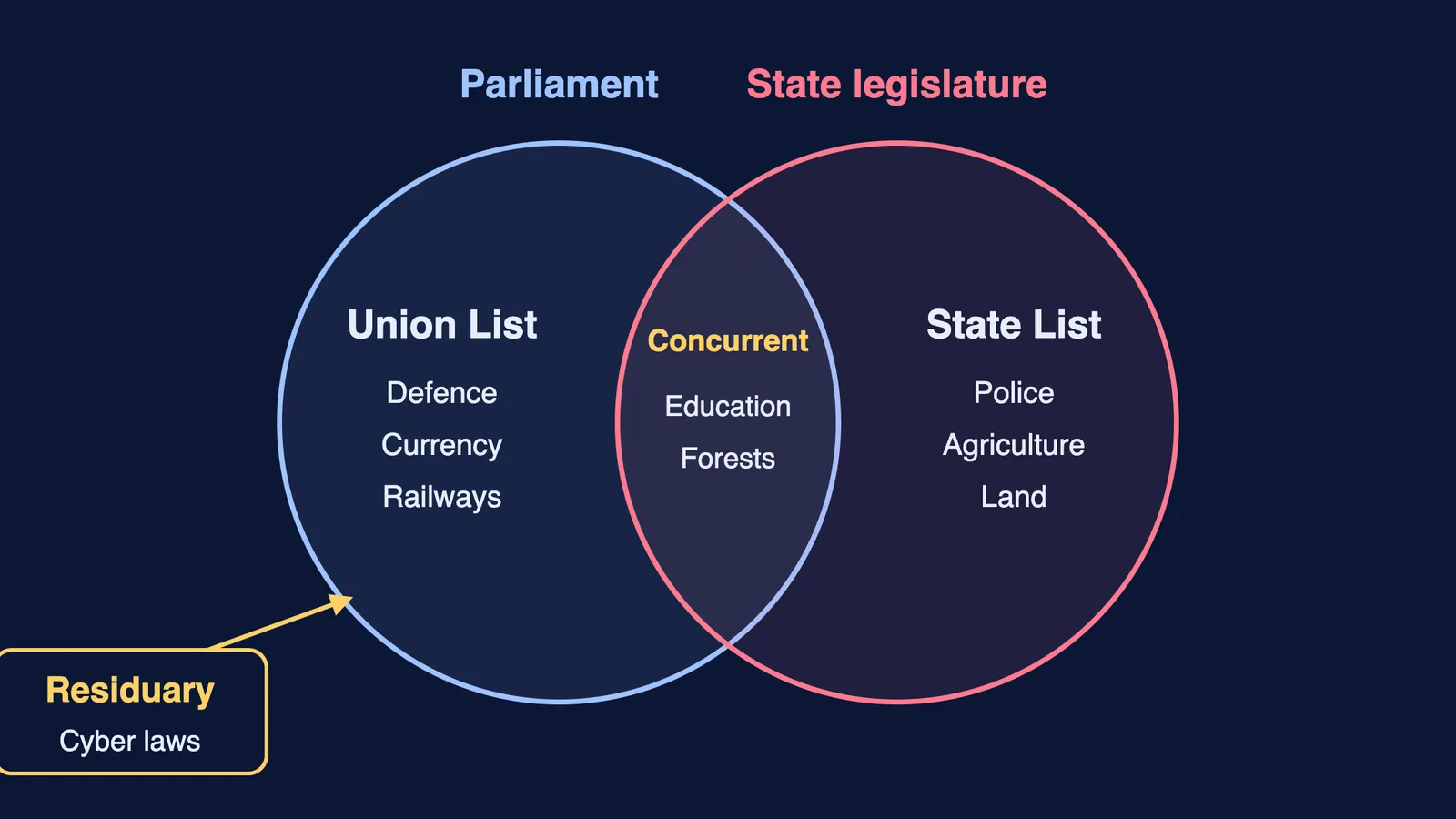
Article 246 gives Parliament exclusive power over the Union List and sets out the Concurrent and State Lists in the Seventh Schedule (Article 246). NCERT's chart gives examples (NCERT, Chapter 7):
Union List: defence, banking, railways, currency.
State List: police, agriculture, prisons, land.
Concurrent List: education, forests, trade unions.
Residuary powers: matters in no list, such as cyber laws, belong to Parliament (Article 248).
NCERT adds that States carry large responsibilities but have limited revenue. Local bodies form a third tier; see our guide to the 73rd and 74th Amendments.
Why does India have federalism with a strong centre?
Two reasons: unity, since more than 500 princely states had to be integrated, and development, since poverty, illiteracy and inequality needed planning (NCERT, Chapter 7). The provisions that make the centre strong:
Parliament can form new States or change boundaries and names, after seeking the State legislature's views (Article 3).
Emergency provisions can centralise the system.
The main revenue sources sit with the centre.
The Governor can reserve a State bill for the President.
Parliament can legislate on a State List subject if the Rajya Sabha approves, in the national interest (Article 249).
The Union can give States directions (Article 257).
States cannot remove the IAS and IPS officers who serve them.
What is Article 356 and why is the Governor's role debated?
Article 356 provides for President's rule when a State's government cannot be carried on according to the Constitution; the Union government then takes over (Article 356). NCERT notes that Parliament must ratify the proclamation and that President's rule can be extended up to three years (NCERT, Chapter 7).
NCERT explains why the Governor's role is contested: the office is unelected and centrally appointed, so its actions can be seen as central interference, especially when different parties govern the centre and the State (NCERT, Chapter 7). The Sarkaria Commission, appointed in 1983, reported in 1988 and recommended strictly non-partisan appointments. NCERT adds that the Governor's power to recommend dismissing a State government has caused many conflicts; the Supreme Court has ruled that courts can review whether President's rule is constitutional. For the President's other powers, see our executive and legislature guide.
What conflicts and special provisions does the chapter cover?
NCERT sorts autonomy demands into four kinds: powers, finance, administration, and culture or language. Other tensions:
New States: Gujarat and Maharashtra were created in 1960, Chhattisgarh, Uttarakhand and Jharkhand in 2000, and Telangana in 2014.
Interstate disputes: over borders (Belgaum, between Maharashtra and Karnataka) and river water (the Kaveri, between Tamil Nadu and Karnataka). NCERT calls these political as well as legal, best settled by negotiation.
Special provisions: most apply to north-eastern States with sizeable tribal populations, and some to hill States such as Himachal Pradesh.
NCERT explains that Jammu and Kashmir's special status under Article 370 (State concurrence for Union and Concurrent List laws) no longer exists: the Jammu and Kashmir Reorganisation Act 2019 divided it into two Union Territories, Jammu and Kashmir and Ladakh, from 31 October 2019 (NCERT, Chapter 7).
Federalism Class 11 practice questions
(1 mark) Which legislature makes cyber laws? *Hint: residuary powers.*
(2 marks) Give two reasons the framers wanted a strong centre. *One mark each: unity, development.*
(4 marks) A State and the Union disagree over who may legislate on a subject. Which body settles it, and on what basis? *Judiciary (1), supreme Constitution (1), three lists (1), residuary rule (1).*
(6 marks) Explain four provisions that give the centre more power than the States, and how the chapter says disputes are resolved. *Four provisions (4), courts for legal disputes (1), negotiation for political ones (1).*
If you are unsure where to begin revising, Fermi's AI tutor can work out what you already know and build a plan for the session.