

On this page
Chapter 8 of the NCERT Class 11 political science book, Indian Constitution at Work, is called Local Governments (NCERT Class 11, Chapter 8). It rests on two 1992 amendments.
What did the 73rd and 74th Amendments change?
Before 1992, local government was a State subject, and the Constitution mentioned it only in the Directive Principles, which courts cannot enforce (NCERT Class 11, Chapter 8). Many States postponed local elections or handed dissolved bodies to government officers. In 1989 the P.K. Thungon Committee recommended constitutional recognition for local government.
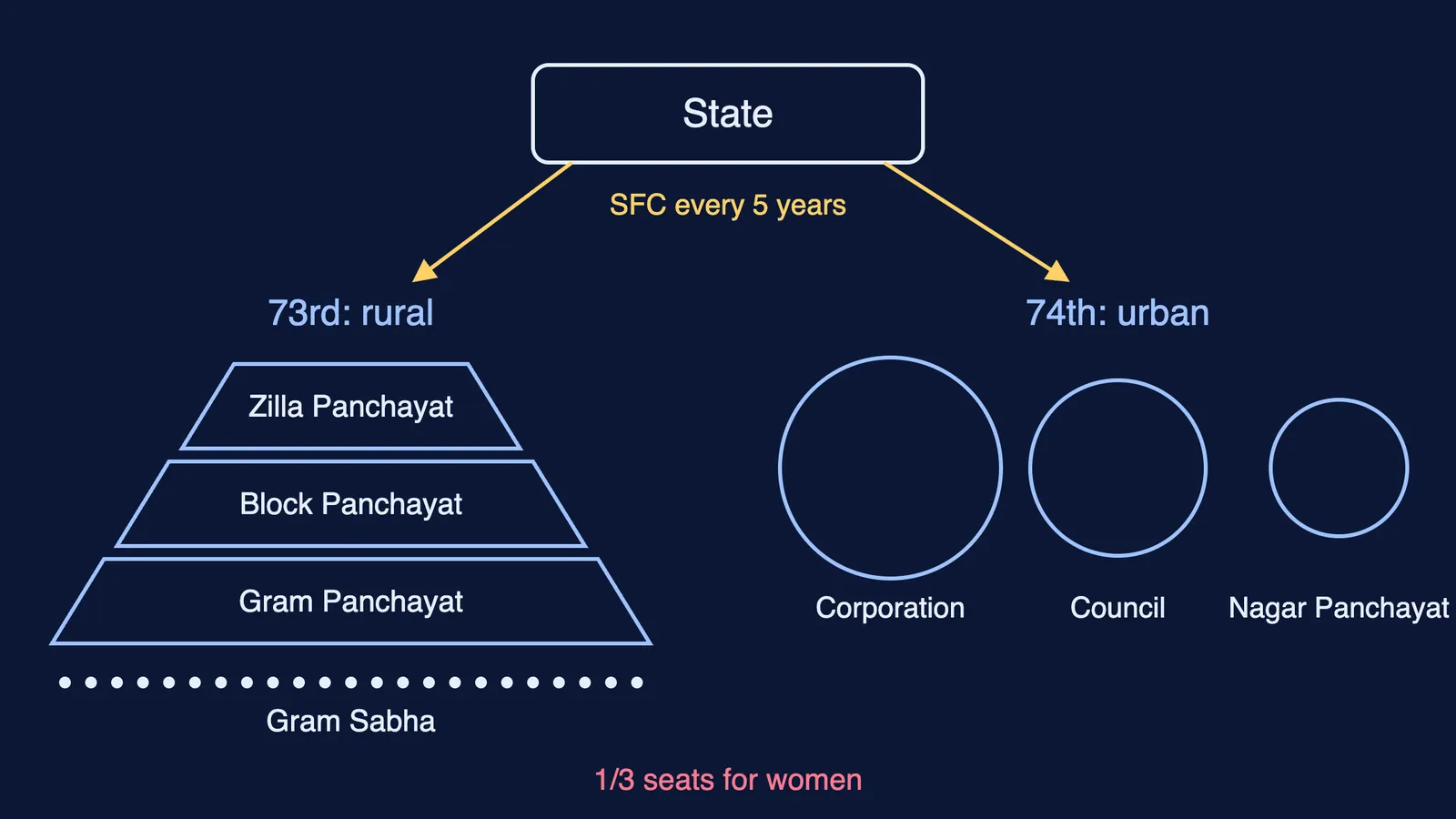
The 73rd Amendment covers rural local government, the Panchayati Raj Institutions. The 74th covers urban local government, the Nagarpalikas. Both came into force in 1993, and States were given one year to bring their own laws in line with them.
For a refresher, see our Panchayati Raj Class 6 guide from gram sabha to zila parishad and the Federalism Class 10 guide to the three lists and the 1992 reforms.
What are the three tiers of Panchayati Raj?
Every State now has a uniform three-tier structure (NCERT Class 11, Chapter 8):
Gram Panchayat: a village or a group of villages.
Intermediate level: the Mandal, Block or Taluka Panchayat.
Zilla Panchayat: the whole rural area of a district.
A State with a population not exceeding twenty lakh need not set up the intermediate level (Article 243B). The 73rd Amendment also made a Gram Sabha compulsory, made up of every adult registered as a voter in the panchayat area.
Every panchayat has a five-year term, and if it is dissolved early, fresh elections must be held within six months (Article 243E). Elections are run by a State Election Commissioner appointed by the Governor (Article 243K). NCERT stresses that this officer is independent and not under the Election Commission of India.
How do reservations work in local bodies?
Not less than one-third of the seats filled by direct election in every panchayat are reserved for women, and that count includes the women's seats inside the SC and ST quota (Article 243D). Seats for Scheduled Castes and Scheduled Tribes are reserved in proportion to their population, and States may also reserve seats for backward classes. Not less than one-third of chairperson posts at each level are reserved for women.
What does the 74th Amendment add for towns and cities?
NCERT calls the 74th Amendment largely a repetition of the 73rd for urban areas: its rules on direct elections, reservations, subjects and both State commissions apply to Nagarpalikas (NCERT Class 11, Chapter 8). Article 243Q names three kinds of municipality: a Nagar Panchayat for a transitional area, a Municipal Council for a smaller urban area and a Municipal Corporation for a larger one (Article 243Q).
The Eleventh Schedule lists 29 subjects for panchayats, starting with agriculture (Eleventh Schedule). The Twelfth Schedule lists 18 subjects for municipalities, starting with urban planning (Twelfth Schedule). Each State decides how many it actually transfers, and NCERT notes that many States have not handed over most of them.
What is the State Finance Commission?
The Governor must set up a Finance Commission within one year of the 73rd Amendment coming into force and then at the expiration of every fifth year (Article 243I). It reviews the finances of panchayats and recommends how State taxes and fees are shared with them, which taxes they may collect, and what grants they receive. The same commission reviews the finances of municipalities (Article 243Y). NCERT's reason: it keeps the allocation of funds to rural local governments from becoming a political matter (NCERT Class 11, Chapter 8).
How do you write a 4-mark answer on the 73rd Amendment?
Take a typical question: describe any four provisions of the 73rd Amendment. Write one point per line: the provision, its Article and its purpose.
Three-tier structure (Article 243B): Gram, intermediate and Zilla Panchayats, plus a Gram Sabha of all registered adult voters.
Elections (Articles 243E and 243K): a five-year term, a fresh election within six months of an early dissolution (Article 243E) and an independent State Election Commission.
Reservations (Article 243D): at least one-third of seats and chairperson posts for women; SC and ST seats in proportion to population.
Funds (Article 243I): a State Finance Commission every five years to review local finances, so money does not depend on politics.
If the question asks about the 74th Amendment, swap in Nagarpalikas, the three kinds of municipality and the 18 subjects of the Twelfth Schedule.
A three-day revision plan:
Day 1: draw the tier diagram from memory and write the reservation rules without looking.
Day 2: put the numbers on one card: 1992, 1993, five years, six months, one-third, 29, 18, twenty lakh.
Day 3: write both 4-mark answers and check them against the book.
If a chatbot gives you an Article number, check the AI's Article against the Constitution first. And if political science shares your week with physics or maths, Fermi's AI tutor can work out what you already know in those subjects and build a plan for the session, so you sit down to a clear next step.


