

On this page
Panchayati Raj is the chapter where Class 6 civics stops being about Delhi and starts being about the village down the road. NCERT teaches it in Chapter 11 of Exploring Society: India and Beyond, "Grassroots Democracy, Part 2: Local Government in Rural Areas" (NCERT chapter PDF). Here is what each body is, who chooses whom, and where the money comes from.
What is Panchayati Raj in Class 6?
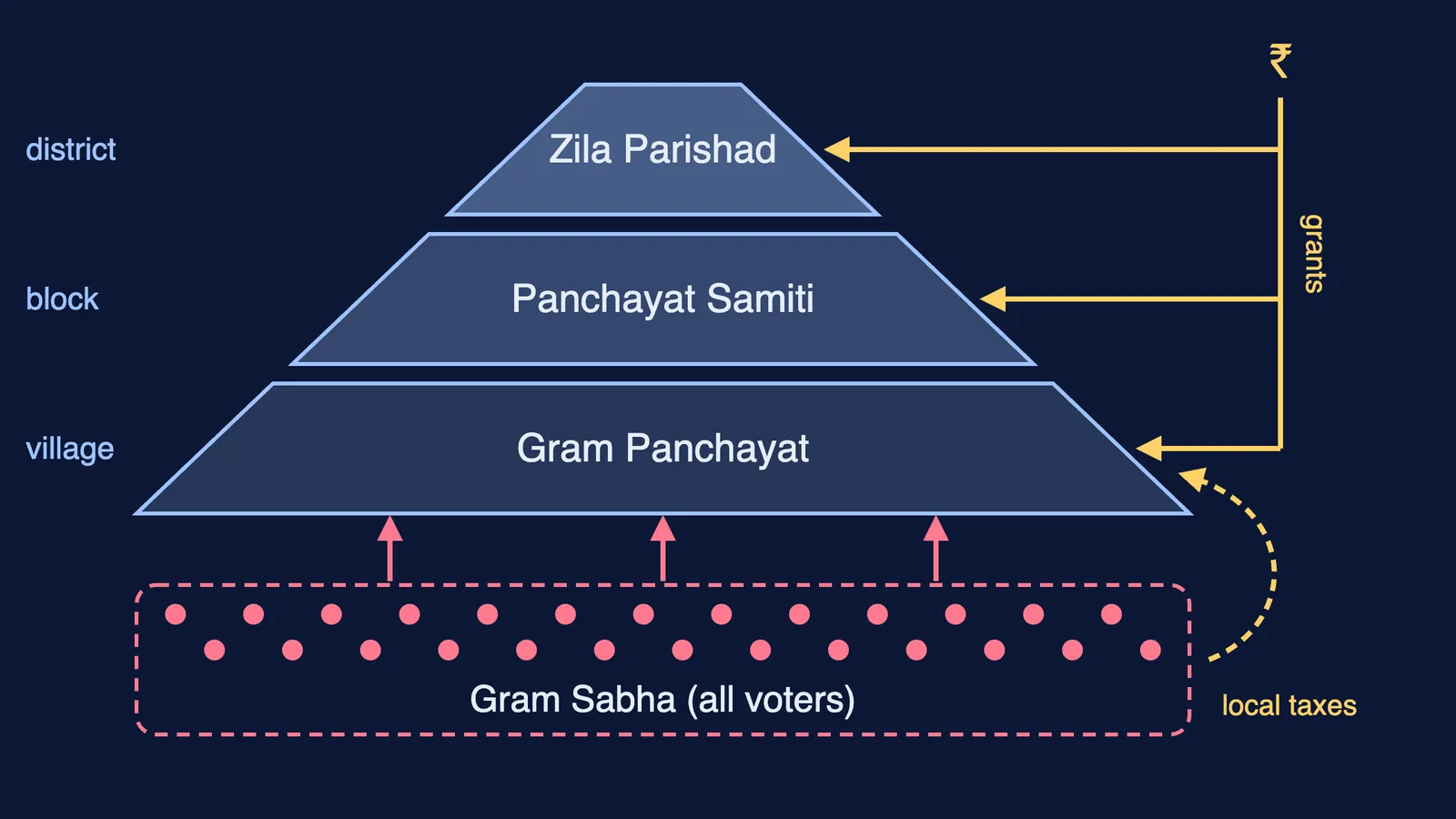
NCERT calls the panchayat a "village council" and Panchayati Raj "a form of self-government" that brings governance closer to the people (NCERT, Chapter 11). It works at three levels, from the bottom up: village, block and district. That is the "three-tier system".
Article 243B of the Constitution says every state shall have panchayats "at the village, intermediate and district levels" (Constitution, Part IX). The same article lets a state with a population of 20 lakh or less skip the middle tier.
Names differ by state: NCERT's pyramid gives Gram Panchayat or Village Parishad; Panchayat Samiti, Block Panchayat or Mandal Parishad; and Zila Parishad or District Panchayat (NCERT, Fig. 11.1).
What is the difference between gram sabha and gram panchayat?
Gram sabha: every person registered on the electoral roll of the village (Constitution, Article 243(b)). It is people, not an office, and NCERT describes it as the village's adult voters, women and men, discussing local matters and taking decisions.
Gram panchayat: the elected council. NCERT says its members are elected directly by the gram sabha, and its head is called the sarpanch or pradhan (NCERT, Chapter 11).
A panchayat secretary calls meetings and keeps records, and in many parts of India a patwari keeps land records. Every panchayat runs for five years from its first meeting unless dissolved earlier (Article 243E). At least one-third of directly elected seats, and at least one-third of chairperson posts at each level, are reserved for women (Article 243D).
What do the panchayat samiti and zila parishad do?
The panchayat samiti at the block level links the gram panchayats to the zila parishad at the district level (NCERT, Chapter 11). It collects development plans from its gram panchayats and puts them together for the district or state, which helps funds reach projects and schemes such as the Pradhan Mantri Gram Sadak Yojana for all-weather rural roads.
Upper-tier members are elected by local people but may also include sarpanchs and local MLAs. The make-up differs between states, because states have authority over panchayats. If the idea of powers shared between levels is new, our guide to the features of the Indian Constitution sets out the bigger picture.
Where does a panchayat's money come from?
Article 243H lets a state law give panchayats three sources of money and a fund to hold it (Constitution, Article 243H):
Taxes, duties, tolls and fees the panchayat collects itself.
Taxes the state collects and assigns to it.
Grants-in-aid from the state's Consolidated Fund.
Funds where this money is kept and spent from.
Article 243-I makes the Governor set up a State Finance Commission every five years to review panchayat finances and recommend how money is shared.
The central Finance Commission adds grants too. The Ministry of Panchayati Raj said ₹4,35,236 crore has been recommended for rural local bodies under the 16th Finance Commission, covering 2.76 lakh rural local bodies (All India Radio, July 2026).
Worked example: which tier fixes it?
NCERT ends the chapter with a real puzzle: your village school is next to a highway and children struggle to cross it (NCERT, Chapter 11, question 4). Here is one way to answer it in steps.
Gram sabha: students and parents raise the problem at a meeting, so it is on record.
Gram panchayat: the sarpanch can arrange a safer gate or a crossing helper on the village side.
Panchayat samiti: a footbridge or road change goes into the block's plan.
Zila parishad: bigger works and their funds are taken up at the district level.
Students: write to the sarpanch and invite panchayat members to school, two things the chapter's own questions and activities practise.
For "Name the three tiers and their functions", a full answer names each tier, its level and one job, then adds that the gram sabha elects the gram panchayat. To see how a complaint travels further up, read who runs a government school and where to raise a problem.
When maths or science homework is where you get stuck, Fermi's AI tutor can work out what you already know and build a plan for the session, so you start with a clear next step.
These ideas return in Class 9: what is democracy and why democracy picks up from here.


