On this page
If you searched for this chapter, you may be holding an older guide. NCERT's textbook page now lists *Understanding Society: India and Beyond* (Parts I and II) for Class 9 Social Science. The older *Democratic Politics-I*, where "What is Democracy? Why Democracy?" was Chapter 1, is no longer listed. The same questions are now answered in Chapter 6, "Democracy", of Part I (NCERT chapter PDF).
CBSE's 2026-27 Class 9 Social Science curriculum gives the Democracy theme 9 instructional hours. It covers the meaning, features and types of democracy, its roots in India, challenges to democracy in India, and democratic systems in the world. If your school or state board still uses the older book, follow your teacher's chapter list, and check which NCERT chapters changed before you buy a guide.
What is democracy?
The chapter's starting definition is simple: democracy is a form of government in which power and authority come from the citizens, who elect their representatives through free and fair elections (NCERT, Chapter 6).
The key idea is popular sovereignty: the state gets its authority from the people. In India, every citizen aged 18 or above can vote by secret ballot, a right called Universal Adult Franchise. The same chapter notes that India had over 96.8 crore registered voters in 2024 and has more than 2,800 registered political parties.
What are the features of a democracy?
The NCERT chapter lists these principles, each backed by the Constitution:
Popular sovereignty: the people are the final source of power and use it through elections.
Rule of law: no one is above the law, and no one can be punished except by procedure established by law.
Fundamental Rights: six rights, from the Right to Equality to the Right to Constitutional Remedies, which citizens can enforce in court.
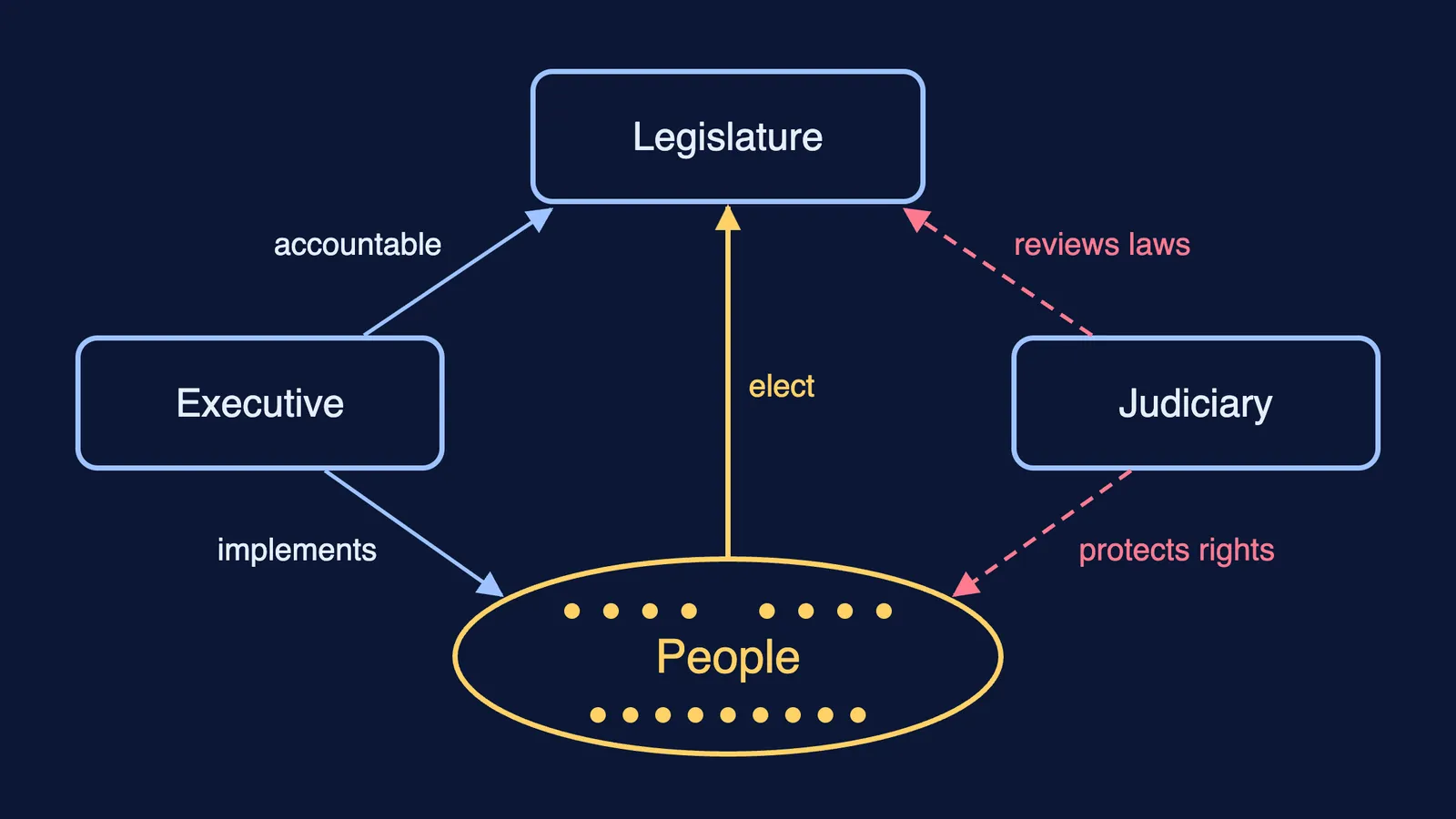
Separation of powers: the legislature makes laws, the executive implements them and the judiciary interprets them; courts can strike down a law that breaks the Constitution.
Accountability and transparency: elections, Question Hour in Parliament and the Right to Information Act, 2005.
Multi-party system: several parties compete, so voters have a real choice.
Protecting vulnerable groups: for example, Article 46 asks the State to promote the educational and economic interests of weaker sections.
The chapter also separates types of democracy: direct (Switzerland) and representative (India), and parliamentary (India, Canada) or presidential (USA). When you quote an Article number in an answer, check it against the Constitution itself.
Why democracy? What are the arguments for and against it?
Examiners want both sides and a conclusion. The chapter has no for-and-against list, so build one from its material. Every point below comes from the NCERT chapter.
Arguments for democracy
It makes rulers answer to people. Elections, Question Hour and the RTI Act let citizens question the government.
It protects rights. Rule of law and enforceable Fundamental Rights guard against arbitrary action.
It settles disagreement peacefully. The chapter says a democratic system seeks to promote participation, ensure fairness, limit the concentration of power and resolve disagreements peacefully.
Every adult gets a vote. In India, Universal Adult Franchise covered men and women alike from 1950, while women in the USA won the vote in 1920 and in Britain won full voting rights only in 1928, after long struggles.
Challenges to democracy
Misinformation. Fake news, especially on social media, can mislead voters.
Unequal participation. Illiteracy, poverty, regionalism, gender inequality and discrimination keep some people from taking part equally.
Weak implementation. Gaps in carrying out laws and policies can reduce trust in institutions.
Power can be misused. During the Emergency of 1975-77, most Fundamental Rights were suspended and the press was censored.
How do you answer "Is voting alone enough to make a country democratic?"
This is Question 6 at the end of the chapter, and it tests the whole topic. Use this five-step plan:
Define democracy in one line, using popular sovereignty.
Agree in part: voting is essential, because it is how the people's power is used.
Show the gap: use the chapter's Team D example, a council where elections are held but only selected candidates may stand and opposition is discouraged. Voting happens, but power is concentrated and opposition is weak.
Add two features voting cannot give on its own, such as rule of law and Fundamental Rights, or a free press and more than one party.
Conclude with India: democracy also works through Gram Sabhas, courts and RTI, not only at the ballot box.
For questions about other countries, use the chapter's four-question test:
Does the country hold regular elections?
Who chooses the head of government?
Is there more than one political party?
How free are citizens to express opinions and criticise the government?
For your science and maths chapters, Fermi's AI tutor works out what you already know and builds a plan for the session. If you are wondering how much this year's tests count, read where Class 9 marks matter and where they don't.