On this page
Your child already watches ice shrink in a glass and steam rise from the pressure cooker. This guide names what they see: the three states, how particles sit in each, melting and boiling, and an ice-to-steam activity for your kitchen.
What are the three states of matter?
Most of what we handle is a solid, a liquid or a gas. The free textbook OpenStax Chemistry 2e gives a simple test for each:
Solid: rigid, with a definite shape. A pencil, an ice cube, a steel tumbler.
Liquid: it flows and takes the shape of its container. Water, milk, oil.
Gas: it takes both the shape and the volume of its container. The air in a balloon, the invisible water vapour above a boiling pan.
A quick check for Class 4: put it in a different bottle. Keeps its own shape? Solid. Changes shape but stays at the bottom? Liquid. Spreads to fill the whole bottle? Gas.
How are particles arranged in solids, liquids and gases?
All matter is made of particles far too small to see. What changes between states is how close they sit and how freely they move, as the OpenStax section on intermolecular forces describes:
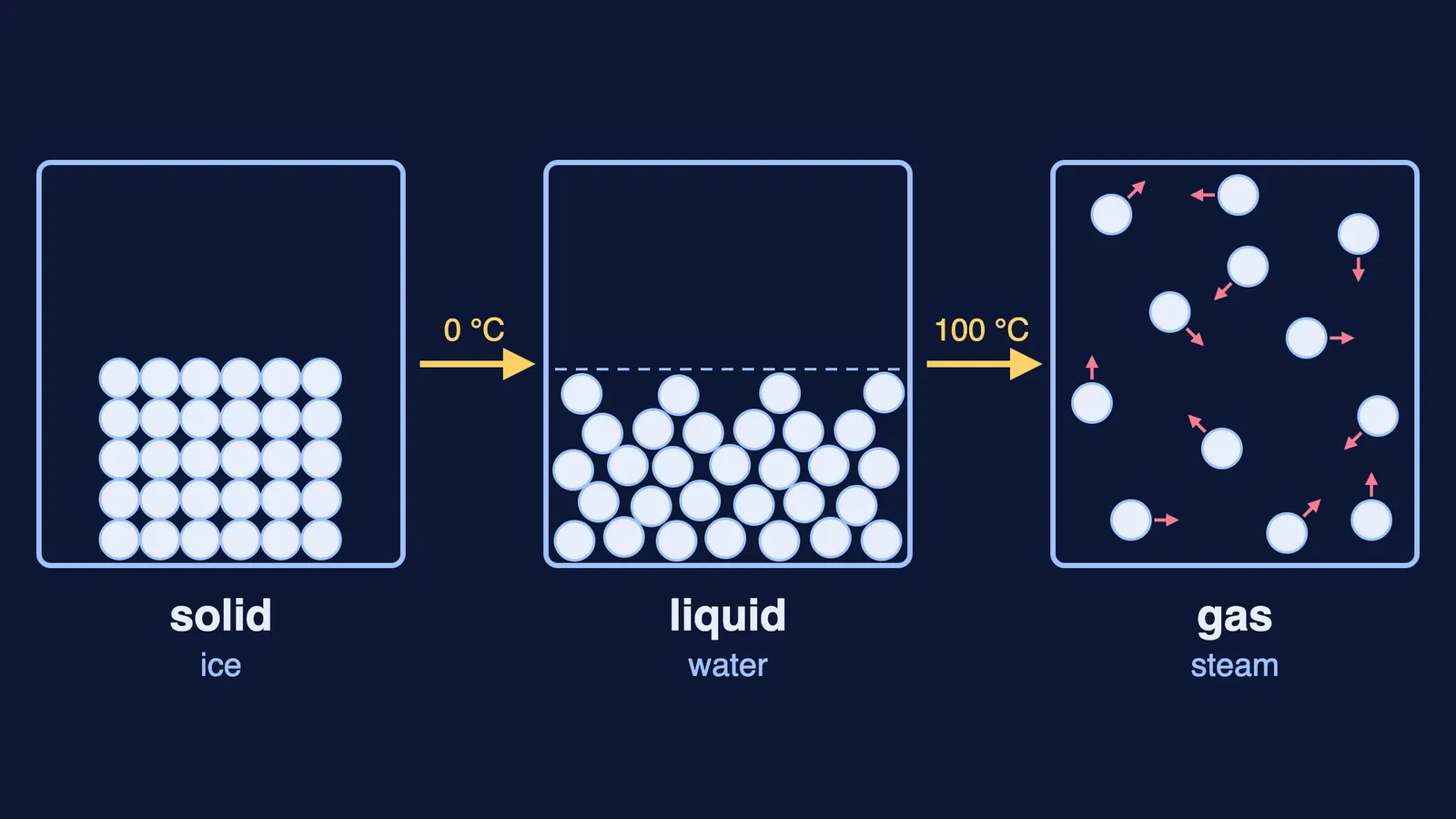
In a solid, particles are tightly packed, often in a regular pattern, and vibrate about fixed positions.
In a liquid, particles are close together with no regular pattern, and move past each other.
In a gas, particles are far apart and move on their own except when they collide.
A picture for an eight-year-old: a solid is the class at morning assembly, in rows, swaying on the spot. A liquid is the class in a crowded corridor, close but slipping past one another. A gas is the class at break, running across the whole playground.
What happens when ice melts and water boils?
Heat makes particles move faster. Add enough and a solid melts into a liquid, then the liquid boils into a gas. Take heat away and the steps run backwards: a gas condenses into a liquid, and a liquid freezes into a solid (OpenStax, phase transitions).
Ice melts, and water freezes, at 0 °C, the temperature at which water molecules lock into a crystal (NOAA JetStream).
Water's normal boiling point, at sea-level air pressure, is 373.17 K, which is about 100 °C (NIST Chemistry WebBook).
The surprise: while ice is melting, its temperature stays the same even though heat keeps flowing in, and the same is true while water boils (OpenStax). The heat goes into pulling particles apart, not into making them hotter.
Water expands by about nine percent when it freezes, which is why ice floats (NOAA JetStream).
Water boils at a lower temperature high up: in Leadville, Colorado, at 10,200 feet, air pressure of about 68 kPa means water boils at about 90 °C (OpenStax).
Water also turns into gas from its surface without boiling. That is how clothes dry on a line, and why you feel cold after a bath.
How do you do the ice-to-steam activity at home?
You need a steel pan with a lid, a handful of ice cubes, a stove, a notebook and, if you have one, a kitchen thermometer.
Predict. Your child draws the particles in an ice cube and guesses what will happen.
Put the ice in the pan. An adult stirs and reads the thermometer; your child writes the number down.
Heat gently and keep stirring. Read the temperature every couple of minutes while ice is left; draw the particles again at half melted.
Keep heating after the last ice has gone and watch the number climb.
When the water bubbles hard, read it again. Then an adult holds the lid over the pan briefly and shows your child the underside.
Turn off the stove and let the pan cool before anyone touches it.
What you should see: the reading stays near 0 °C while ice is floating, climbs once it has melted, then holds near 100 °C while the water boils, as the OpenStax heating curve predicts. Drops under the lid are steam condensing back into water. For why the white cloud is not steam itself, see our explainer on the clear gap above a boiling kettle's spout. Kitchen thermometers are rarely exact; the two flat stretches matter more than the numbers.
What should you ask your child afterwards?
A short talk fixes the idea better than a worksheet:
"Where did the ice go?" It became water, then steam.
"Why did the number stop rising while there was still ice?" The heat was busy pulling particles apart.
"Where did the drops under the lid come from?" Steam cooled and turned back into water.
"Can you act out a solid, a liquid and a gas?" Stand and sway; shuffle close together; run around the room.
Particles are hard to picture because no one can see them. The Fermi Simulation Lab has interactive simulations for ideas that are easier to see than to read.
For another hands-on model at this age, try the planets in order with a fruit scale model.