On this page
If your child has a science or EVS test on the solar system, three questions usually come up: what order the planets are in, which planet is biggest, and why Pluto is missing. This guide answers all three, with a mnemonic and a fruit-bowl model sized from NASA's own numbers.
What are the eight planets in order from the Sun?
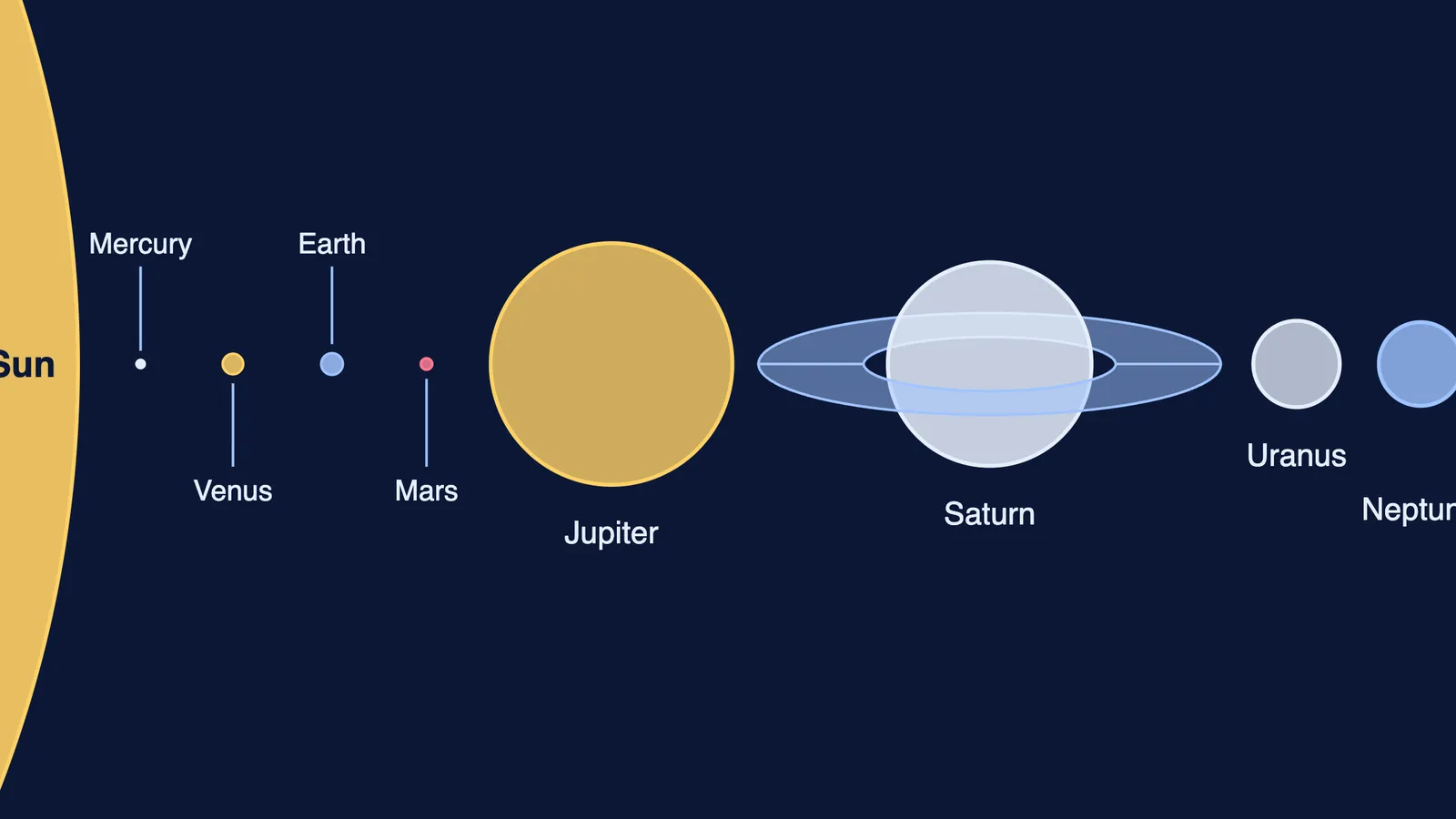
The eight planets, from nearest the Sun to farthest, are Mercury, Venus, Earth, Mars, Jupiter, Saturn, Uranus and Neptune. NASA's Planetary Fact Sheet lists each planet's average distance from the Sun, and the order comes straight from those numbers:
Mercury: 57.9 million km
Venus: 108.2 million km
Earth: 149.6 million km
Mars: 228.0 million km
Jupiter: 778.5 million km
Saturn: 1,432 million km
Uranus: 2,867 million km
Neptune: 4,515 million km
The first four planets are small and rocky. The last four are giants made mostly of gas and ice, and the same NASA fact sheet shows that all four of them have rings. Look at the jump after Mars: Jupiter is more than three times as far from the Sun as Mars is.
What is an easy mnemonic for the planets in order?
The classic one is My Very Educated Mother Just Served Us Noodles. Each word starts with the same letter as a planet, in order: M, V, E, M, J, S, U, N.
Two spots often trip children up: the two Ms, and the last two planets. Two checks help:
The first M is Mercury, the smallest planet and the closest to the Sun. The second M is Mars, the red planet, which comes just after Earth.
"Us" comes before "Noodles", so Uranus comes before Neptune. Neptune is last, just as "Noodles" is the last word.
Your child can also write their own sentence with the same eight letters, about cricket or food. If they enjoy memory tricks, the memory palace technique for long lists works for these too.
How big are the planets compared to each other?
Many pictures draw the planets at similar sizes, which hides the real story. NASA's Planetary Fact Sheet gives Jupiter's diameter as 142,984 km and Earth's as 12,756 km, so Jupiter is about 11 times wider than Earth. The NASA Sun Fact Sheet gives the Sun's radius as 695,700 km, which makes the Sun about 109 Earths wide.
Here is a fruit-bowl scale model. We made Earth 2.5 cm across, about the size of an amla, and scaled every other planet by its NASA diameter:
Mercury, 1.0 cm: a chickpea
Venus, 2.4 cm: a slightly smaller amla
Earth, 2.5 cm: an amla
Mars, 1.3 cm: a small grape
Jupiter, 28 cm: a big watermelon
Saturn, 24 cm without its rings: a smaller watermelon
Uranus, 10 cm: a large orange
Neptune, 9.7 cm: another large orange, a little smaller
The Sun, 2.7 m: no fruit is big enough, so picture a ball about as tall as a room
Real fruit varies, so treat these as close matches.
Worked example: how far apart would the fruit be?
On this scale, 1 cm stands for about 5,102 km (12,756 km ÷ 2.5). Earth's distance from the Sun, 149.6 million km on the NASA fact sheet, becomes 149,600,000 ÷ 5,102, or about 29,300 cm. That is roughly 293 metres. Do the same sum for Neptune's 4,515 million km and you get about 8.8 km. So if the Sun-ball stood at your school gate, the Earth-amla would be a few minutes' walk away and the Neptune-orange would be in another part of town. Most of the solar system is empty space.
Why is Pluto not a planet any more?
Pluto was counted as the ninth planet for decades. NASA explains that the International Astronomical Union reclassified Pluto as a dwarf planet in 2006. Pluto is also small: NASA's Planetary Fact Sheet gives its diameter as 2,376 km, which is less than our Moon's 3,475 km. Older books may still say nine; today's textbooks say eight.
How can you practise the planets at home in 20 minutes?
A short plan for a child in Class 4 to 6 and a parent or older sibling:
Minutes 0 to 5: say the mnemonic together three times, then write a planet name under each word.
Minutes 5 to 12: lay the fruit, or paper circles cut to the sizes above, on the floor. Your child puts each one in place and says its name.
Minutes 12 to 17: ask three questions. Which planet is the biggest? Which planets are rocky? Why is Pluto not in the row?
Minutes 17 to 20: cover the list and ask your child to write the order from memory. Count the right answers, not the mistakes.
End with a puzzle. NASA's Planetary Fact Sheet gives Venus a mean temperature of 464 °C and Mercury 167 °C, so Venus is the hottest planet even though Mercury is closer to the Sun. Ask your child to guess why before you look it up together.
Older siblings will meet gravity and orbits later in school, and orbits are easier to see moving than to picture from a page. The Fermi Simulation Lab has interactive simulations for ideas that are easier to see than to read, and the Fermi Concept Library gives each physics concept its own lesson.
If your child is hooked on the planets now, find out what a planetary parade is and when to look up, or plan a trip with our guide to science museums and planetariums in India.