On this page
Biology is full of lists you must hold in order: twelve cranial nerves, the hormones of each gland, the steps of a cycle. The memory palace, also called the method of loci, turns a list into a walk through a place you already know.
What is the memory palace technique?
The method of loci is a mnemonic in which you picture items at specific points along a familiar route and recall them by walking that route in your mind, as described in a 2021 meta-analysis in the Quarterly Journal of Experimental Psychology. The route supplies the order for free, so your only job is to make each image easy to spot at its stop.
Memory champions use it. A 2003 brain-imaging study in Nature Neuroscience found that people with superior memory did not have exceptional intellect or unusual brain structure; they used a spatial learning strategy that engaged the hippocampus.
Does the method of loci actually work?
For recall, yes, with caveats. The meta-analysis by Twomey and Kroneisen pooled 13 randomised controlled trials, mostly in university settings, and found a medium effect size (g = 0.65). The authors also flagged a high risk of bias, because most trials did not report how participants were randomised.
Beginners can learn it. In a 2017 study in Neuron, university students new to the method practised it for 30 minutes a day for 40 days. The words they could memorise in 5 minutes rose from 16.6 to 42.3 on average, and brain changes resembling those of memory athletes predicted memory gains up to 4 months later.
It has been tried in a physiology course too. In one study in Advances in Physiology Education, students who built memory palaces for insulin and diabetes with their teacher after lectures performed significantly better on assessments than a group that had a self-directed learning session instead.
How to use the memory palace technique in five steps
Pick a route you know cold. Your home or your walk to school, something you can see with your eyes shut.
Fix the stops in order. Name one stop per item: gate, doorbell, shoe rack. Never change the order.
Make one image per item. Tie the name to a sound-alike and the function to an action. Make it odd or funny so it stands out.
Place and walk. Put each image at its stop, then walk the route in your head, forwards and backwards.
Test without the list. Next day, write the items from memory and check. Rebuild only the stops you missed.
Worked example: the 12 cranial nerves in your home
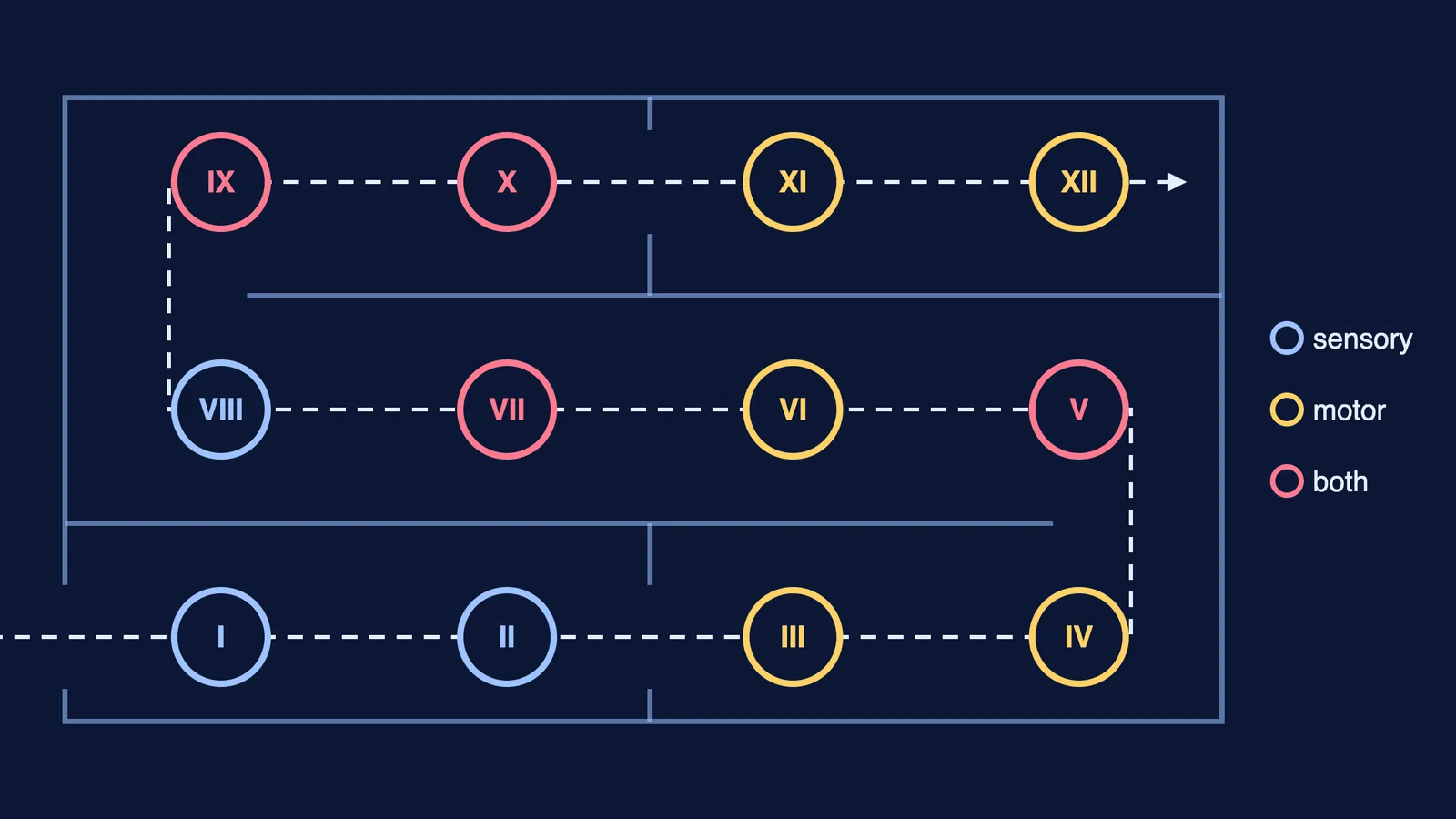
There are twelve cranial nerves, numbered I to XII; three are only sensory, five only motor and four are mixed, according to OpenStax Anatomy and Physiology. Each image carries the name as a sound-alike and the job from that chapter.
Gate (I, olfactory): a jasmine garland so strong you smell it from the road. Smell.
Doorbell (II, optic): a giant eye stares out of the peephole. Vision.
Shoe rack (III, oculomotor): an octopus juggles eyeballs and lifts your eyelid. Eye movement, eyelid, pupil.
Umbrella stand (IV, trochlear): a toy truck whose headlight eyes swivel as it drives. Eye movement.
Sofa (V, trigeminal): three gems on the cushion; your cousin chews loudly and rubs their face. Face sensation, chewing.
TV (VI, abducens): a cartoon alien abducts a cow while every eye in the room follows the ship. Eye movement.
Dining table (VII, facial): someone in a face pack pulls faces, tastes pickle and drools. Expressions, taste, saliva.
Pressure cooker (VIII, vestibulocochlear): the whistle blows and you wobble. Hearing, balance.
Fridge (IX, glossopharyngeal): a glossy kulfi you taste and swallow, mouth watering. Mouth and upper-throat muscles, taste, saliva.
Balcony (X, vagus): a vagabond wanders down through the chest and belly, checking each organ. Organs of the chest and upper abdomen.
Bathroom (XI, accessory): a heavy necklace you turn your neck to adjust. Neck muscles.
Terrace (XII, hypoglossal): a hippo sticks out its tongue. Tongue, lower throat.
When is a memory palace the wrong tool?
A palace stores names and order. It does not explain why the facial and glossopharyngeal nerves both carry taste. Learn the idea first, then let the palace hold the list. If a nerve's job is still fuzzy, the Fermi Concept Library has a lesson for every concept in biology, so the image you place is one you understand.
Review on a schedule. Walk the route again after a day, then a few days later; a Leitner box for flashcards gives you a timetable.
Check borrowed images. If a chatbot writes your mnemonics, check every letter of AI-made NEET biology mnemonics first.
Heading to MBBS? Fit the same walk into a weekly plan for first-year anatomy.
Tonight, walk your home once and place the first four nerves. Tomorrow, write them from memory before you add the next four.