

On this page
You could run a garden pipe from the bottom of a pool to the surface, so why are shop snorkels only about as long as your forearm? Two ideas from school science stop you: water pressure that grows with depth, and stale air you breathe back in.
Why can't a snorkel be very long?
The European snorkel standard, EN 1972 (2015), limits a tube for users with larger lungs to 38 cm in length and 230 cubic centimetres in internal volume, and for users with smaller lungs to 35 cm and 150 cc, as summarised in Wikipedia's snorkel article). The same article notes that the maximum length in snorkel standards has almost halved over the years, from 600 to 380 mm, as understanding of dead space and breathing resistance improved.
There are two reasons. A longer tube only helps if your chest goes deeper, and every extra centimetre of tube is air you breathe twice.
How does water pressure stop you breathing through a long tube?
Pressure in water rises by about one atmosphere for every 10 metres you go down, according to NOAA's Ocean Service. That works out to roughly 10 kPa per metre, or 1 kPa for every 10 cm.
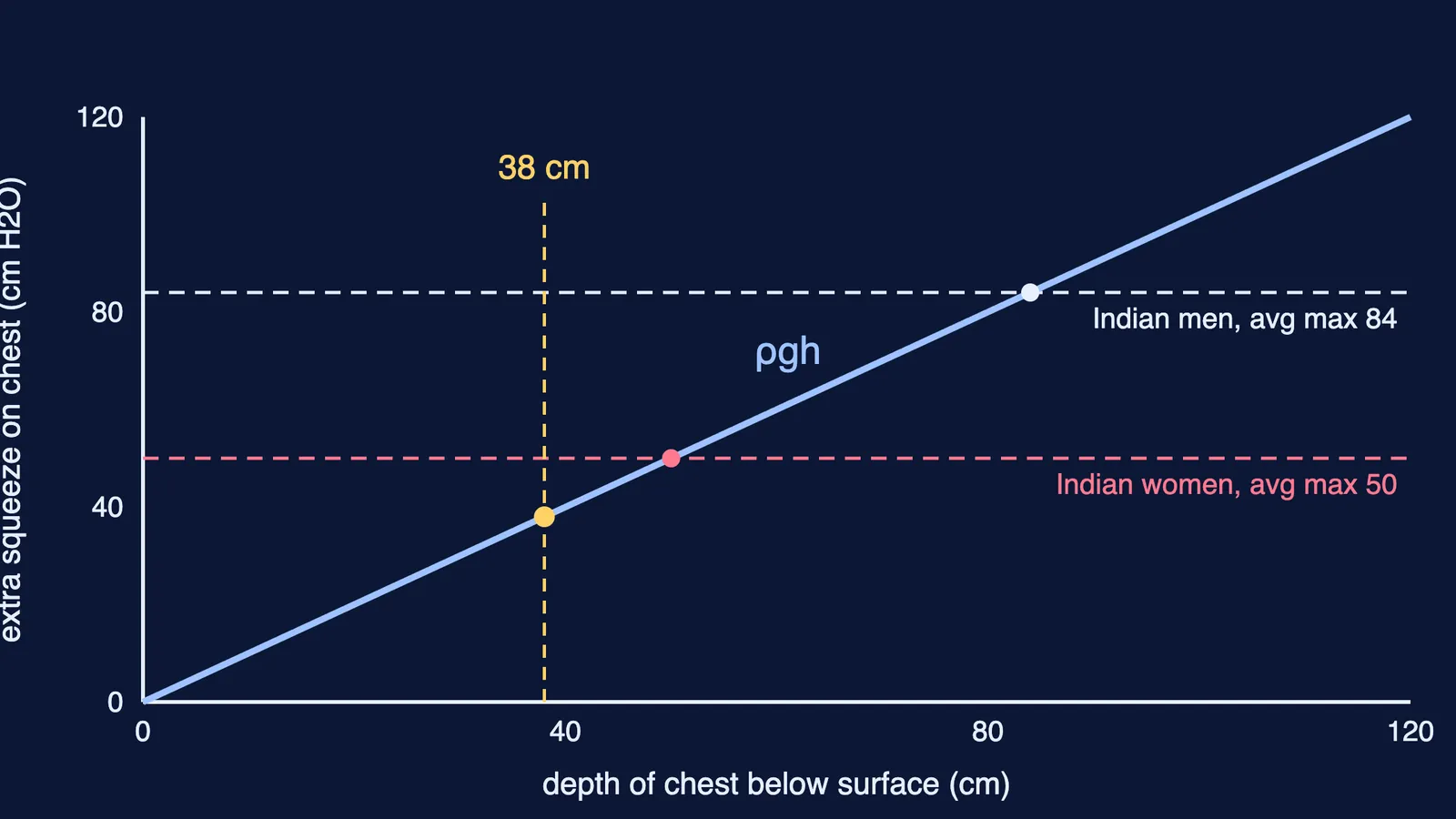
Through a snorkel, the air reaching your lungs is at the pressure of the air above the water. The water around your chest is at that pressure plus ρgh, where h is how far your chest sits below the surface. To breathe in, your diaphragm and rib muscles must expand your chest against that difference. (If gauge and absolute pressure are hazy, our explainer on why a flat tyre reads zero on a gauge sorts them out.)
Doctors measure breathing strength in centimetres of water (cm H2O), which makes the comparison neat: in fresh water, each centimetre of depth adds 1 cm H2O of squeeze.
In the Baltimore Longitudinal Study of Aging, healthy men averaged a maximal inspiratory pressure of 101 cm H2O and women 72 cm H2O (Harik-Khan and colleagues, 1998). A Singapore study that included 120 Indian adults found averages of about 84 cm H2O for Indian men and 50 cm H2O for Indian women (Johan and colleagues, 1997). Those are single, all-out efforts to breathe in, not something you can repeat every few seconds.
A worked example
Put your chest 1 m below the surface: Δp = ρgh = 1000 × 9.8 × 1 = 9,800 Pa. Since 1 cm H2O is about 98 Pa, that is roughly 100 cm H2O, about the average man's strongest single breath-in in the Baltimore data and twice the Indian women's average. Your breathing muscles cannot keep that up, breath after breath. Even with your chest a full 38 cm down, the squeeze would be about 38 cm H2O; in practice a snorkeller floats with the chest just under the surface, and the tube only has to keep its top above the ripples.
What is dead space, and why does a longer tube make it worse?
Anatomical dead space is the air in your airways, such as the nose, windpipe and bronchi, that never reaches the alveoli: about 150 mL of a typical 500 mL breath, leaving about 350 mL of fresh air for gas exchange (LibreTexts Pulmonary Physiology/03%3A_Lung_Volumes_and_Compliance/3.01%3A_Lung_volumes)). For the textbook values of the other lung volumes, see our guide to lung volumes and capacities in mL.
A snorkel adds 160-170 mL of dead space of its own, which raises the carbon dioxide in the air you breathe in. In a study of 12 people, rebreathing that air made them breathe more deeply (Toklu and colleagues, 2003).
Now the arithmetic, using those figures in a simple model:
No snorkel: 500 − 150 = 350 mL of fresh air reaches the alveoli.
Normal snorkel (170 mL): 500 − 150 − 170 = 180 mL, about half as much.
Same tube, twice as long (340 mL): 500 − 150 − 340 = 10 mL. Nearly all you inhale is air you just breathed out.
Breathing deeper helps but costs effort. Rising carbon dioxide is also what makes you gasp; our post on why you cannot hold your breath for long explains that alarm.
How can you check a snorkel's limits yourself?
Use this four-step check for any tube:
Depth squeeze: Δp = ρgh. In cm H2O it is simply the chest depth in cm (fresh water).
Compare it with 50-100 cm H2O, the range of average one-off maximum breath-in pressures in the Baltimore and Singapore studies. Comfortable breathing needs far less.
Dead space: add the tube's volume to your own 150 mL (LibreTexts/03%3A_Lung_Volumes_and_Compliance/3.01%3A_Lung_volumes)).
Fresh air: subtract that total from a 500 mL breath. If little is left, the tube fails.
If ρgh still feels abstract, the Fermi Simulation Lab has interactive simulations for ideas that are easier to see than read. And if pressure, Boyle's law and breathing all feel tangled, Fermi's AI tutor can work out what you already know and build a plan for the session, so you start from a clear next step.


