

On this page
Lung volumes get much easier in Class 11 Biology once you see that NCERT gives you only four numbers to learn. The five capacities are those four volumes added together. Here are the values, the sum behind each capacity, and a worked version of NCERT's own exercise.
What are the four lung volumes in NCERT?
All four come from section 14.2.1, "Respiratory Volumes and Capacities", in Chapter 14 (Breathing and Exchange of Gases) of the NCERT Class 11 Biology textbook.
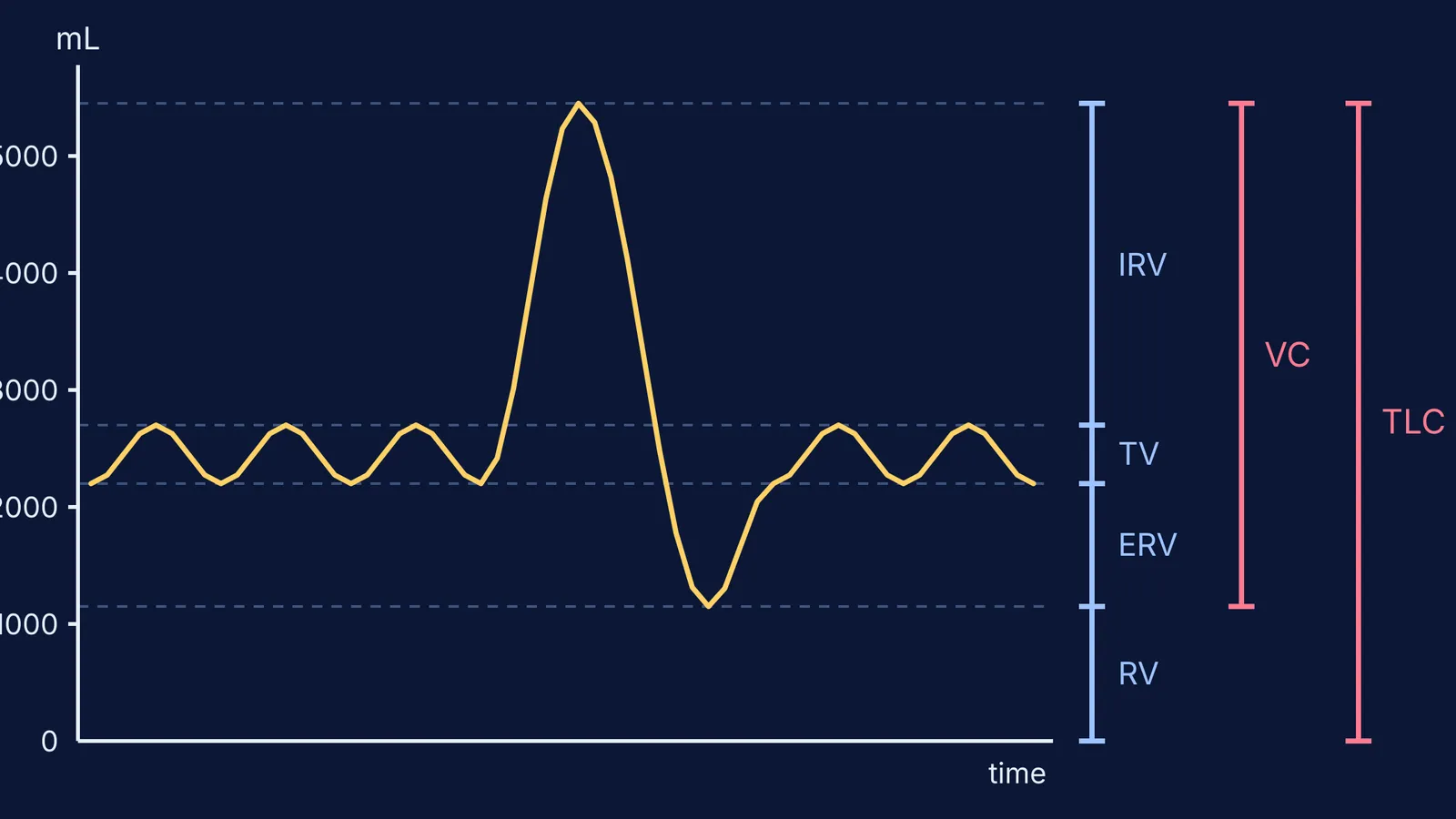
Tidal volume (TV): the air breathed in or out in one normal breath, about 500 mL.
Inspiratory reserve volume (IRV): the extra air you can breathe in by a forcible inspiration, on average 2500 mL to 3000 mL.
Expiratory reserve volume (ERV): the extra air you can breathe out by a forcible expiration, on average 1000 mL to 1100 mL.
Residual volume (RV): the air still left in the lungs even after a forcible expiration, on average 1100 mL to 1200 mL.
The chapter also says that, on average, a healthy human breathes 12 to 16 times a minute, and section 14.2.1 adds that a healthy man can breathe in or out about 6000 to 8000 mL of air per minute (NCERT).
How is each lung capacity a sum of volumes?
NCERT derives each pulmonary capacity by adding volumes (NCERT Chapter 14). It gives no mL totals, so the ranges below are our sums of its volume ranges.
Inspiratory capacity (IC) = TV + IRV, the most you can breathe in after a normal breath out: 3000 to 3500 mL.
Expiratory capacity (EC) = TV + ERV, the most you can breathe out after a normal breath in: 1500 to 1600 mL.
Functional residual capacity (FRC) = ERV + RV, the air left after a normal breath out: 2100 to 2300 mL.
Vital capacity (VC) = ERV + TV + IRV, the most you can breathe out after the deepest breath in: 4000 to 4600 mL.
Total lung capacity (TLC) = VC + RV, everything the lungs hold after the deepest breath in: 5100 to 5800 mL.
A memory hook: capacities with "residual" or "total" in the name include RV; inspiratory and expiratory capacity start from a normal breath, so they include TV.
Why is vital capacity not the same as total lung capacity?
Vital capacity is the air you can move. Total lung capacity also counts residual volume, the air that stays in the lungs even after a forcible expiration (NCERT). So TLC is always bigger than VC, by exactly RV.
That is also why a simple spirometer cannot measure residual volume: it records air moving in and out, and RV never leaves. Lung labs measure TLC and RV with methods such as whole-body plethysmography and helium dilution, which a 2013 study in the Jornal Brasileiro de Pneumologia compared in 169 people, most of them patients with lung disease. To practise on a real trace, see our post on reading a spirometer trace and how exercise shifts it.
How do you solve NCERT's tidal volume per hour question?
One NCERT exercise asks for the approximate tidal volume of a healthy human in an hour (NCERT, Chapter 14):
Per minute: 500 mL x 12 breaths = 6000 mL, and 500 mL x 16 breaths = 8000 mL.
Per hour: 6000 mL x 60 = 360,000 mL, and 8000 mL x 60 = 480,000 mL.
In litres: about 360 to 480 L of air an hour.
Watch the trap in another exercise, which asks for the air left in the lungs after normal breathing. That is FRC (ERV + RV, about 2100 to 2300 mL), not residual volume, which is what is left after a forced breath out.
When a question gives its own numbers, use them, not NCERT's averages. If TV is 500 mL, IRV 3000 mL and ERV 1100 mL, then IC is 3500 mL, EC is 1600 mL and VC is 4600 mL. If a step goes wrong, the Fermi Problem Library has a step-by-step solver that explains the reasoning rather than printing an answer.
A two-minute self-test before your exam
Write the four volumes and values from memory.
Stack them in a tall bar, bottom to top: RV, ERV, TV, IRV.
Bracket each capacity on the bar with its formula.
Add the ranges for VC and TLC and check them above.
Say which capacities include RV (FRC and TLC) and why a spirometer misses them.
If the stacking still feels shaky, the Fermi Concept Library gives each biology concept its own lesson and its place in the map. Next, read our breathing and gas exchange chapter guide and our explainer on anatomical dead space.


