

On this page
When we breathe, not all the air we inhale actually reaches our lungs' gas-exchanging surfaces. Some of it gets trapped in the airways, a physiological hurdle that explains why how you breathe is just as important as how fast you breathe.
Whether you are preparing for NEET biology or trying to manage exam stress, understanding your respiratory volume holds a very practical lesson for studying.
What is dead space in respiration?
Anatomical dead space is the volume of inhaled air that remains in the conducting zone of your respiratory system—the nose, pharynx, larynx, trachea, and bronchi—where no gas exchange occurs.
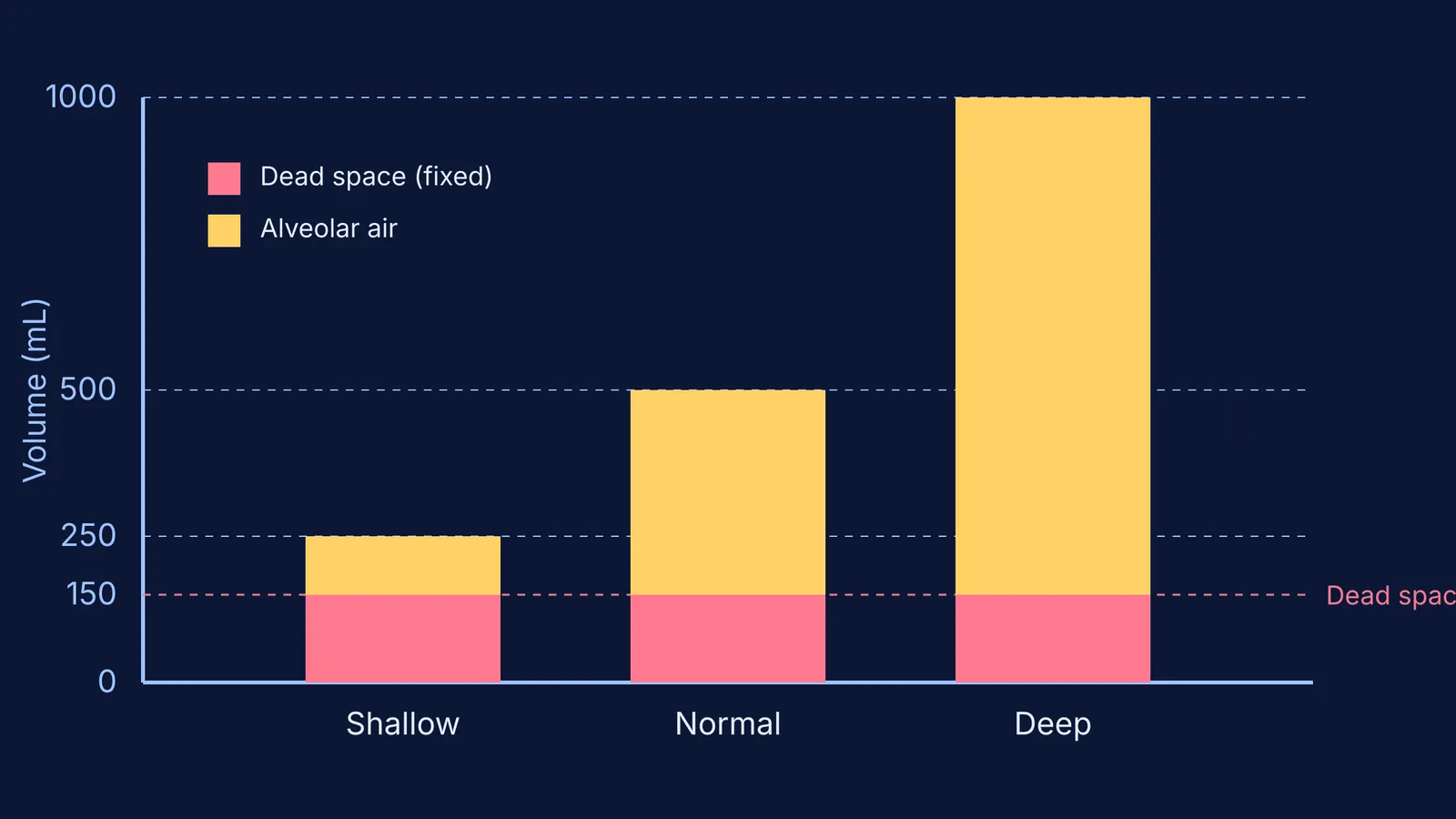
In a healthy adult, anatomical dead space typically accounts for about 150 mL of air per breath [[1]](https://www.ncbi.nlm.nih.gov/books/NBK482501/). Since a normal resting breath, or tidal volume, is about 500 mL, this means roughly 30% of each breath is wasted in the conducting airways before it ever reaches the alveoli. This volume stays relatively constant because the physical size of your airways does not change much.
Why do slow deep breaths ventilate alveoli better?
Alveolar ventilation is the actual volume of fresh air reaching your alveoli per minute. It is defined as the tidal volume minus the dead space, multiplied by your respiratory rate [[1]](https://www.ncbi.nlm.nih.gov/books/NBK482501/). Because the 150 mL dead space is a fixed barrier, shallow breathing is extremely inefficient.
Imagine taking rapid, shallow breaths of 250 mL at a rate of 30 breaths per minute. While your total ventilation seems high at 7,500 mL per minute, only 100 mL of each breath reaches the alveoli. Your actual alveolar ventilation is just 3,000 mL per minute.
Now consider taking slow, deep breaths of 1,000 mL at just 7.5 breaths per minute. Your total ventilation is still 7,500 mL per minute. However, 850 mL of each breath reaches the alveoli. Your alveolar ventilation jumps to 6,375 mL per minute—more than double the efficiency of shallow breathing.
By inhaling deeply, you easily bypass the anatomical dead space, delivering a much higher fraction of fresh oxygen to your blood and tissues.
How does slow breathing calm exam anxiety?
Beyond oxygen delivery, how you breathe directly alters your brain state. In periods of high stress, such as during an exam or a difficult study block, students often slip into rapid, shallow breathing.
Studies show that voluntarily slowing your breathing to under 10 breaths per minute increases parasympathetic nervous system activity, often called the rest-and-digest mode [[2]](https://pubmed.ncbi.nlm.nih.gov/30245619/). This slow breathing pattern increases heart rate variability and shifts brain activity towards relaxed alertness, significantly reducing symptoms of anxiety and confusion.
How can you apply this to your study routine?
You can use a simple paced breathing protocol to reset your focus before a high-stakes mock test or when tackling a challenging problem:
Inhale slowly for 5 seconds, drawing air deep into your lungs to maximise tidal volume.
Exhale slowly for 5 seconds to signal safety to your vagus nerve.
Repeat this cycle for just one minute.
The next time you hit a difficult question in the Fermi Problem Library, take three slow, deep breaths. The step-by-step solver explains the reasoning rather than printing an answer, and paced breathing keeps your mind clear enough to follow it.
For biology students, linking respiratory physiology to daily habits is a great way to revise. To explore more about respiratory pathways, read about J. S. Haldane, carbon monoxide and the animals that warned miners or review the respiratory quotient: why RQ is 1, 0.7 or 0.9 for different fuels.
If you are working through other challenging topics, explore the Fermi Concept Library, which covers every concept in physics, chemistry, biology, mathematics and computing, each with its own lesson and its place in the map.


