On this page
Take a big breath and hold it. Soon your chest tugs, and you breathe whether you meant to or not. Your lungs still have air in them, and your blood still has plenty of oxygen. What makes you stop is mostly your brain, reacting to carbon dioxide.
What makes you breathe again when you hold your breath?
Breathing is run by the nervous system. The NCERT Class 11 Biology chapter Breathing and Exchange of Gases describes three parts:
The respiratory rhythm centre in the medulla of the brain is primarily responsible for regulating breathing.
The pneumotaxic centre in the pons can shorten each inspiration and so change the breathing rate.
A chemosensitive area next to the rhythm centre is highly sensitive to CO2 and hydrogen ions; when they rise, it signals the rhythm centre to adjust breathing so they can be removed.
Receptors in the aortic arch and carotid artery also sense CO2 and H+ and report to the rhythm centre. The same chapter says the role of oxygen in regulating the respiratory rhythm is "quite insignificant".
So here is what happens during a breath-hold. Your cells keep making CO2. It cannot leave through the lungs, so it builds up in the blood. CO2 reacts with water, helped by the enzyme carbonic anhydrase, to form carbonic acid, which splits into bicarbonate and hydrogen ions, as the NCERT chapter shows. More CO2 means more H+, and the chemosensitive area pushes the rhythm centre harder, until the drive to breathe beats your will. More in our explainer on the respiratory rhythm centre in the medulla; for the chemistry, see how carbonic anhydrase carries CO2 in blood.
How long can a normal person hold their breath?
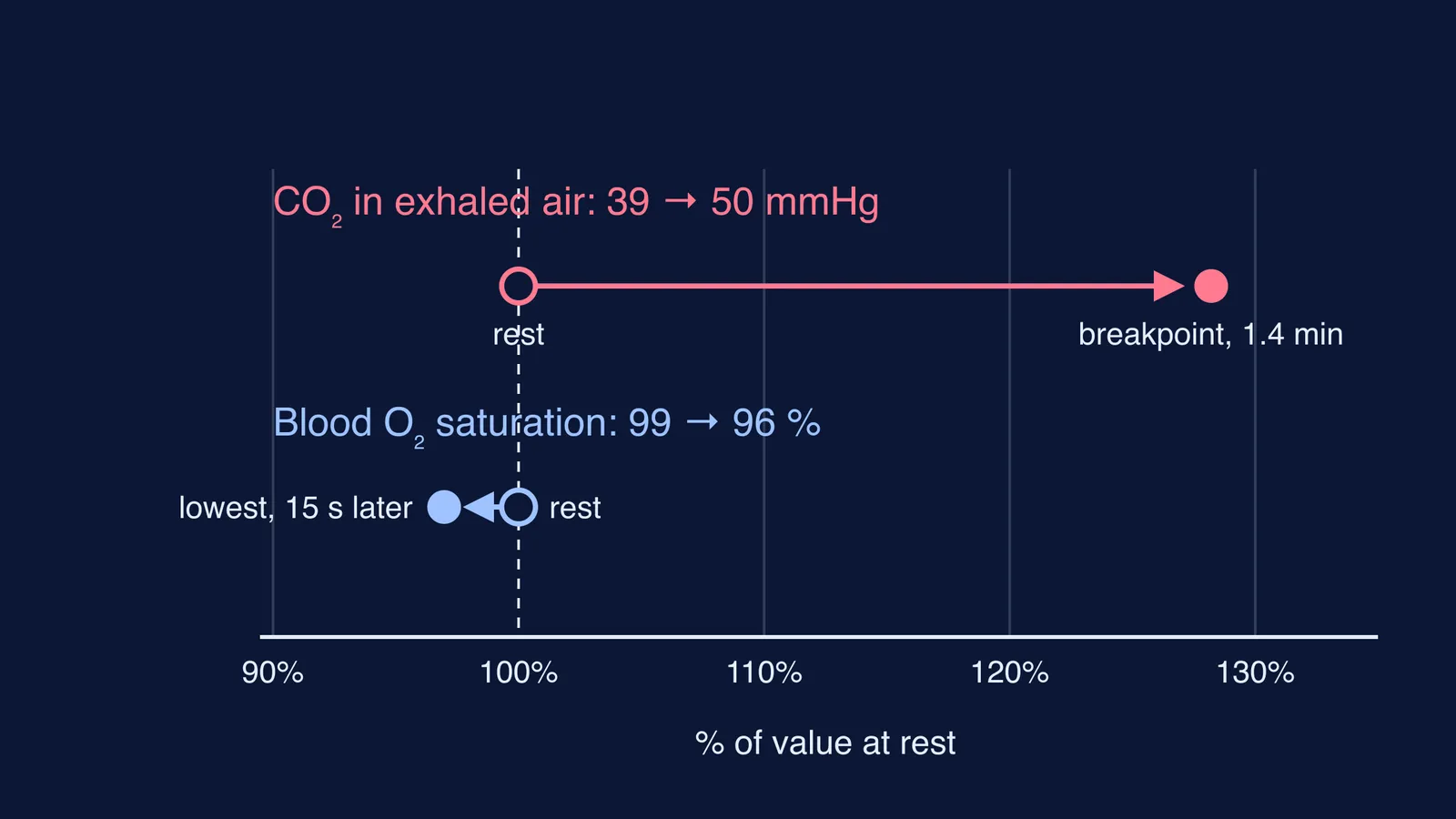
A study in the British Journal of Radiology by M. J. Parkes and colleagues measured this in 12 healthy people aged 20 to 22 with no breath-holding experience. After breathing in fully, they held their breath for 1.4 minutes on average. By the breakpoint, the CO2 in their exhaled breath had risen from 39 to 50 mmHg. Their blood oxygen saturation fell only from 99% to a low of 96%, reached about 15 seconds after the breakpoint.
In a review in Experimental Physiology, Parkes notes that healthy people appear unable to hold their breath until they pass out, because a powerful involuntary mechanism overrides the voluntary hold. The review also says the breakpoint does not seem to be caused solely by blood gases, the carotid chemoreceptors or the lungs shrinking; signals from the diaphragm may matter too, and no single explanation yet fits every observation.
Why is hyperventilating before swimming underwater dangerous?
If CO2 is the alarm, then lowering it first delays the alarm, and that is what fast, deep breathing before a dive does. A CDC report from 2015 explains that hyperventilation before swimming lowers the body's CO2 and delays the brain's response to come up for air, while oxygen keeps falling until the swimmer can black out underwater. The report reviewed 16 cases of dangerous underwater breath-holding in New York State between 1988 and 2011; four people died, and all four deaths involved deliberate hyperventilation.
How do you write this as an exam answer?
A five-step chain for a short answer on regulation of breathing:
Holding the breath stops CO2 leaving the lungs, but cells keep producing it.
Blood pCO2 rises above its normal arterial value of 40 mmHg (NCERT Table 14.1), and H+ rises with it: CO2 + H2O to H2CO3 to HCO3- + H+.
The chemosensitive area beside the respiratory rhythm centre in the medulla is activated; receptors in the aortic arch and carotid artery add their signals.
The rhythm centre drives the breathing muscles, and the voluntary hold is overridden.
Oxygen plays only a minor part in this normal control, which is why the urge comes while blood oxygen is still high.
Then test yourself with three predictions, checked against the Experimental Physiology review:
Breathing extra oxygen first: longer or shorter?
Blowing off CO2 by over-breathing first: longer or shorter?
Holding right after a sprint, when metabolism is high: longer or shorter? Our post on why we breathe hard after running gives the clue.
The review's answers: extra oxygen and low CO2 both lengthen a hold, and a higher metabolic rate shortens it. In the British Journal of Radiology study, breathing 60% oxygen first doubled the average hold to 2.8 minutes, so falling oxygen does add to the urge during a long hold, even if CO2 leads.
Feedback loops like this are easier to see than to read. The Fermi Simulation Lab has interactive simulations for ideas of that kind. If the medulla, pons and carotid bodies still blur together, the Fermi Concept Library gives every concept in biology its own lesson and its place in the map.
Next time you surface from a dive gasping, you will know what you felt: mostly your brain reading the rising CO2.