On this page
Carol Dweck is a psychologist at Stanford University, where she holds the Lewis and Virginia Eaton professorship in psychology (Stanford profile). Her central idea fits in one sentence: people with a fixed mindset believe abilities are fixed, while people with a growth mindset believe abilities can be developed (Mindset, Penguin Random House). She brought it to a general audience in her 2006 book *Mindset*.
What did Carol Dweck's praise experiment find?
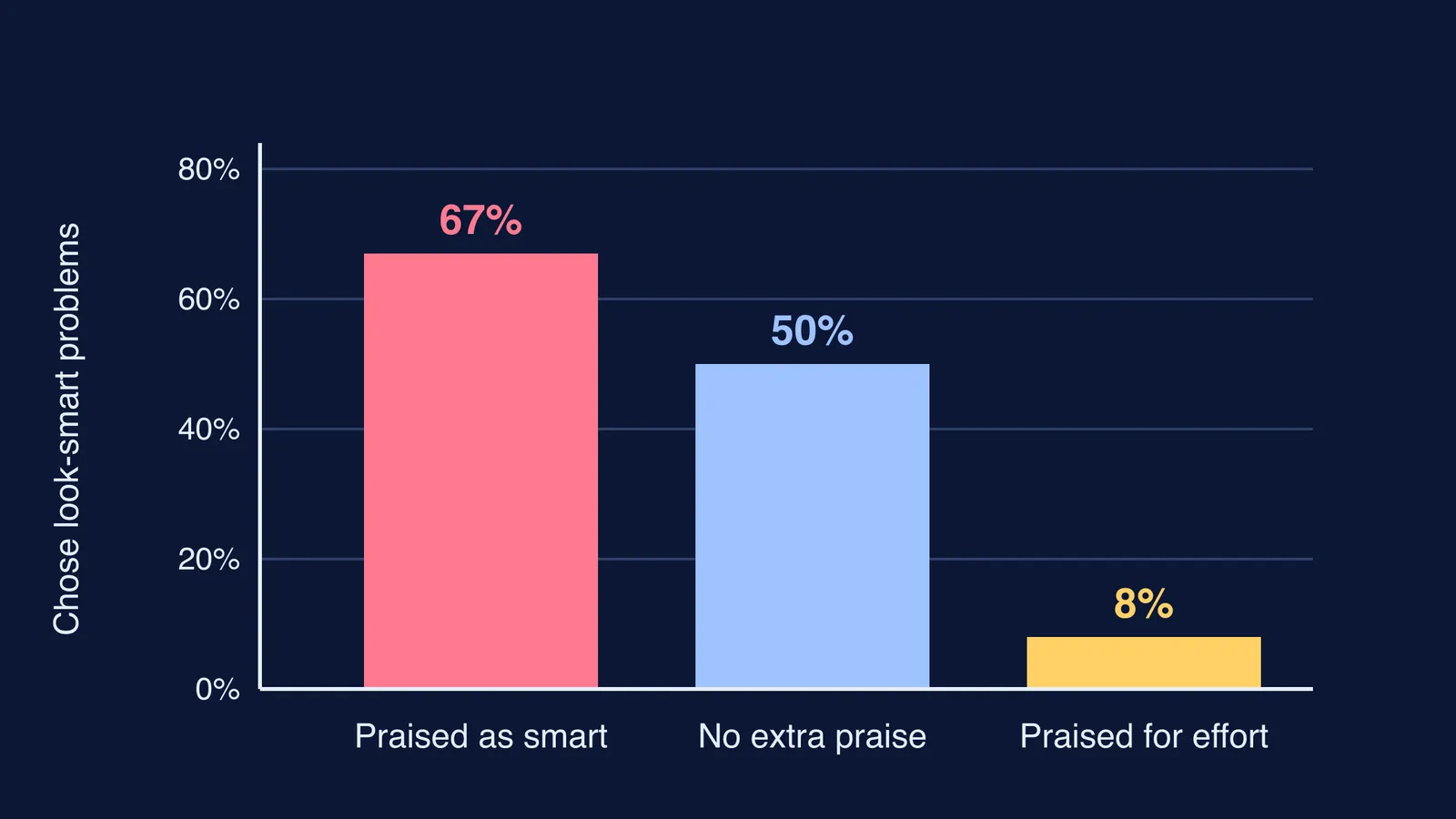
The best-known study is from 1998, by Claudia Mueller and Carol Dweck, then at Columbia University (Journal of Personality and Social Psychology). In the first of six studies, 128 fifth graders solved a set of pattern puzzles and were all told they had done well. Then one group heard “You must be smart at these problems”, a second heard “You must have worked hard at these problems”, and a third heard nothing extra (full paper, Columbia University).
Next, each child chose what kind of problems to do later. In that study, 67% of children praised for intelligence chose problems that would let them look smart, while only 8% of children praised for effort did; 92% of the effort group chose problems they could learn from (Mueller and Dweck, 1998). After a harder set went badly, the children praised as smart enjoyed the work less, wanted to persist less, and blamed low ability more.
The lesson is not that praise is bad. Praise tells a child what you value. “Smart” says the score proves something fixed, so a bad score becomes a threat. “Worked hard” says the process matters, so a bad score becomes information.
Does a growth mindset actually improve marks?
Sometimes, by a modest amount, and mostly for students who are struggling. Three studies show the range.
A 2007 study by Lisa Blackwell, Kali Trzesniewski and Dweck followed 373 seventh graders and found that believing intelligence can grow predicted rising maths grades over two years of junior high. In a second study, an intervention teaching that belief to 48 students reversed their decline in grades, while a control group of 43 kept declining (Child Development).
Two 2018 meta-analyses by Victoria Sisk and colleagues, one on the link between mindset and marks (365,915 students) and one on mindset interventions (57,155 students), found the overall effects were weak, though students from low-income families or at academic risk might benefit (Psychological Science).
A 2019 national experiment in the United States with 12,490 ninth graders found that an online growth-mindset lesson of under an hour raised the grades of lower-achieving students by 0.10 grade points and increased enrolment in advanced maths (Yeager and colleagues, Nature).
So a mindset is not a switch that turns a weak student into a topper. We cover the wider debate in growth mindset: what the big studies found and what it means.
Is praising effort enough?
No, and Dweck has said so herself. In a 2015 Education Week essay she warned against praising effort when a student is not learning, and wrote that students “need this repertoire of approaches—not just sheer effort—to learn and improve” (Education Week). She suggested teachers say: “Let's talk about what you've tried, and what you can try next.”
A student who spends four hours rereading the same chapter has worked hard but used a weak strategy. Praising only the hours teaches the wrong lesson.
What should you say instead? A script for a disappointing result
Your child brings home a physics unit test with a lower mark than they hoped. Try this, in order:
Notice the work: “I saw you doing numericals every evening this week.”
Ask about strategy, not ability: “Which questions went wrong, and what did you try on them?”
Sort each mistake: the concept was unclear, the method was wrong, or it was a slip in calculation.
Pick one next step for each kind: relearn the concept, redo the problem by another method, or add a checking step.
Close on the plan, not the mark: “Let's try that for two weeks and look again.”
Drop “You're a natural at maths”: the next bad mark then feels like proof of the opposite. For more examples, read how to praise children: process praise vs “you're so smart”.
How can a student use this before boards or JEE?
Talk to yourself the way the script talks to a child. When a mock test goes badly, write “What did I try, and what can I try next?” at the top of your error log, then sort each mistake as above. For a wrong method, a worked solution helps more than an answer key: the Fermi Problem Library has a step-by-step solver that explains the reasoning rather than printing an answer, so you can see where your method broke. For a concept gap, start from that idea's lesson in the Fermi Concept Library.
If fear of getting things wrong stops your child from starting at all, read helping a child who is afraid of making mistakes in studies. If worry about marks affects sleep, eating or mood for weeks, talk to a school counsellor or a doctor, or call Tele MANAS on 14416 for free counselling and referrals (Tele MANAS details).