

On this page
When a child erases a math line until the paper tears, leaves tough exam questions completely blank, or bursts into tears over a single incorrect calculation, the root issue is rarely lack of talent. More often, the student is grappling with an acute fear of making mistakes. In academic environments focused heavily on competitive selection—such as CBSE board exams, JEE, or NEET—children quickly absorb the idea that an error is an indictment of their intelligence. Over time, this dread transforms homework into high-stakes judgment, driving avoidance, procrastination, and chronic test anxiety.
Why is my child afraid of making mistakes in studies?
Fear of failure in academic tasks is widespread and begins early. In the global PISA 2018 assessment, 56.4% of 15-year-old students across OECD countries agreed with the statement "When I am failing, I worry about what others think of me," according to the OECD PISA 2018 report. For many students, an incorrect answer feels like social exposure: a signal to parents, teachers, and peers that they are not as capable as presumed.
When children believe that intelligence is a fixed trait, every wrong answer feels dangerous. They reason that if they were truly smart, the problem would come easily. Consequently, encountering friction feels like proof of deficiency. For families navigating rigorous academic routines, understanding how parents can help children learn without adding pressure begins by recognizing that error avoidance is a protective shield against feeling inadequate.
How do parental reactions shape a child's view of failure?
Parents often believe that telling children "intelligence can grow" is enough to build confidence. However, research reveals that children watch how parents respond to real-world setbacks much more closely than they listen to general advice.
A landmark study by Kyla Haimovitz and Carol S. Dweck published in *Psychological Science* (Haimovitz & Dweck, 2016) showed that parents' failure mindsets—whether they view failure as debilitating or enhancing—directly predict their children's beliefs about intelligence. When parents react to poor marks with anxiety, frustration, or consoling pity ("Maybe you're just not a maths person"), children conclude that failure is debilitating and adopt a fixed mindset. Conversely, when parents react to mistakes with curiosity and interest in the learning process, children come to view setbacks as valuable feedback.
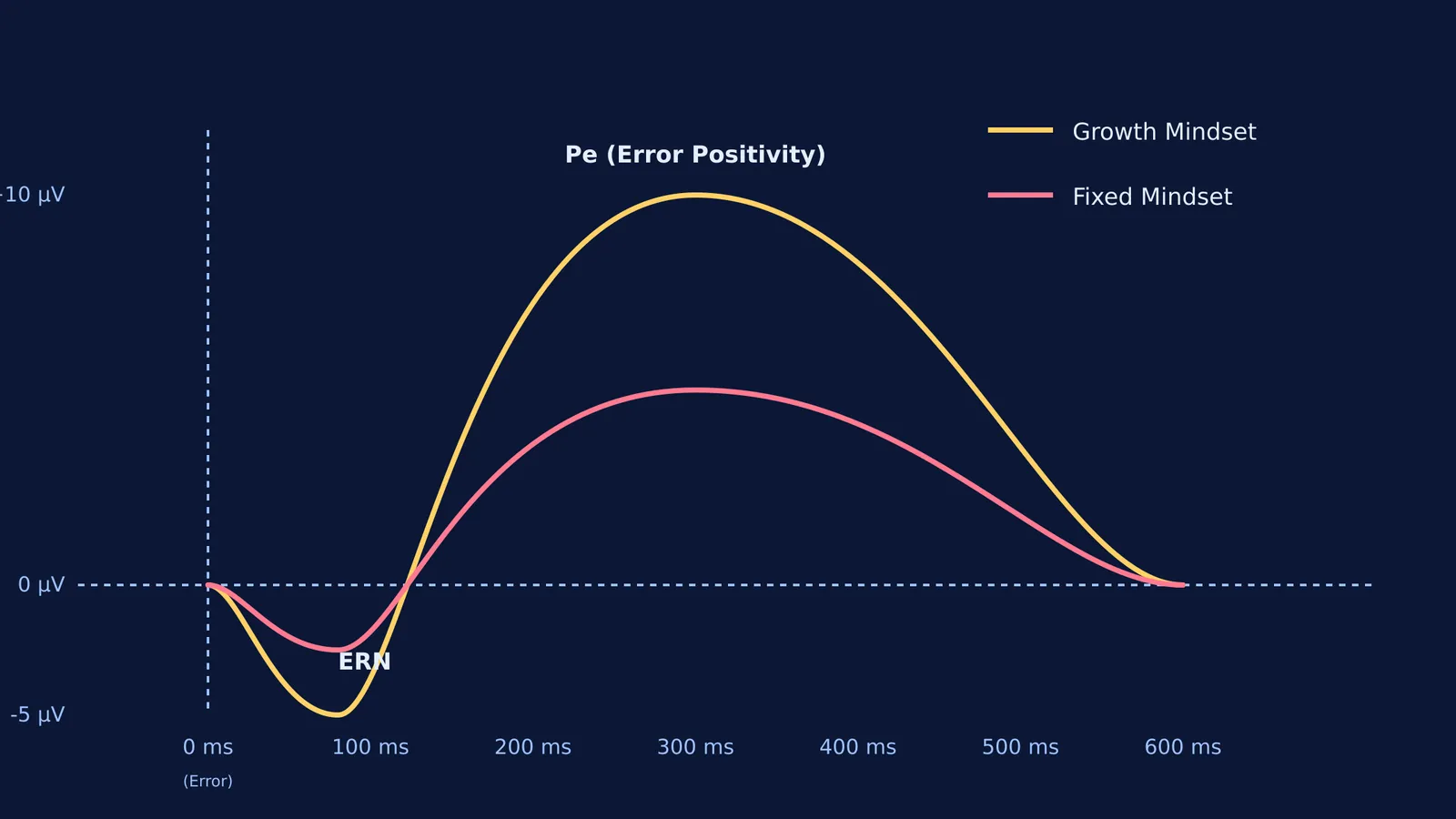
This psychological orientation changes how the brain itself processes errors. In electrophysiological research published in *Psychological Science* (Moser et al., 2011), researchers recorded neural event-related potentials after participants committed mistakes. Students with a growth mindset exhibited a significantly larger Error Positivity (Pe) signal—a brain wave occurring 200 to 500 milliseconds after an error that reflects conscious awareness and allocation of attention. Crucially, this heightened neural attention directly mediated greater accuracy on subsequent attempts. Shifting away from innate ability praise, as discussed in how to praise children: process praise vs 'you're so smart', helps children engage this constructive neural response rather than shutting down.
What language helps children treat errors as information?
The everyday culture at home determines whether a child views mistakes as catastrophic or informative. A study of 1,116 students across 56 mathematics classrooms published in *Contemporary Educational Psychology* (Steuer et al., 2013) identified that a constructive "error climate"—where mistakes are openly discussed without negative teacher or peer reactions—directly fosters student persistence and reduces academic anxiety.
Parents can establish an error-friendly climate at home by replacing judgment with diagnostic inquiry:
Instead of: "Why did you make such a careless mistake on this easy step?"
Say: "Let's look at this step together. Where did your thinking branch away from the concept?"
Instead of: "Don't worry, you tried your best, some topics are just too difficult."
Say: "This wrong answer shows exactly where the formula became confusing. That gives us a clear place to start."
Instead of: Hiding adult mistakes to appear infallible.
Say: Share an everyday error at dinner—such as miscalculating a travel schedule or overlooking a bill—and describe how you identified and fixed it.
Normalising errors requires showing that capable adults make miscalculations, review the data, and make adjustments without losing self-worth.
How can families build low-stakes practice at home?
Children cannot learn to tolerate mistakes if every problem set feels like an exam. In a comprehensive review in the *Annual Review of Psychology* (Metcalfe, 2017), cognitive psychologist Janet Metcalfe demonstrated that avoiding errors during practice impairs conceptual learning. Engaging in generative retrieval where mistakes occur, followed by explanatory feedback, leads to superior long-term retention compared to errorless repetition. Metcalfe emphasized that for students to reap these cognitive benefits, practice must take place in low-stakes conditions where mistakes carry no punitive consequences.
To implement low-stakes practice at home, use this four-step review routine:
Mark without grades: When checking homework, circle incorrect steps with a neutral pencil mark, avoiding red pens, score percentages, or rankings.
Classify the slip: Ask your child to categorise the issue into one of three buckets: a misread question, a calculation slip, or an underlying concept gap.
Trace the line of reasoning: Encourage the child to narrate their thinking out loud until they spot the divergence, rather than immediately writing out the correct answer for them.
Re-attempt an unranked twin: Provide one similar problem right away so they experience immediate mastery of the corrected concept.
When working through unfamiliar numerical problems at home, the Fermi Problem Library has worked problems with a step-by-step solver that explains the reasoning rather than printing an answer, allowing students to inspect where their reasoning parted from the solution without marks or time pressure. Similarly, for independent study sessions where a student wants to explore difficult concepts privately, Fermi's AI tutor notices where a student is stuck and decides whether to explain, ask or show, checking understanding as it goes.
As detailed in why making mistakes helps you learn, and how to use them, errors are the primary signals the brain uses to update its mental models. When home becomes a safe place to get things wrong, academic study ceases to be a test of worth and becomes what it was always meant to be: an ongoing process of discovery.


