On this page
Plant the stone of a mango you ate this summer and you may wait years for a single fruit. A grafted nursery sapling may set fruit within a year or two of planting, according to Fruits of Warm Climates. The difference is the age of the shoot, and grafting lets a grower borrow an old one.
Why does a mango seedling take so long to fruit?
Every tree grown from seed starts in a juvenile phase. Juvenility is "the extended period of post-germination, vegetative development in which flowering is repressed even under otherwise favorable environmental conditions", as Steve van Nocker and Susan Gardiner define it in a 2014 review in Horticulture Research. Their table of field figures shows how long it lasts: 6 to 12 years for apple and pear, 5 to 10 years for oranges and lemons, and 15 years or more for avocado.
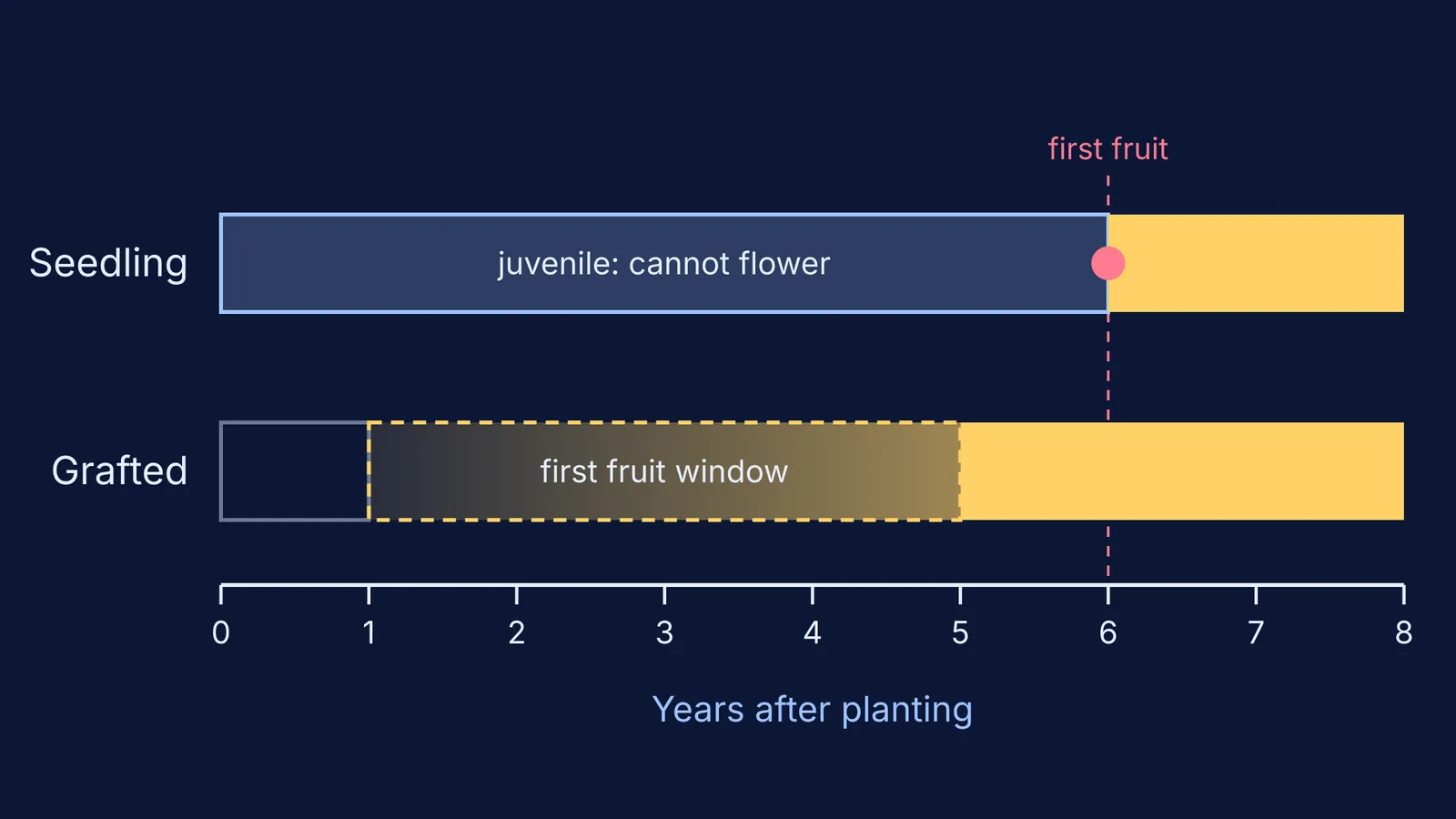
For mango, seedlings generally take 6 years to fruit and 15 years to reach their optimum yield, according to Julia Morton's 1987 book Fruits of Warm Climates.
What keeps a young tree juvenile? Part of the answer is a small RNA molecule. In a 2011 study in PLoS Genetics, Jia-Wei Wang, Scott Poethig and colleagues report that miR156 is highly abundant in seedlings and falls as the plant moves from the juvenile to the adult phase. In trees that change takes months or years.
What does grafting change?
A graft joins two plants. The rootstock is a young seedling that supplies roots. The scion is a shoot or bud of the variety you want, and it grows into the canopy that flowers and fruits. For the tissue-level picture, see our explainer on how stock and scion tissues unite.
The key point is that the adult state belongs to the shoot, not to the calendar. Van Nocker and Gardiner note in the same review that the top of a plant that has reached the adult state can be grafted onto a rootstock for further growth. A scion taken from a fruiting Alphonso or Dasheri tree is already adult, so it does not start the juvenile clock again on its new roots.
Morton writes that grafted mangoes may set fruit within a year or two from planting (Fruits of Warm Climates). The University of Florida's Mango Growing in the Florida Home Landscape puts the start of bearing at 3 to 5 years after planting. Early flowering is common enough that TNAU's mango guide tells growers to remove flowers for the first three years so the young tree builds its frame first.
Why not just plant the seed?
Speed is half the reason. The other half is that most seeds do not give you the same mango. The UF/IFAS guide explains that monoembryonic seeds hold one embryo with genes from both parents, so the tree is a hybrid, while polyembryonic seeds contain several embryos, most of them genetically identical to the mother tree.
Most Indian mangoes are monoembryonic, Morton notes in Fruits of Warm Climates, and inarching and approach grafting are traditional in India. TNAU lists approach and epicotyl grafts as the methods used for planting.
Grafting is a form of vegetative propagation: a new plant made from part of one parent, with no seed and no mixing of genes, like cuttings and layering in our post on vegetative propagation in Bryophyllum and beyond. For the full contrast, see sexual vs asexual reproduction side by side.
What happens if you plant a seedling and a graft together?
Say you plant a seedling from an Indian mango stone and a grafted sapling of the same variety in July. Using the figures above:
Years 1 to 2: both trees put out leafy flushes. The grafted tree may already push flower panicles; the seedling cannot, because it is still juvenile.
Year 3: following TNAU's advice, you have been removing the grafted tree's flowers. From now on you let them set.
Years 3 to 5: the grafted tree starts bearing, in line with the UF/IFAS range, and its fruit matches the parent variety.
Around year 6: the seedling finally fruits, close to Morton's typical figure. Its fruit is a surprise, because a monoembryonic seed gives a hybrid.
How do you explain this in an exam answer?
A four-line checklist for this question:
Name the parts: scion (shoot of the desired variety) and stock (rooted seedling).
State the trait rule: the scion decides the variety of fruit; the stock supplies roots.
State the age rule: the scion is taken from a mature tree, so it is already past its juvenile phase.
Name the category: grafting is vegetative propagation, so the fruiting canopy is genetically identical to the scion's parent.
A common trap is writing that grafting simply makes the tree grow faster. The key idea is different: the graft skips a stage the scion has already finished.
If phase change still feels abstract, the Fermi Concept Library gives every biology concept its own lesson and its place in the map. For ideas that are easier to see than read, try the interactive simulations in the Fermi Simulation Lab.