On this page
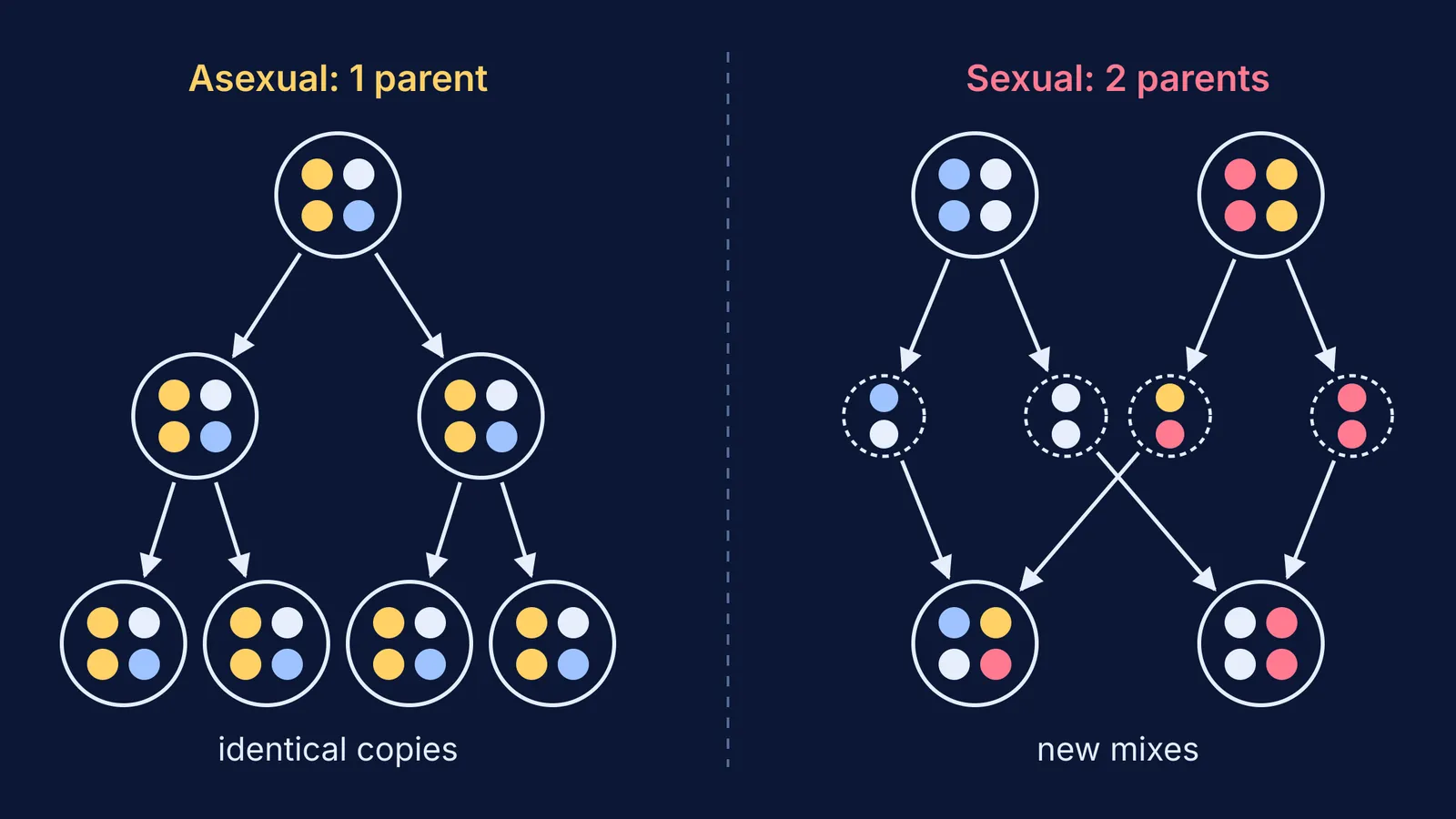
Your exam will ask you to tell the two kinds of reproduction apart. Almost every difference comes back to one question: does the offspring come from one parent's copied cells, or from two gametes that fuse?
What is the difference between sexual and asexual reproduction?
Asexual reproduction produces offspring that are genetically identical to the parent, because the offspring are clones (OpenStax Biology 2e). In sexual reproduction, the genetic material of two individuals is combined to produce genetically diverse offspring (same source).
The combining happens through gametes. A gamete is a reproductive cell, an egg or a sperm, that carries only one copy of each chromosome (NHGRI glossary). In humans, meiosis gives each sperm and egg 23 chromosomes, and fertilisation restores the full 46 (NHGRI glossary).
Here is the comparison, point by point:
Number of parents: asexual, one; sexual, usually two.
Gametes: asexual, no fusion of gametes; sexual, a male and a female gamete fuse at fertilisation.
Cell division: asexual, the parent's cells copy themselves (binary fission in bacteria); sexual, meiosis halves the chromosome number to make gametes.
Offspring: asexual, identical clones; sexual, different from each parent and from each other.
Speed: asexual, fast, with large numbers of offspring from one individual; sexual, slower, because a mate is needed.
Forms: asexual, fission, budding, fragmentation and parthenogenesis; sexual, fertilisation of an egg by a sperm.
OpenStax adds that colonising a new habitat is easier when an individual does not need a mate (OpenStax Biology 2e). For the difference between one split and many, see our explainer on binary vs multiple fission.
Why is asexual reproduction faster?
There is no mate to find and no gametes to make, and every individual can reproduce. Because males in a sexual population do not produce offspring themselves, an asexual population could, in theory, grow twice as fast (OpenStax Biology 2e, section 11.2).
Bacteria show the speed at its extreme. *Escherichia coli* can double in as little as 20 minutes under the best lab conditions, though in harsh environments it may need several days (OpenStax Microbiology).
A worked example makes both points concrete:
Start with one *E. coli* cell doubling every 20 minutes. Two hours is 6 doublings, so you get 2 x 2 x 2 x 2 x 2 x 2 = 64 cells.
Now take two populations of 100, where every female has 2 offspring per generation. The asexual population is all female: 100 becomes 200, then 400.
The sexual population is half male. Its 50 females have 100 offspring, so it stays at 100.
That gap is the cost of sex on paper. So why do most living things pay it?
Why does sexual reproduction matter for evolution?
Natural selection can only choose among differences, and sexual reproduction makes a great many of them. Humans have 23 chromosome pairs, which gives over eight million (2 to the power 23) genetically distinct gametes just from how chromosomes line up in meiosis (OpenStax Biology 2e, section 11.1). Crossing over adds more, and fertilisation then pairs one of these gametes with one from another parent. Our post on why meiosis creates variation walks through each step.
The genetic diversity of sexually produced offspring is thought to give a species a better chance of surviving in an unpredictable or changing environment (OpenStax Biology 2e). One reason the environment keeps changing is other living things. The Red Queen hypothesis, first proposed by Leigh Van Valen in 1973, says species coevolve with their parasites and rivals, so they must keep changing just to hold their place (OpenStax Biology 2e, section 11.2).
Levi Morran and colleagues at Indiana University tested this with *C. elegans* worms, which can either self-fertilise or mate with another worm (Morran et al., Science, 2011). In mixed-mating populations, coevolving with a bacterial pathogen led to significantly more outcrossing, and it rapidly drove populations that could only self-fertilise to extinction, while outcrossing populations persisted. The authors note that most organisms reproduce by outcrossing despite its costs.
How do you write a difference answer that scores full marks?
Write matched pairs, not two separate paragraphs. Use this plan for a 3 or 5 mark question:
Open with one definition line for each, using the words genetically identical and gametes.
Compare on the same points in the same order: parents, gametes, cell division, offspring, speed.
Give one named example on each side.
Finish with one evolution line: variation gives a species a better chance in a changing environment.
Watch for one trap. In parthenogenesis an egg develops into a complete individual without being fertilised (OpenStax Biology 2e). An egg is involved, yet it counts as asexual. That is why no fusion of gametes is a safer phrase than no gametes.
If a row in your comparison feels memorised rather than understood, the Fermi Concept Library gives every biology concept its own lesson and its place in the map, so you can see how meiosis, gametes and variation connect.
For the full chapter, including budding, spores and pollination, read our Class 10 guide to how organisms reproduce.