

On this page
Both are forms of asexual reproduction where a parent cell copies its genetic material and divides. The difference lies in the number of offspring and the timing of the division.
In a single-celled organism, reproduction is a matter of survival and efficiency. When comparing these strategies, biologists look at three main differences:
Number of offspring: Binary fission creates exactly two daughter cells, while multiple fission creates many.
Timing of division: Binary fission splits the cytoplasm immediately after the nucleus divides, whereas multiple fission delays cytoplasmic division until many nuclei are formed.
Purpose: Binary fission is a steady way to multiply, while multiple fission is often used to rapidly overwhelm a host or survive harsh environments.
How does an Amoeba reproduce by binary fission?
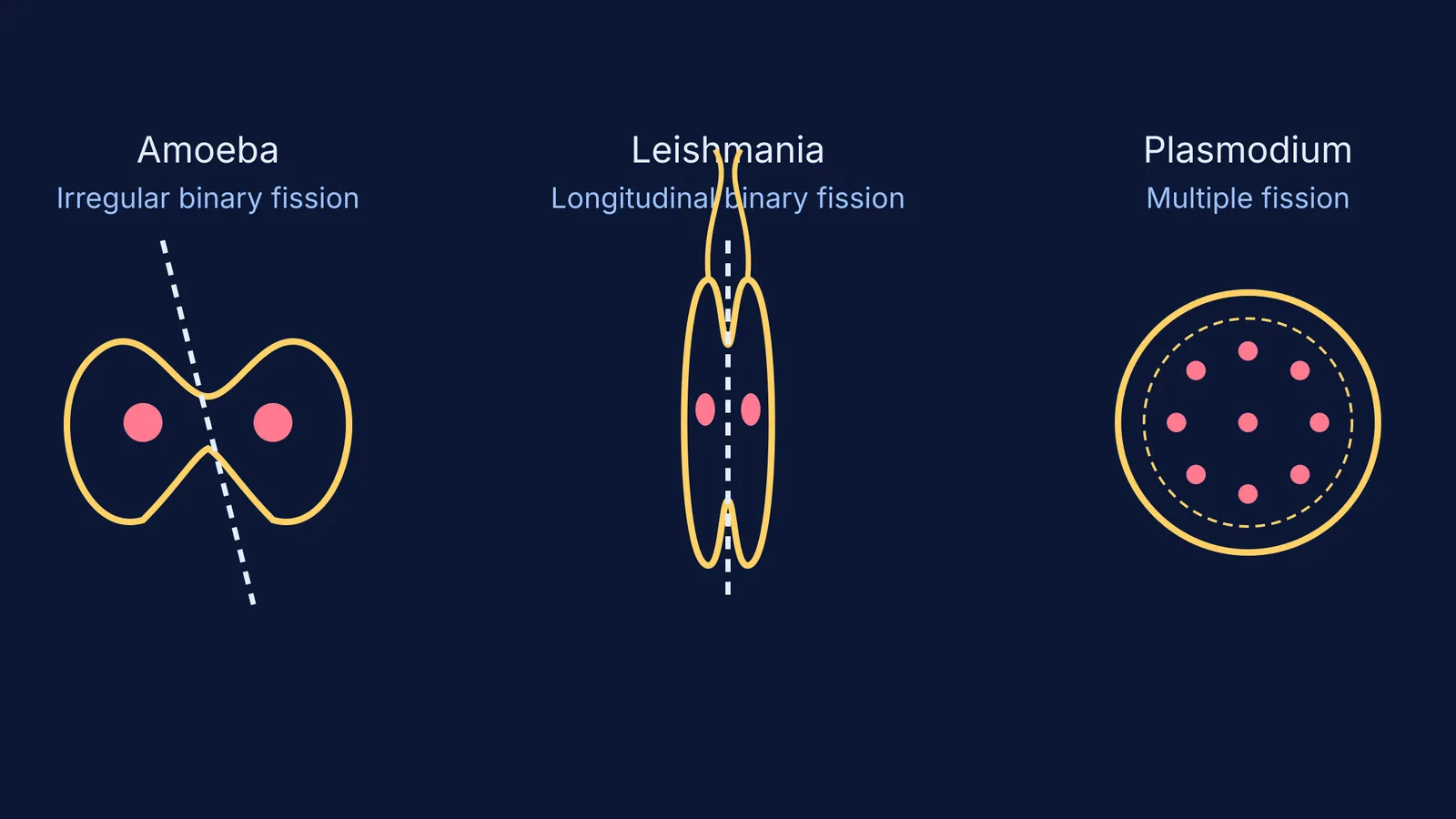
*Amoeba proteus* is a single-celled organism with no fixed shape. Because it constantly changes its form by extending temporary structures called pseudopodia, it does not have a fixed axis of symmetry. When it reproduces, it undergoes what biologists call irregular binary fission, meaning the plane of division can pass through any angle as long as it accurately divides the nucleus.
During this process, the Amoeba will withdraw its pseudopodia and become nearly spherical. The nucleus elongates and undergoes mitosis to form two identical daughter nuclei. Once the nucleus has divided, the cytoplasm pinches in the middle and separates the cell into two distinct individuals. The physical act of this splitting allows the Amoeba to reproduce efficiently without needing a partner, provided the environmental conditions are favourable.
Why is the plane of division important in Leishmania?
Unlike the shapeless Amoeba, *Leishmania* has a highly distinct, elongated shape. It features a whip-like structure called a flagellum at one end, which it uses for movement, as well as a specialized DNA-containing organelle called a kinetoplast. To ensure both daughter cells receive the necessary complex cellular structures, *Leishmania* divides longitudinally—straight down its vertical axis.
Research shows that *Leishmania* must carefully replicate these intricate structures before the cell body itself cleaves. The kinetoplast and nucleus both replicate, and a new flagellum begins to grow alongside the old one. Once the internal organelles are duplicated and positioned correctly, the cell membrane starts to split from the anterior end downwards, eventually producing two complete, slender daughter cells.
If you find it hard to picture how these internal structures coordinate their split, the Fermi Concept Library maps out every concept in biology. Each topic has its own lesson placed in a wider map, so you can trace how single-celled organisms evolved different ways to maintain their complex shapes during division.
How does Plasmodium reproduce by multiple fission?
*Plasmodium*, the parasite that causes malaria, uses multiple fission to survive and multiply rapidly inside a human host. When an infected mosquito injects the parasite in its sporozoite form into the human bloodstream, it quickly travels to the liver. There, it invades a liver cell and forms a multinucleated stage known as a schizont.
Inside the schizont, the nucleus divides repeatedly, but the cytoplasm does not divide with each nuclear split. This allows the parasite to build up a massive number of nuclei within a single membrane. Eventually, the cytoplasm partitions around each nucleus. A single *Plasmodium falciparum* parasite inside a liver cell can produce tens of thousands of daughter cells (up to 90,000), called merozoites, at once source.
These merozoites then burst out of the liver cell and into the bloodstream to infect red blood cells. Inside the red blood cells, they undergo further rounds of multiple fission, causing the cells to rupture and release even more parasites. (You can trace this entire path in our guide to Malaria and the Plasmodium life cycle for NEET biology.) This rapid, explosive multiplication strategy is exactly why malaria symptoms can appear suddenly and with severe intensity.
Why do cells choose different division strategies?
Because asexual reproduction appears early in the biology syllabus (often covered in Reproduction in animals in Class 8: sexual and asexual methods), it is easy to assume it is always a simple matter of one cell splitting in half. However, an organism's life cycle dictates its reproductive strategy. A free-living Amoeba can afford to divide steadily one by one. In contrast, a parasite like *Plasmodium* must overwhelm its host's immune system quickly, making the sudden burst of multiple fission a critical survival tool.
The jump from an Amoeba's irregular division to the coordinated longitudinal split of Leishmania, and finally to the massive burst of Plasmodium merozoites, shows how varied and adapted these single cells can be. If you want to understand the reasoning behind these biological strategies rather than just printing an answer, Fermi's AI tutor teaches through the topic, drawing the figures and checking your understanding as you go.


