

On this page
Reproduction questions in Class 8 are mostly about sorting: one parent or two, inside the body or outside, eggs or live young. This post explains each method, works one piece of chromosome arithmetic that shows why gametes carry half the instructions, and lists the slips that cost marks.
Where is this topic in the 2026-27 books?
NCERT's Class 8 book is Curiosity, marked "Reprint 2026-27". Reproduction is Section 13.5, "What Keeps Life from Disappearing?", of Chapter 13, "Our Home: Earth, a Unique Life Sustaining Planet". It covers plants and animals together. The older Class VIII book had a full chapter, "Reproduction in Animals", with more on the frog's life cycle and on egg-laying versus live birth. NCERT's new Class 9 book has a chapter, "Reproduction: How Life Continues", that goes deeper. Check which book your school follows.
Why do living things reproduce at all?
Curiosity's answer is direct: without reproduction, each kind of living thing would disappear. Parents pass on instructions, called genetic material or genes, stored in every cell. These tell a single cell how to develop into a calf or a kitten.
Reproduction also allows small changes in those instructions. Over many generations, the chapter explains, such changes can help living things adapt.
How does asexual reproduction work in animals?
In asexual reproduction, one parent produces young that are exact copies of itself, in terms of the instructions inside the cell. Curiosity's examples:
Binary fission: single-celled organisms such as bacteria and amoebae divide into two identical individuals. The older chapter describes amoeba's nucleus dividing first, then its body.
Budding: hydra grows small buds that break off and become new individuals.
Regeneration: a planarian, a flatworm, can regrow a whole body from a small piece.
How does sexual reproduction work in animals?
In sexual reproduction, two parents are involved. Each makes special reproductive cells called gametes: sperm in males and eggs in females. When a sperm and an egg fuse, this is fertilisation, and the new cell is a zygote. The zygote divides again and again to become an embryo.
Where fertilisation happens differs:
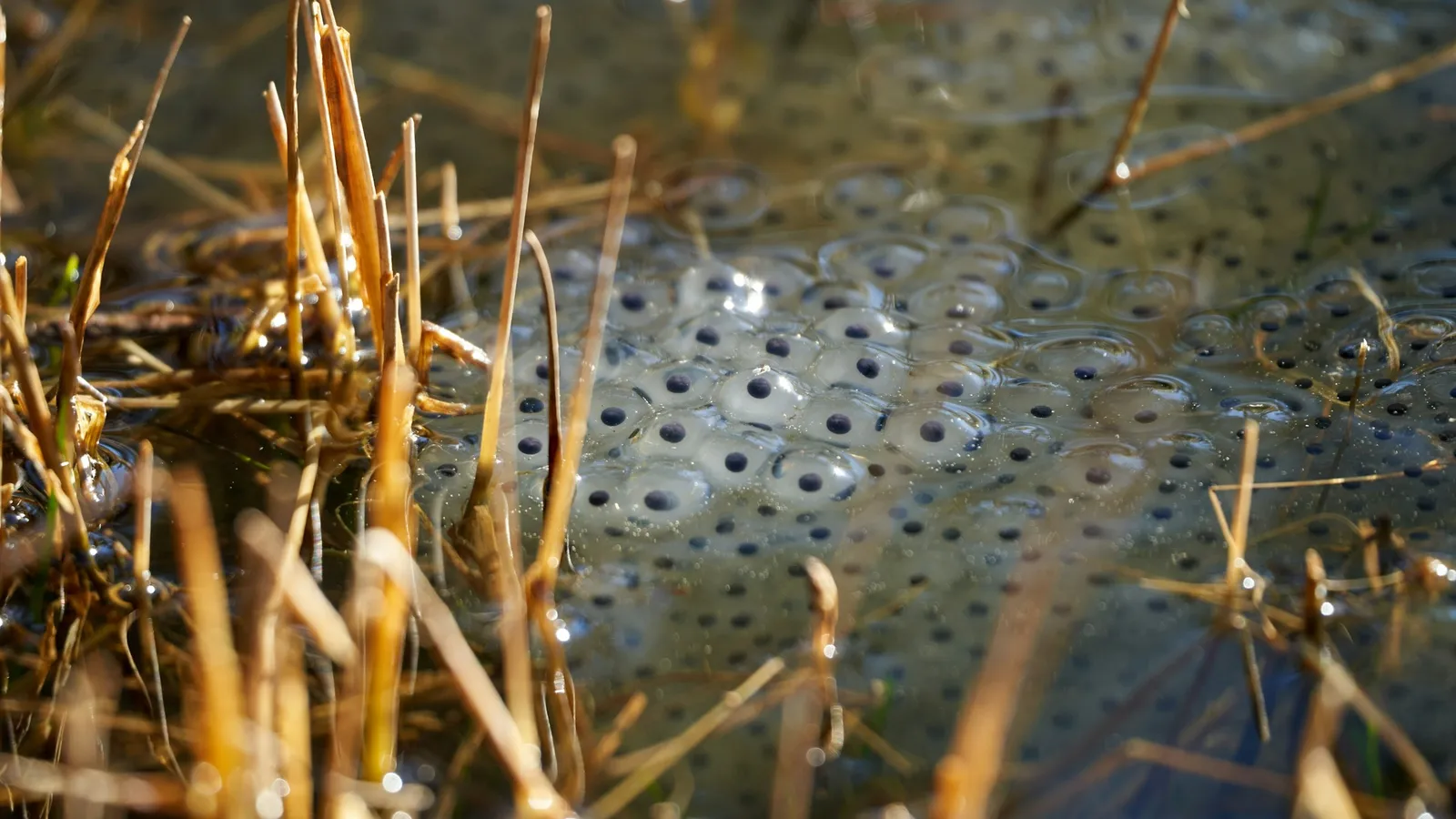
External fertilisation: fish and frogs release sperm and eggs into water, where they fuse. The embryo also develops in the water. The older chapter shows the frog's stages: eggs, tadpole, adult.
Internal fertilisation: in birds and mammals, including humans, fertilisation happens inside the female's body.
After that, birds and mammals differ. A hen lays the fertilised egg, and the embryo develops outside her body until it hatches, fed by the food stored in the egg. In most mammals, the embryo develops inside the mother, who supplies food and oxygen until birth. The older chapter calls egg-laying animals oviparous and those that give birth to young viviparous.
Worked example: why gametes carry half
Curiosity asks a sharp question. If both parents passed on all their instructions, wouldn't the amount double every generation? It doesn't, because each gamete carries only half the parent's genetic material.
The new Class 9 chapter gives the numbers for humans: 23 pairs of chromosomes, 46 in total.
Body cell of each parent: 46 chromosomes.
Each gamete gets one chromosome from each pair: 46 ÷ 2 = 23.
Zygote = 23 from the sperm + 23 from the egg = 46. The number stays the same.
If gametes carried all 46, the zygote would have 92, the next generation 184, and so on, which does not happen.
Now the zygote's divisions. Each division doubles the number of cells: 1 → 2 → 4 → 8 → 16. After 4 divisions there are 2⁴ = 16 cells, and each still has 46 chromosomes, because ordinary cell division copies the full set.
The common mistake is to halve the chromosomes at every division. Halving happens only when gametes are made.
Which mistakes cost marks?
Mixing up zygote and embryo. The zygote is the single cell formed at fertilisation; the embryo develops from it.
Calling hydra's buds "seeds" or "eggs". They are outgrowths of one parent.
Saying offspring of sexual reproduction are copies. They carry a mix from both parents, so they differ.
Linking egg-laying to external fertilisation. Birds lay eggs after internal fertilisation.
A practice routine for this chapter
Day 1: Make two lists from memory: asexual methods with an example each, and sexual reproduction steps from gametes to embryo.
Day 2: Sort ten animals into "fertilisation inside" and "fertilisation outside".
Day 4: Redo the doubling: how many cells after 6 divisions? (answer: 64)
Day 7: Explain to someone at home why a zygote has the same number of chromosomes as its parents.
If the step from gametes to zygote still feels muddled, the Fermi Concept Library covers every concept in physics, chemistry, biology, mathematics and computing, so you can read one idea at a time. For the Class 10 version, see our guide to how organisms reproduce.
Today, write the four-step chromosome sum from memory, then check it against this post.


