

On this page
Plants do not always need seeds to reproduce. When a new plant grows from a vegetative fragment of a parent plant—such as a leaf, stem or root—it is called vegetative reproduction or vegetative propagation (Wikipedia). This asexual method is common in nature, but it is also a powerful tool in agriculture.
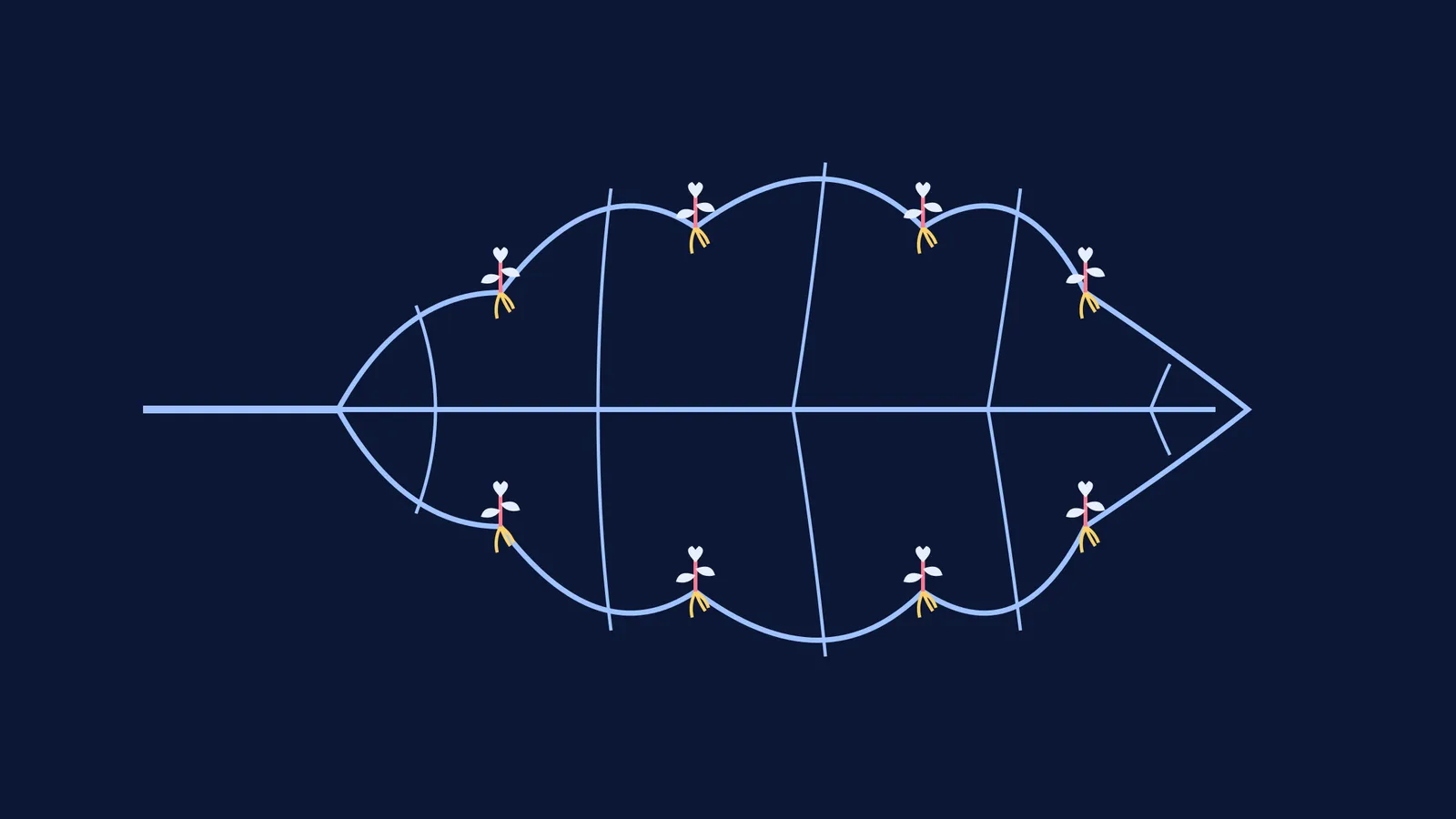
One of the most striking natural examples happens on the leaves of the *Bryophyllum* plant (often classified as *Kalanchoe pinnata*). Instead of relying on flowers and seeds, it produces tiny, fully formed plantlets right on its edges (Wikipedia).
How do Bryophyllum leaf buds grow?
The leaves of the *Bryophyllum* plant are thick and fleshy, with a scalloped margin. Between the teeth of this leaf margin, adventitious buds appear (Wikipedia). These buds develop into miniature plantlets, complete with their own tiny roots, stems and leaves.
When the leaf matures, or if it falls to the damp ground, these plantlets detach. Because they already have roots, they quickly take hold in the soil and grow into independent plants. Because they grow from the vegetative tissue of a single parent, rather than from the fusion of gametes, the new plants are genetically identical to the parent.
If you are mapping out how different plants reproduce asexually, you can explore the complete hierarchy of reproduction methods in the Fermi Concept Library.
Why do farmers use vegetative propagation?
While *Bryophyllum* propagates naturally, farmers and horticulturists use artificial vegetative propagation heavily. There are three main reasons why agricultural systems rely on these techniques over planting seeds:
Propagating seedless plants: Crops like commercial bananas have lost the ability to produce viable seeds over centuries of cultivation. Vegetative propagation is the only way to keep these lines going.
Cloning exact traits: When a plant reproduces sexually through seeds, the offspring are a genetic mix of two parents. If a horticulturist breeds a plant with a perfect trait—like a particularly sweet apple—planting its seeds will not guarantee the same traits in the offspring. Vegetative propagation allows them to produce offspring that are practically clones of the parent plant (Wikipedia).
Speed and resource efficiency: Growing a plant from a cutting or a graft is often much faster than starting from a seed. It allows farmers to produce more offspring per unit of resource than reproduction through seed production, and the plants often reach maturity and bear fruit sooner (Wikipedia).
However, there is a catch. Vegetative reproduction does not allow for genetic diversity (Wikipedia). If an entire farm is planted with clones of a single parent, a new pest or disease that affects one plant will likely destroy the entire crop.
What are cuttings, layering and grafting?
To replicate plants artificially, horticulturists rely on several established techniques. These methods manipulate the plant's natural ability to grow adventitious roots or heal wounds.
Cuttings A piece of a plant—usually a stem, but sometimes a root or leaf—is cut off and placed in a suitable medium like moist soil or water. The cutting eventually develops adventitious roots and grows into a new plant. This is an ancient form of cloning.
Layering In this method, a stem or branch is manipulated to promote root development while it is still attached to the parent plant (Wikipedia)). For example, a flexible branch might be bent down and covered with soil. The buried part develops roots while the parent plant continues to supply it with water and nutrients (Wikipedia)). This is especially useful for plants that form roots slowly. Once the roots are well established, the branch is severed from the parent to grow on its own.
Grafting Grafting joins the tissues of two different plants so they continue their growth together as a single plant (Wikipedia). The upper part, called the scion, is chosen for its desirable stems, leaves, flowers or fruits (Wikipedia). It is attached to the rootstock of another plant, which is chosen for its strong or disease-resistant root system. For the graft to succeed, the vascular tissues of both plants must grow together in a process known as inosculation. Apple trees, mangoes and many ornamental plants are grown using this technique.
When you are reviewing these methods for a biology exam, the sheer number of examples can be overwhelming. Fermi's AI tutor can help you work out what you already know and build a plan for the session, so you sit down to a clear next step in your revision.
Read more:


