On this page
A hair does not change colour once it is out of your scalp. It gets its colour while it is being made, deep in the follicle. When the pigment supply at the root runs low, the next stretch of hair simply grows in white. A head that looks "grey" is often a mix of coloured and white hairs, as the hair biologist Desmond Tobin notes in his review of the ageing hair pigment system.
What gives hair its colour in the first place?
Hair colour comes from melanin, a pigment made by cells called melanocytes in the hair bulb at the bottom of the follicle. According to Tobin's review in the International Journal of Trichology, these cells pass their melanin granules to the keratin-making cells of the hair cortex as the hair is built.
There are two main kinds of melanin. Eumelanin is brown to black; pheomelanin is red to yellow. The mix and the amount give you your natural shade.
The key detail is timing. Hair grows in cycles, and the same review notes that no melanin is actively made during the resting stage of the cycle. So every time a new hair starts growing, the follicle has to restock its pigment cells. Those new pigment cells come from a small reserve of melanocyte stem cells that live higher up in the follicle.
Why does hair turn grey or white with age?
In 2005, Emi Nishimura, Scott Granter and David Fisher used tagged pigment cells in mice and ageing human hair follicles to show that hair greying is caused by defective self-maintenance of melanocyte stem cells (Science, 2005). Put simply, the reserve stops renewing itself, so it can no longer restock the bulb.
A 2023 study from Mayumi Ito's lab at New York University, led by Qi Sun, added a twist. Working in mice, they found that these stem cells normally move between two compartments of the follicle and switch between states (Nature, 2023). In the lower compartment, the hair germ, a signal called WNT pushes them to mature and make pigment. With age, more of them get stranded in the upper compartment, the bulge, where they stop renewing and no longer make pigment.
In the same study, ageing the mice's hair by repeated plucking and forced regrowth raised the share of follicles with stuck stem cells from 15% before plucking to nearly half. The researchers say the same mechanism may exist in humans; that has not yet been shown.
Tobin's review also reports that grey and white hair fibres build up hydrogen peroxide in millimolar concentrations, a sign of oxidative stress.
Does stress turn your hair grey?
In mice, yes. A 2020 Nature study from Ya-Chieh Hsu's lab at Harvard found that stress activates the nerves of the fight-or-flight response, whose noradrenaline makes the pigment stem cells turn into pigment-making cells too early, using up the reserve. "After just a few days, all of the pigment-regenerating stem cells were lost," Hsu told the Harvard Gazette. Mice whose adrenal glands were removed, so they could not make cortisol-like hormones, still went grey under stress.
In people, the evidence is smaller. A 2021 eLife study mapped colour along 397 hairs from 14 people and found that some grey hairs regained colour, and that greying and its reversal sometimes lined up in time with stressful periods in people's lives. The authors note that this reversal is limited to rare, isolated follicles.
When does grey hair count as premature?
A survey of 4,192 volunteers found that 74% of people aged 45 to 65 had some grey hair. Only 6 to 23% had at least half their hair grey at 50, depending on ethnic origin and natural hair colour, and people of Asian and African descent greyed less than those of European origin at the same age.
A review in the Indian Journal of Dermatology, Venereology and Leprology defines premature greying as starting before 20 in white people, before 25 in Asians and before 30 in Africans. It says doctors may test vitamin B12, folic acid and thyroid levels when greying starts very early with no family history.
Worked example: how to read a hair like a timeline
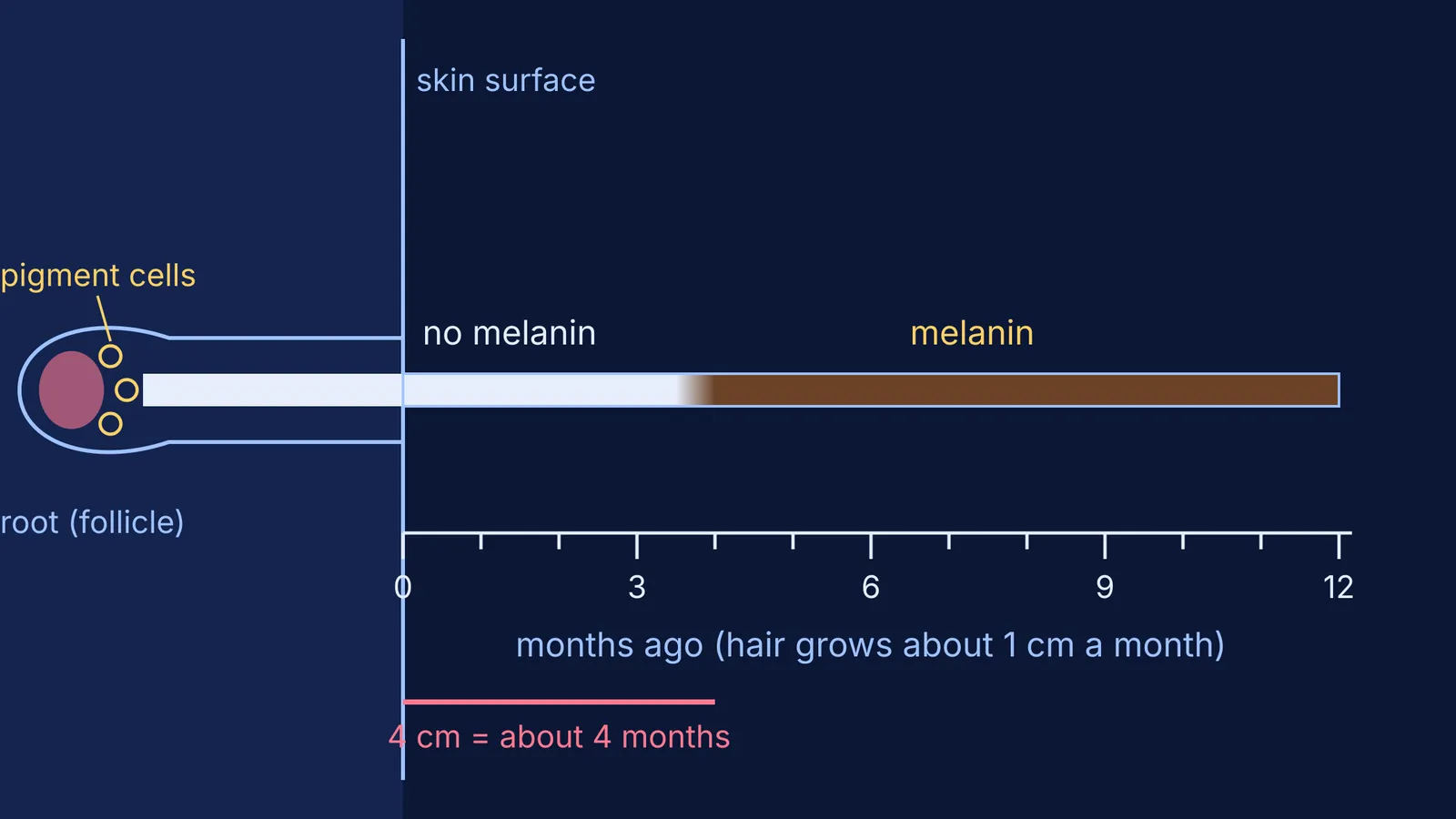
Scalp hair grows about 1.0 to 1.3 cm a month, so a hair is a record of the past few months.
Pick up a fallen hair that is dark at the tip and white near the root.
Measure the white part. Say it is 4 cm.
Divide by the growth rate: 4 / 1.3 is about 3 months, and 4 / 1.0 is 4 months.
So the pigment cells at that root stopped adding melanin roughly 3 to 4 months before the hair fell out.
If you are revising cells, pigments or the chemistry of colour, the Fermi Concept Library has every concept in biology and chemistry, each with its own lesson. For ideas that are easier to see than to read, try the interactive simulations in the Fermi Simulation Lab.