On this page
Working cells make carbon dioxide as they break down food in respiration. That gas has to reach your lungs, and only a small share travels as plain dissolved gas. The rest depends on an enzyme inside your red blood cells, carbonic anhydrase. Get this one reaction right and the “transport of gases” topic in Class 11 biology falls into place.
What does carbonic anhydrase do in red blood cells?
Carbonic anhydrase is a zinc enzyme that catalyses the hydration of carbon dioxide and the dehydration of bicarbonate in red blood cells, which is how it helps carry carbon dioxide to the lungs (Nielsen and Fago, Journal of Inorganic Biochemistry, 2015).
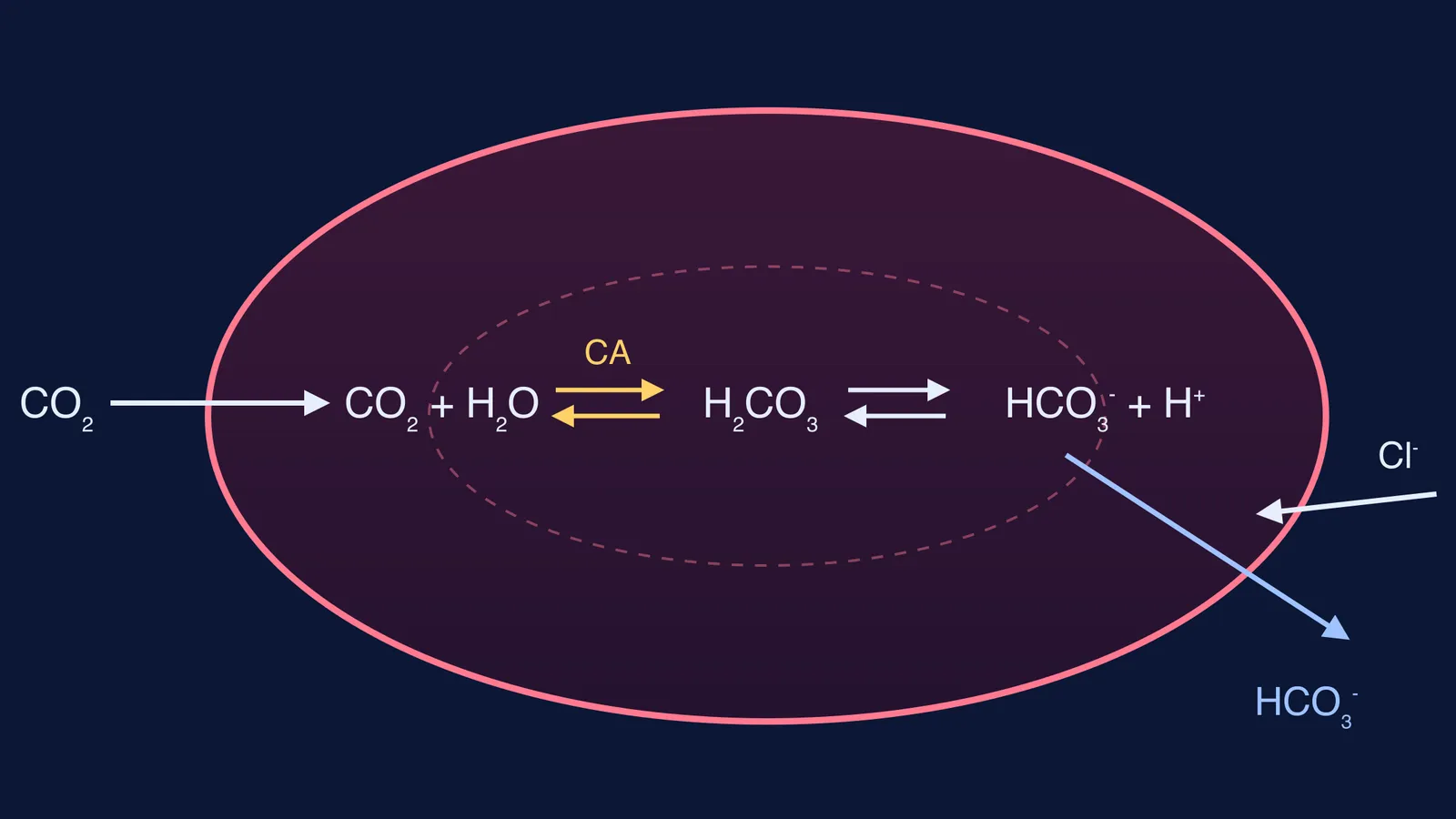
The reaction is CO₂ + H₂O ⇌ H₂CO₃ ⇌ HCO₃⁻ + H⁺. Carbon dioxide and water form carbonic acid, and carbonic acid splits into a bicarbonate ion and a hydrogen ion.
The NCERT Class 11 biology textbook says red blood cells contain a very high concentration of carbonic anhydrase, with minute quantities in plasma too, and that the enzyme speeds the reaction in both directions (NCERT Biology Class 11, Chapter 14).
It is also fast. In stopped-flow measurements on bovine carbonic anhydrase II, the turnover number for carbon dioxide hydration was about 1.47 million per second, meaning one enzyme molecule can convert up to roughly that many carbon dioxide molecules each second (Nielsen and Fago, 2015). N. U. Meldrum and F. J. W. Roughton described the enzyme's preparation and properties in The Journal of Physiology in 1933 (paper record).
How is most carbon dioxide carried in the blood?
NCERT gives three routes (NCERT Biology Class 11, Chapter 14):
About 70 per cent of carbon dioxide is carried as bicarbonate.
About 20-25 per cent is carried by haemoglobin as carbamino-haemoglobin.
About 7 per cent travels dissolved in plasma.
So bicarbonate is the main route, and it exists because of carbonic anhydrase. The same chapter notes that every 100 mL of deoxygenated blood delivers about 4 mL of carbon dioxide to the alveoli.
The red cell membrane swaps bicarbonate for chloride, an exchange called the chloride shift. When researchers slowed this exchange in isolated rat lungs perfused with human red cells, carbon dioxide excretion fell by about 16 per cent (Crandall and colleagues, Journal of Clinical Investigation, 1981). The story of who first described the shift is in our post on Hartog Hamburger and the chloride shift in red blood cells.
What happens to bicarbonate when blood reaches the lungs?
The reaction runs backwards. NCERT explains that where carbon dioxide's partial pressure is high, in the tissues, carbon dioxide enters blood and forms bicarbonate and hydrogen ions; at the alveoli, where it is low, the reaction runs the other way and releases carbon dioxide and water (NCERT Biology Class 11, Chapter 14). The pressures behind this, 45 mm Hg in tissues against 40 mm Hg in alveoli, are set out in our table of oxygen and carbon dioxide partial pressures.
Worked example: follow one carbon dioxide molecule
A working muscle cell releases carbon dioxide. Partial pressure is high here, so the gas diffuses into the capillary.
It enters red blood cells and plasma. A little stays dissolved, and some binds haemoglobin as carbamino-haemoglobin.
Inside the red cell, carbonic anhydrase joins carbon dioxide and water into carbonic acid.
Carbonic acid splits into bicarbonate and a hydrogen ion.
Bicarbonate is swapped for chloride across the red cell membrane (the chloride shift).
The extra hydrogen ions matter for oxygen too: NCERT notes that high hydrogen ion concentration in tissues favours oxygen release from oxyhaemoglobin, which you can see in our interactive oxygen dissociation curve post.
In the lung capillary, partial pressure of carbon dioxide is low, so the reaction runs in reverse. Bicarbonate moves back into the red cell in exchange for chloride, carbonic anhydrase turns it back into carbon dioxide and water, and carbon dioxide diffuses into the alveolus to be breathed out.
Which exam traps should you check?
Before a test, check yourself against these, using the NCERT chapter as your answer key:
“Carbonic anhydrase is in plasma.” Mostly not. NCERT says the concentration is very high in red cells and only minute in plasma.
“Most carbon dioxide rides on haemoglobin.” No. That is 20-25 per cent; bicarbonate carries about 70 per cent.
“The enzyme only makes carbonic acid.” It works in both directions.
“Carbamino binding is the same everywhere.” NCERT says more carbon dioxide binds where its partial pressure is high and oxygen's is low, as in tissues, and it is released in the alveoli.
If a step in the chain still feels shaky, the Fermi Concept Library has a lesson for each biology concept and shows where it sits in the map, so you can see how gas transport links to respiration and blood. When you want practice, the Fermi Problem Library has worked problems with a step-by-step solver that explains the reasoning rather than printing an answer.
Draw the red cell from memory tonight, label all seven steps, then check it against the textbook.