

On this page
Every time you take a breath, millions of tiny air sacs in your lungs called alveoli fill with fresh air. But how does the oxygen know to enter your blood, and how does the carbon dioxide know to leave? The answer lies in partial pressure gradients—the fundamental driving force of human respiration.
For students preparing for exams like NEET-UG, the NCERT table of partial pressures is a crucial memorisation target. However, understanding how these numbers set the direction of gas diffusion makes them much easier to remember.
What is partial pressure and why does it matter?
Partial pressure is the pressure contributed by a single gas in a mixture of gases. In biology, we measure it in millimetres of mercury (mm Hg). Gases always diffuse from a region of high partial pressure to a region of low partial pressure.
In the human body, gas exchange happens entirely by simple diffusion. The difference in partial pressures between two areas creates a gradient. The steeper the gradient, the faster the gas moves.
How does oxygen move from the alveoli to the tissues?
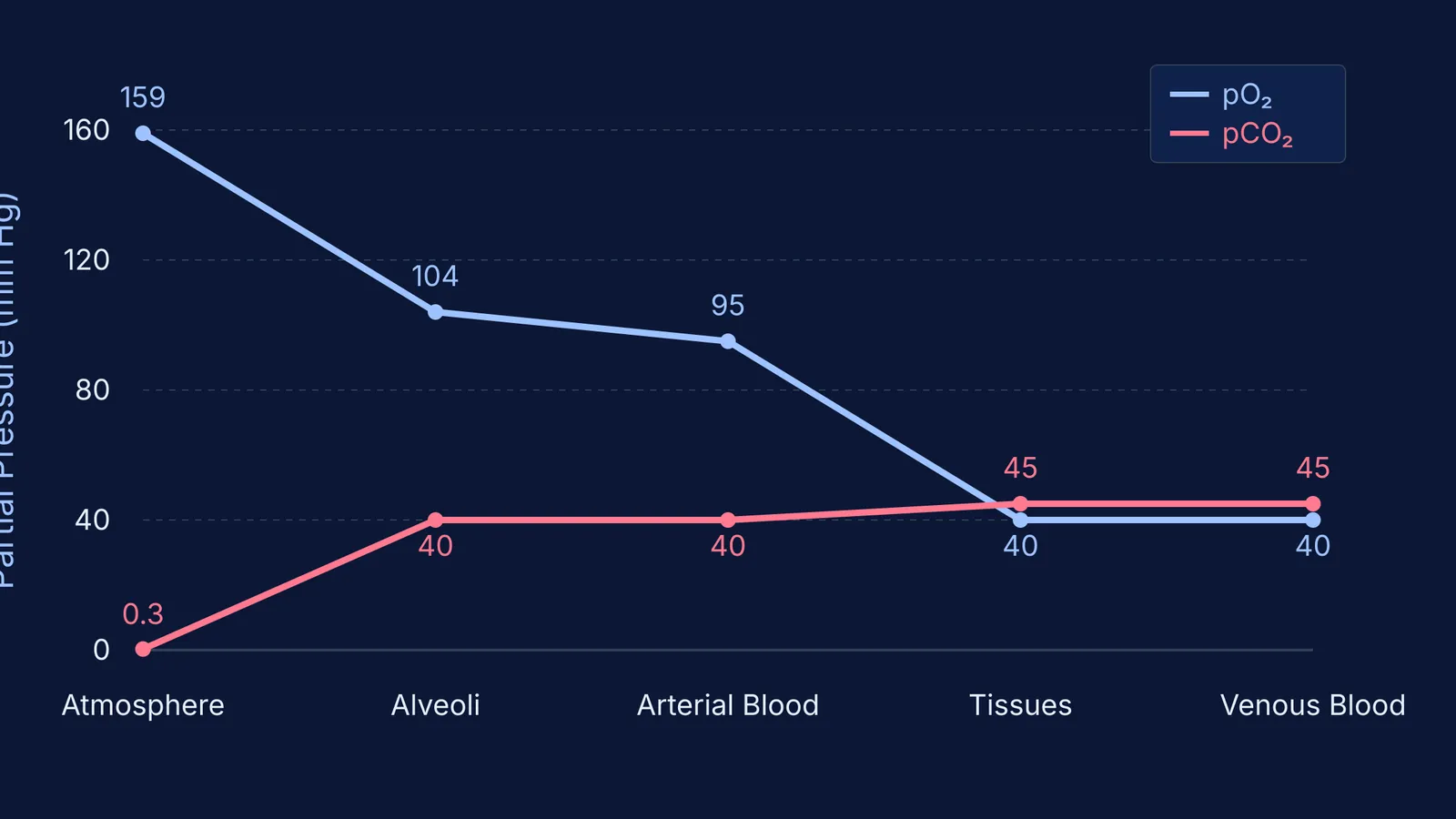
Oxygen must travel from the outside air all the way to your cells, flowing down a continuous pressure gradient at every step. According to research on alveolar gas exchange, the partial pressure of oxygen (pO₂) shifts at each stage:
Atmosphere: The air we breathe is rich in oxygen, with a pO₂ of roughly 159 mm Hg.
Alveoli: As fresh air mixes with the residual stale air in the lungs, the alveolar pO₂ settles at 104 mm Hg.
Lungs to Blood: Deoxygenated blood arriving at the pulmonary capillaries has a pO₂ of just 40 mm Hg. This massive 64 mm Hg difference forces oxygen across the alveolar membrane into the blood.
Blood to Tissues: The newly oxygenated blood leaves the lungs with a pO₂ of 95 mm Hg. When it reaches the body's tissues, which constantly consume oxygen, it meets a pO₂ of 40 mm Hg. The gradient pushes oxygen out of the blood and into the cells.
Why does carbon dioxide move in the opposite direction?
Carbon dioxide is a waste product of cellular metabolism. The body must expel it continuously, and the gradients flow in the reverse direction to oxygen, which is also confirmed by gas exchange data.
Tissues to Blood: Actively metabolising tissues maintain a high partial pressure of carbon dioxide (pCO₂) at 45 mm Hg. Oxygenated blood arriving at the tissues has a pCO₂ of only 40 mm Hg, drawing the gas into the bloodstream.
Blood to Lungs: The deoxygenated blood, now carrying a pCO₂ of 45 mm Hg, travels to the alveoli.
Exhalation: The alveolar air has a pCO₂ of 40 mm Hg. This 5 mm Hg difference pushes the carbon dioxide out of the blood and into the lungs to be breathed out.
The rate of your breathing is tightly controlled by the brain based on these carbon dioxide levels, a mechanism pioneered by J. S. Haldane in his study of respiration. Furthermore, depending on whether the body is burning fats or carbohydrates, the ratio of CO₂ produced to O₂ consumed will shift, which is measured as the respiratory quotient.
How can you remember the NCERT partial pressure table?
Instead of memorising the table through sheer repetition, you can look for the built-in patterns. There is a simple "twins" framework you can use to reconstruct the partial pressure values in an exam:
The Deoxygenated Twins: The values for deoxygenated blood and tissues are perfectly identical. In both, pO₂ is 40 mm Hg and pCO₂ is 45 mm Hg.
The Carbon Dioxide Twins: Alveoli and oxygenated blood share the exact same pCO₂ value of 40 mm Hg.
The Extremes: The atmosphere holds the highest pO₂ (159 mm Hg) and the lowest pCO₂ (0.3 mm Hg).
When you are revising human physiology, remembering isolated numbers is harder than understanding the physical systems behind them. The Fermi Concept Library contains a lesson for every concept in biology. If you are struggling with a topic, Fermi's AI tutor can work out what you already know and build a plan for the session to strengthen your grasp of gas exchange.


