

On this page
The Dutch physiologist Hartog Jacob Hamburger was the first to describe something odd about blood exposed to carbon dioxide: chloride ions moved out of the plasma and into the red blood cells. That swap, the chloride shift or Hamburger shift, lets your blood carry most of its CO2 as bicarbonate. For Class 11 and NEET-UG biology, it is the step that makes the textbook equation make sense.
Who was Hartog Hamburger?
Hamburger was born in Alkmaar, in the Netherlands, on 9 March 1859, according to a biography by the physiologist Nico Westerhof published by the Federation of European Physiological Societies. He studied chemistry at Utrecht, taught physiology at the State Veterinary School in Utrecht from 1888, and became professor of physiology at Groningen in 1901.
At the veterinary school he studied how respiration changes the size of red blood cells and how permeable mammalian cells are to anions. Westerhof credits him as the first to describe the ion shift: at high blood CO2, chloride ions move from the plasma into the red cells. His 1918 paper on anion movements in serum and blood appeared in Biochemische Zeitschrift, and his Wikipedia biography dates his description of the chloride shift to that year. He died in 1924.
Others had seen part of the picture. In 1867, Schmidt and Zuntz separately reported that exposing whole blood to CO2 raises plasma bicarbonate much more than exposing plasma alone, according to a review of 150 years of red cell anion research by Michael Jennings (2021). Hamburger's work showed the other half of the trade: chloride moving the opposite way.
For another physiologist of blood and breathing, read about J. S. Haldane and carbon monoxide in mines.
What is the chloride shift in red blood cells?
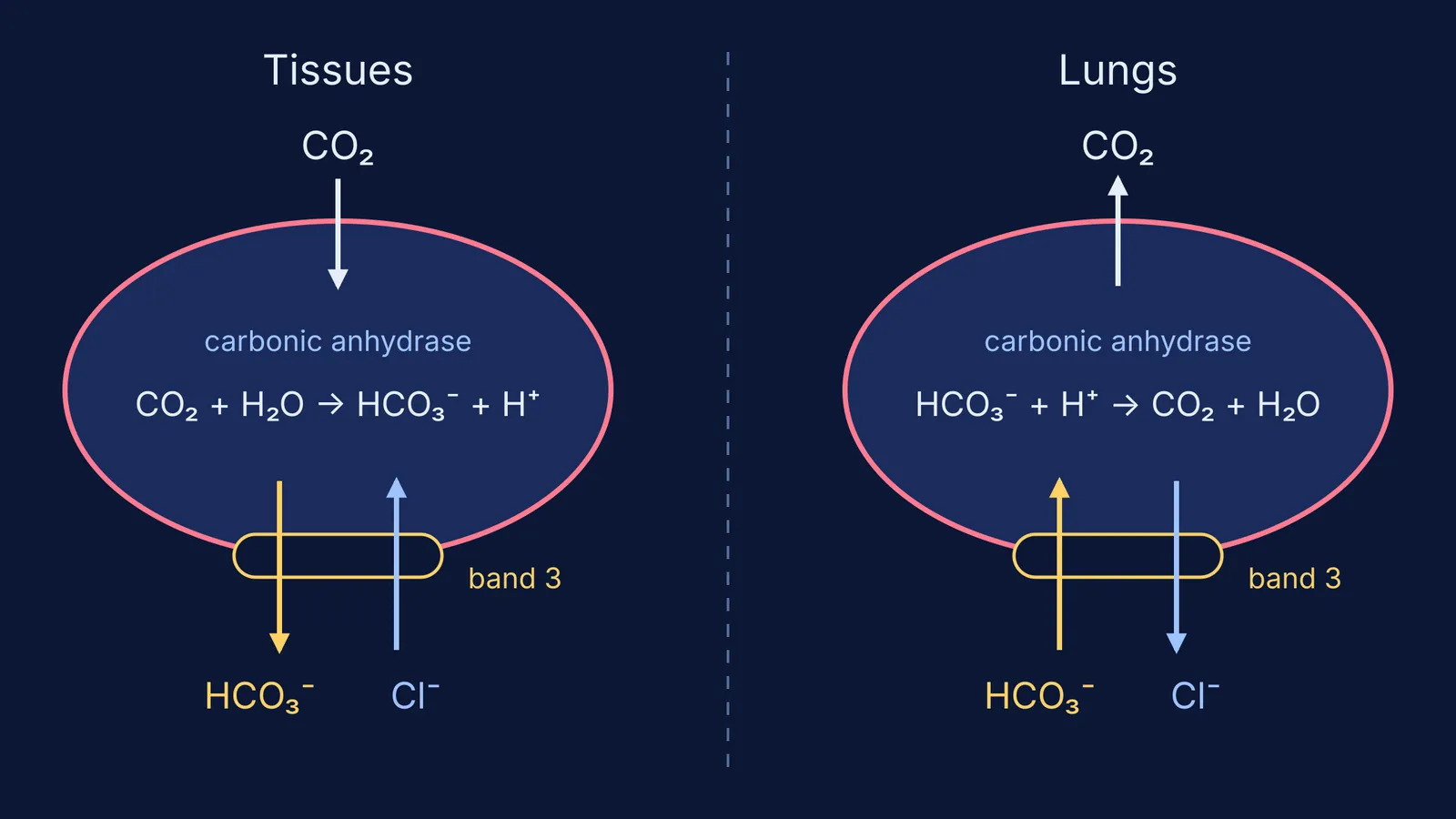
The chloride shift is the movement of chloride ions from the plasma into red blood cells as blood flows from the arterial to the venous end of systemic capillaries (Westen and Prange, 2003).
In a tissue capillary:
CO2 from respiring cells diffuses into the blood and into the red cells.
Red cells hold a very high concentration of the enzyme carbonic anhydrase, which speeds up CO2 + H2O → H2CO3 → HCO3- + H+ (NCERT Class 11 Biology, Chapter 14).
Bicarbonate builds up inside the cell and leaves through band 3, a membrane protein that swaps one chloride for one bicarbonate.
Chloride comes in as bicarbonate goes out, so the swap carries almost no net charge across the membrane.
Red cell chloride transport is a tightly coupled 1:1 exchange, and each exchange is nearly electroneutral (Jennings, 2021). Each red cell carries about 1.2 million band 3 molecules, and under physiological conditions the half-time for bicarbonate and chloride to equilibrate across the membrane is less than 0.1 seconds (same review).
Chloride is not just a passive passenger, though. Westen and Prange stress the role of haemoglobin in causing the shift, and note that more recent work suggests the incoming chloride matters for both oxygen unloading and the acid-base balance of blood (Westen and Prange, 2003).
Why does the chloride shift matter for CO2 transport?
About 70 per cent of the carbon dioxide in blood is carried as bicarbonate, 20 to 25 per cent as carbamino-haemoglobin and about 7 per cent dissolved in plasma (NCERT Class 11 Biology, Chapter 14). Every 100 mL of deoxygenated blood delivers about 4 mL of CO2 to the alveoli (same chapter).
The chloride shift keeps that bicarbonate route running. Shipping bicarbonate out stops it piling up where it is made, which helps the reaction keep moving forward.For the full chapter with lung volume sums, see our guide to breathing and gas exchange.
What happens to the chloride shift in the lungs?
In the pulmonary capillaries every arrow flips. Bicarbonate re-enters the red cells and chloride leaves (Deranged Physiology). Where pCO2 is low, the reaction runs the other way, turning bicarbonate back into CO2 and water, and the CO2 diffuses out into the alveoli (NCERT Class 11 Biology, Chapter 14).
How do you write the chloride shift in an exam answer?
Use this five-line frame for a short answer or a viva:
Name it: the chloride shift, or Hamburger shift.
Place it: red blood cells in systemic capillaries, reversed in the lungs.
Cause: CO2 enters, carbonic anhydrase makes HCO3- and H+ inside the cell.
The swap: HCO3- leaves through band 3 and Cl- enters, one for one.
Purpose: keeps the cell's charge balanced and lets most CO2 travel as bicarbonate.
Then cover the frame and check for common slips:
Saying both ions enter the cell. They move in opposite directions.
Putting carbonic anhydrase mainly in plasma. NCERT says plasma has only minute quantities.
Calling band 3 a pump. It is an exchanger that swaps one ion for another.
Forgetting the reversal in the lungs.
The Fermi Simulation Lab has interactive simulations for ideas that are easier to see than to read, and the Fermi Concept Library gives each biology concept its own lesson and its place in the map.
Next, see where red cells fit in our guide to formed elements of blood.


