On this page
You cleared NEET-UG by picking the right option, fast. First-year anatomy is different: a teacher points at a structure on a cadaver or a slide, and you name it, place it and explain it out loud. The curriculum itself shows how to prepare.
How is first-year anatomy different from NEET biology?
The National Medical Commission's Competency Based Medical Education (CBME) guidelines, 2024 apply from the 2024-25 MBBS batch onwards. Phase I lasts 12 months, starts with a two-week Foundation Course, and covers anatomy, physiology and biochemistry, with the university exam in the 12th month.
Three things change for you:
The answer is spoken, not ticked. The NMC says the viva should assess identification of specimens and interpretation of data such as X-rays, alongside written papers with long answers, short answers and MCQs.
Practicals count separately. To pass a subject you need 50% overall and at least 40% in theory and in practical separately, so a strong written paper cannot rescue a weak practical.
You are tested all year. The guidelines require at least three theory and practical internal assessments in each Phase I subject, and at least 75% attendance in theory and 80% in practicals to sit the university exam.
How do lectures, dissection and histology fit together?
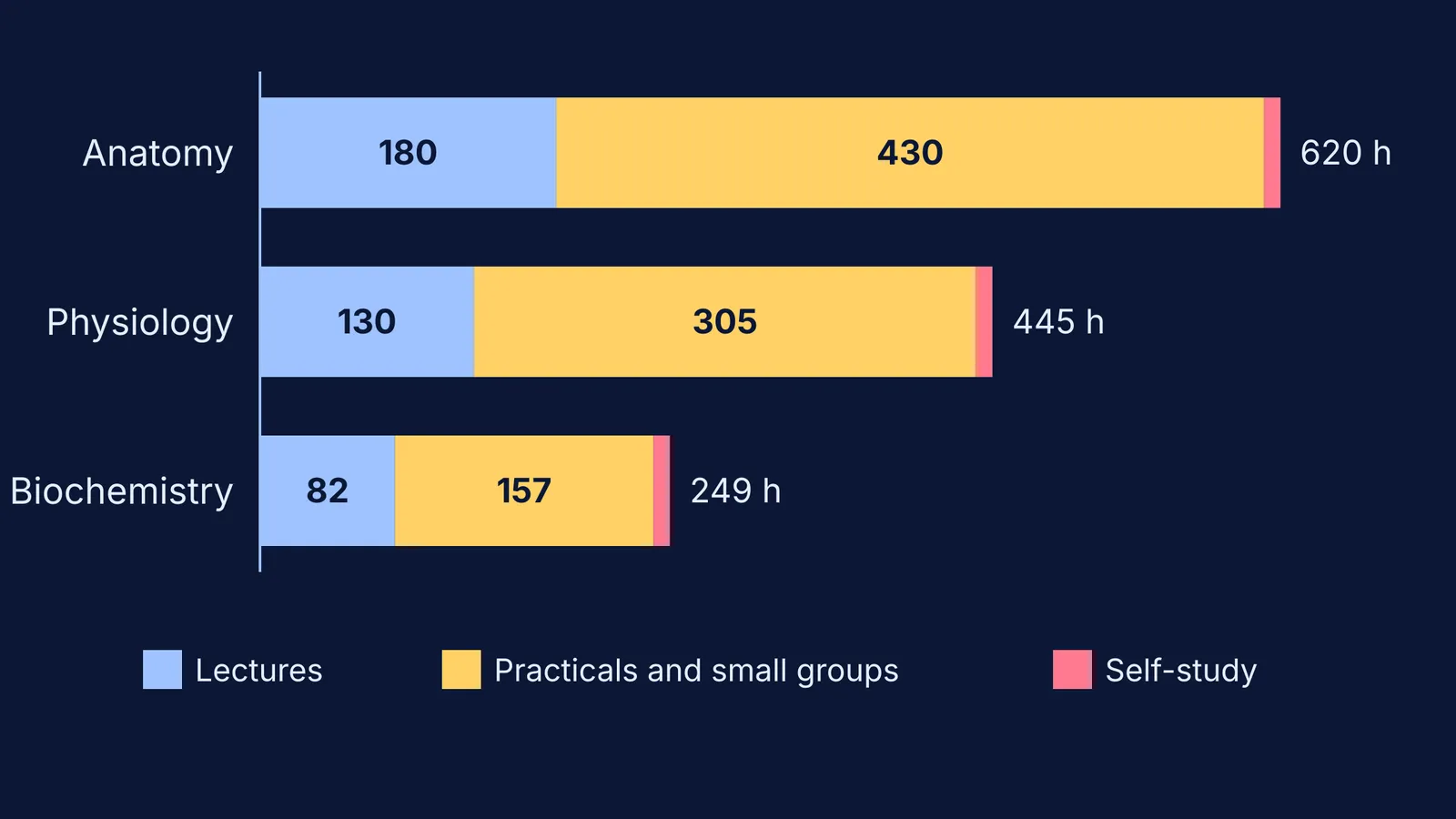
In the NMC's 2024 hour table, anatomy gets 620 hours in Phase I: 180 hours of large-group teaching, 430 hours of small-group teaching, practicals, tutorials and seminars, and 10 hours of self-directed learning. That is about two-fifths of the year's 1,521 teaching hours, mostly outside the lecture hall.
Each mode is a different view of the same region:
Lecture: the map: names, relations, nerve and blood supply.
Dissection: the 3D version: where things sit and what they touch.
Histology: the zoom: what the tissue looks like and why that suits its job.
Embryology: the backstory: why a structure ended up where it is.
The NMC's anatomy goals treat microscopic structure as "a prerequisite for understanding the altered state" in disease, so study the views together, not as separate subjects.
What does a weekly anatomy routine look like?
One region per week, using the brachial plexus as the worked example:
Night before the lecture (20 minutes): skim the region and sketch a rough outline. For the plexus, just five lines for the roots.
Lecture day: notes in two columns, facts on the left, "draw this" on the right.
Dissection evening: draw what you saw from memory, then correct it from your atlas in another colour. The corrections are your revision list.
Histology day: draw each slide with two or three identification points beside it.
Saturday viva drill: a batchmate asks ten questions aloud, such as "Name the cords and their branches" or "What happens if this nerve is injured?" Then swap.
Sunday review (45 minutes): draw the whole region on a blank page, then last week's region too.
For why a quick recall before each class helps, why dual coding keeps words and diagrams together, and how to bring old regions back, see our spaced revision schedule.
Why draw from memory instead of rereading?
In a study in Advances in Health Sciences Education, John L. Dobson and Tracy Linderholm had students in a university anatomy and physiology course study passages in different ways. One week later, the average retention score after read, recall as much as possible, reread was 53.95, against 48.04 for reading three times. Drawing a region from a blank page is a similar habit: you recall first, then check.
When a physiology idea behind a structure is shaky, the Fermi Concept Library has a lesson for each biology concept and shows its place in the map. If you do not know where to start, Fermi's AI tutor works out what you already know and builds a plan for the session.
What should you say in an anatomy viva?
Use the same five steps for any specimen, so nerves cannot wipe your mind blank:
Name it: "This is the right humerus."
Say how you know: "The head faces medially and the bicipital groove faces forward."
Give relations: what lies next to it or passes near it.
Give supply: nerve and blood supply, where it applies.
Add one clinical point: what goes wrong if it is injured.
If the dissection hall feels heavy in the first weeks, talk to a senior, a teacher or your college counsellor. Tele MANAS, a free government helpline on 14416, offers phone counselling 24x7, according to the Press Information Bureau.
Pick this week's region, draw it from a blank page tonight, and check it against your atlas.